Healthcare Executive has published a Five Questions interview with Dr Sangeeta Sharma on running a 50-bed hospital in Noida, surfaced this week under the NABH accreditation coverage on Google News. The format is short, but it lands on something the trade press usually skips: the mid-size Indian hospital is run by a handful of people wearing several hats each. That constraint, more than capital or clinical capability, decides whether a 50-bed facility can become a 100-bed one.
Fifty beds is where the owner is still the operations manager
At this size, the promoter-doctor is often also the medical director, the escalation point for a TPA query, and the person who notices that the second OT has gone idle at 11 am. There is no separate quality cell, no dedicated revenue cycle department, and frequently no full-time IT staff. Responsibilities collapse into two or three people. Any process that depends on somebody manually reconciling two systems — a register and a spreadsheet, a billing screen and a WhatsApp group — will eventually stop happening during a busy week, and nobody will notice until an audit or a rejected claim brings it up.
This matters directly to the growth plan. Adding thirty beds adds nursing shifts, consumable consumption, bed turnaround decisions and discharge documentation. All four are coordination tasks before they are clinical ones. Hospitals at this scale commonly find that their real constraint is the number of senior-staff hours spent chasing information that should already be on a screen: which beds are free, which admitted patient is waiting on a second lab result, whose pending discharge summary is holding up a final bill.
Read operationally, the Noida interview is a job description rather than a mission statement. Operators evaluating software should read their own shortlist the same way — not by what a system can theoretically do, but by which recurring tasks it takes off the desks of the two or three people currently absorbing all of them.
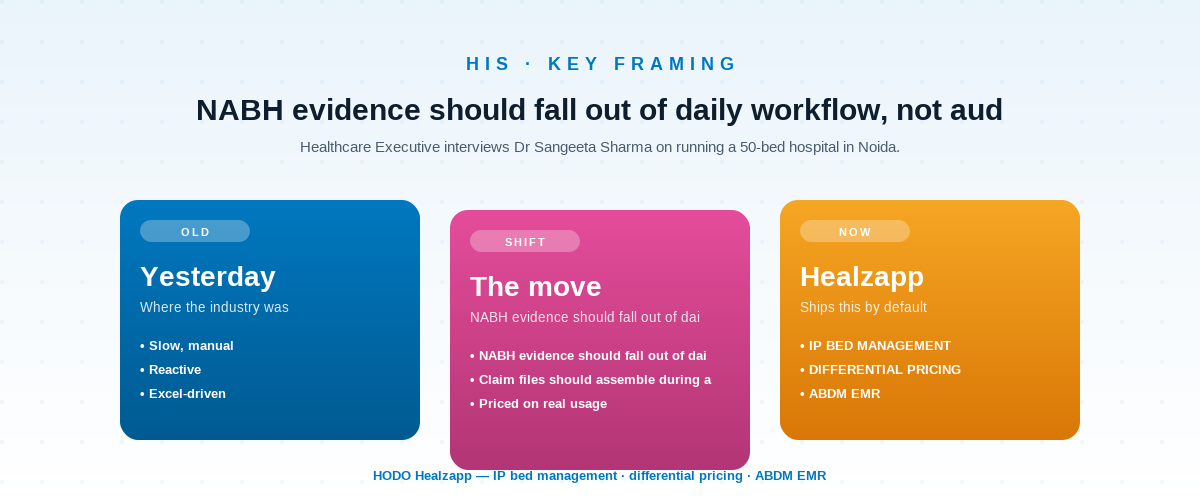
NABH evidence should fall out of daily workflow, not audits.
NABH is a documentation discipline before it is a certificate
Accreditation is usually discussed as an audit event. In practice it is a standing obligation to produce evidence on demand — consents, medication administration records, nursing assessments, incident reports, equipment maintenance logs — for any patient, on any date. Hospitals that treat it as a pre-assessment sprint spend weeks assembling files, clear the visit, then drift until the next cycle. The cost of that drift is paid twice: once in staff time, and again in the quality problems the documentation was meant to catch.
The facilities that hold accreditation without pain are the ones where documentation is a by-product of clinical work rather than a parallel activity. If the nurse records vitals and medication administration at the bedside, the nursing record exists. If pharmacy issue is tied to the patient's order, the medication trail exists. If biomedical servicing is logged against the asset, the maintenance history exists. Nothing has to be reconstructed from memory at assessment time.
This is where unglamorous modules earn their place. Warranty+AMC asset tracking turns equipment maintenance evidence into a dated record instead of a vendor's email thread, and it reduces unplanned downtime on the same ventilator or analyser that an assessor will ask about. A Nursing Station that captures vitals, drug administration and shift handover at the point of care produces precisely the record set NABH expects — without a clerk re-entering anything after the shift ends.
Cashflow is decided at the claims desk, not the billing counter
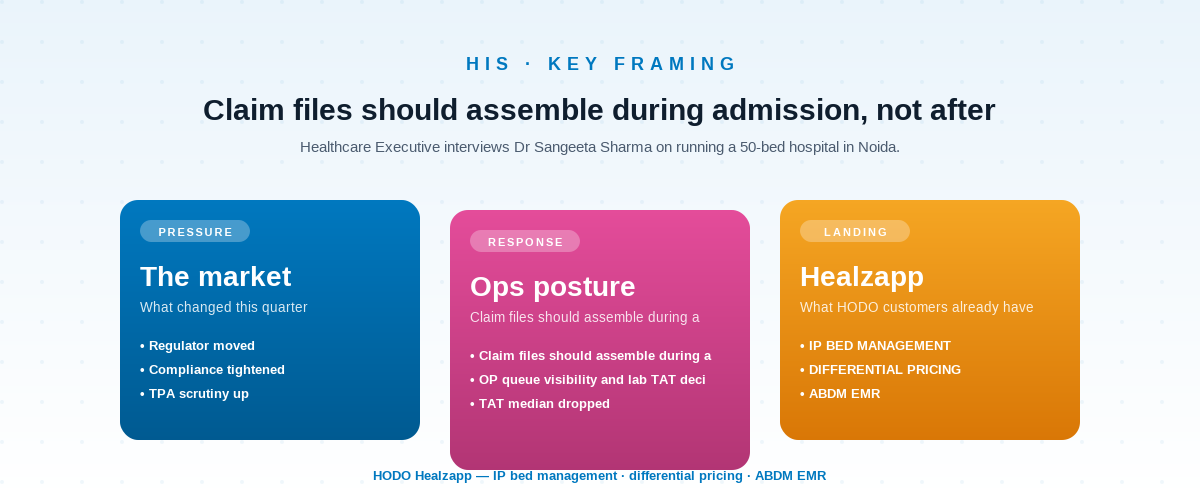
For a 50-bed hospital running a mix of cash, corporate, TPA and PMJAY patients, revenue recognition and cash receipt are separated by weeks and sometimes longer. Part of that gap is structural and has to be financed. The avoidable part comes from claim files that go out incomplete — discharge summary missing, package code mismatched, consent unsigned, investigation report not attached. Every rejection restarts the clock, and the staff time spent on resubmission is time not spent on the next admission.
The operational fix is to make the claim file assemble itself as the admission progresses rather than after discharge. That requires the tariff, the clinical record and the billing document to live in one system instead of three. Differential pricing handles the tariff half of the problem: cash, corporate, scheme and TPA rates for the same procedure, applied automatically by patient category rather than remembered by whoever is at the counter. Tally integration handles the other end, so day-end collections and credit notes are not re-keyed by the accounts team at month close.
A practical test for any hospital reviewing its own cycle: pick ten rejected or short-paid claims from last quarter and classify each as a documentation gap, a coding gap or a genuine payer dispute. Most hospitals at this size find the first two categories dominate, which is good news — those are workflow problems with workflow fixes.
OP throughput is the quiet profit centre
A large share of margin at 50 beds comes from outpatient volume and the in-house lab and pharmacy attached to it. Yet OP is usually the least instrumented part of the hospital. Patients queue without knowing their position, consultants run late without the front desk knowing by how much, and lab reports are collected in person because nobody has set up delivery any other way. Each of those is a measurable loss: reduced consultations per session, abandoned repeat visits, and avoidable crowding in a waiting area that NABH assessors also look at.
Three things change the number. A TV Token Display makes the queue visible and cuts the volume of questions reaching the reception desk. Machine Interfacing on the in-house analysers removes manual result entry, which is where most of the turnaround time and most transcription errors sit. WhatsApp/SMS report delivery closes the loop without a counter visit, and the Patient Health App gives repeat OP patients their own history instead of a plastic folder they will forget.
For consultants, the compounding benefit is EMR with AI-condensed history. In a high-volume OP session, the difference between a usable summary of a returning patient's last four visits and a chronological document dump is the difference between a consultation that runs to time and one that does not.
Claim files should assemble during admission, not after discharge.
HIS replacement is harder than HIS purchase
Most 50-bed hospitals in India are not buying their first system; they are replacing one that has stopped keeping up. That is a different project. Patient identifiers, open bills, pending claims, outstanding advances, drug masters and tariff tables all have to move without a day of billing downtime. Attempting a single big-bang cutover across billing, EMR, pharmacy and inventory in one weekend is how hospitals end up running two systems for a year.
A phased sequence works better: Billing with IP/OP and Appointments first, since those are the screens with the most daily transactions and the clearest success test; Pharmacy and Inventory next, timed to a stock-take; EMR and Teleconsultation last, once staff trust the system they are already using. ABDM-compliant EMR and ABHA linkage should be scoped at the start rather than bolted on later, because the identity plumbing touches registration — not just the clinical record. HODO's position among the first 20 ABDM-integrated HealthTechs in India, with NRCeS and Telemedicine Registry listings, exists so that compliance work is configuration rather than a development project at the hospital's cost.
Hospitals with a second centre on the roadmap should also ask how the second one gets switched on. If a new outlet needs a fresh implementation cycle, the cost of expansion includes a software project every time.
What this means for HODO customers
The gap between a 50-bed hospital that scales and one that stalls is rarely clinical. It is whether evidence, claims and queue data are produced by the day's work or assembled afterwards by people who should be doing something else. Three parts of Healzapp carry most of that load. IP bed management gives a live view of occupancy, expected discharges and turnaround, so bed decisions stop depending on a phone call to the ward. Nursing Station captures vitals, medication administration and handover at the bedside, which is both better care and the NABH record set in one action. ABDM-compliant EMR keeps the clinical record and identity linkage aligned with Indian requirements as they tighten. For hospitals and lab chains planning a second or third location, Multi-outlet scale-up with one-click new-centre setup is what keeps expansion an operational decision rather than an IT programme.