
Over 600 private hospitals have withdrawn from Ayushman Bharat–PMJAY empanelment, with Gujarat leading the exit list, according to a Medical Buyer report. Delayed reimbursements, low package rates and mounting working-capital strain are pushing owners to rethink the empanelment maths. For anyone still in the scheme — or weighing whether to stay — the question has moved past politics to whether billing, claims and receivables workflows are tight enough to survive on scheme rates.
Gujarat's cluster of pullouts is the loudest signal, but the pattern is national. Package rates set years ago have not kept pace with the cost of consumables, oxygen, staffing and utilities. Hospitals running high-volume orthopaedic, cardiac and oncology cases under PMJAY report negative contribution margins on entire specialities. Add pre-authorisation friction, query cycles and audit-driven clawbacks, and effective realisation per case drops further.
The second driver is receivables ageing. Field conversations with Indian hospital CFOs point to 60-180 day cycles on PMJAY payouts in several states, with occasional pockets stretching past a year. For a 100-bed hospital where PMJAY makes up 20-35% of admissions, that ageing profile sinks into working-capital lines, forces overdraft interest, and quietly delays payroll or vendor payments. The exit is not a protest — it is a P&L decision.
Owners who are staying tend to have two things going for them: strong case-mix control, where they are cherry-picking packages that still clear cost, and a claims desk that closes pre-auth and final billing inside 48 hours. Both require software that treats PMJAY as a first-class payer, not an exception the front-office learns on the job.
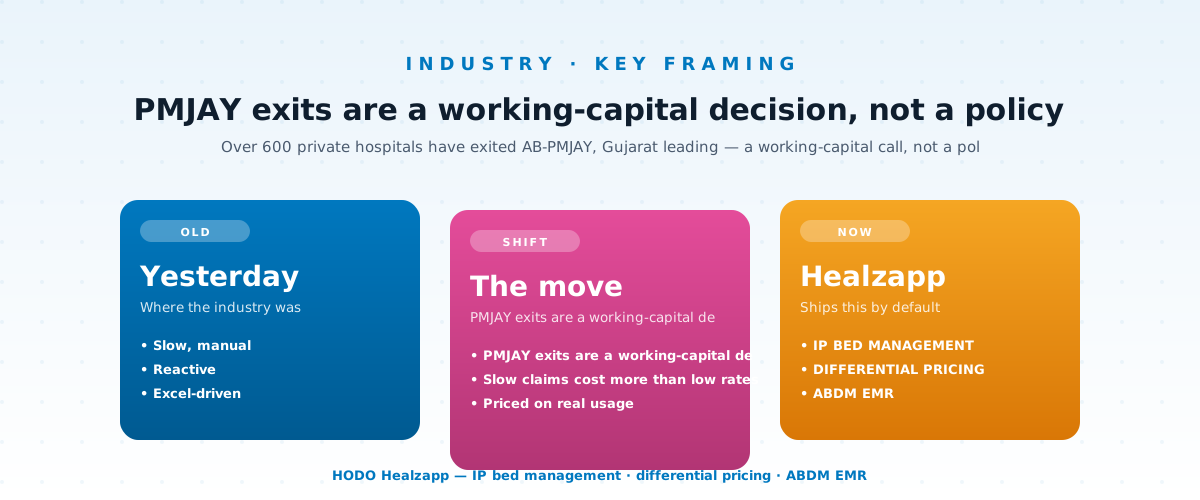
The exit conversation usually starts with rates, but the deeper bleed is float. A ₹40,000 PMJAY case that clears in 45 days costs the hospital roughly ₹450 in working-capital interest at a 9% overdraft line — before any denial or partial payment. Push the same case to 120 days and that number crosses ₹1,300. Multiply by 400 cases a month and the annualised interest drag alone can wipe out 4-6% of PMJAY revenue.
Most hospitals don't see this line because it sits inside 'finance costs' on the P&L, not against the PMJAY revenue line. When you re-plot working-capital drag onto scheme cases directly, the conversation about whether to stay changes. Some packages, especially day-care and short-stay, remain viable. Long-stay ortho, cardiac and onco packages often do not.
The operational fix is boring but effective: cut days-sales-outstanding by tightening pre-authorisation turnaround, cleaning documentation on first submission, and putting an ageing dashboard in front of the CFO every Monday. Hospitals with disciplined claim desks routinely run 25-40 fewer DSO days than peers on the same scheme.
Ask most 100-300 bed hospitals what their true cost per PMJAY case is and the answer is usually a range, not a number. The reason is that costing sits in Tally, clinical activity sits in the HIS, and pharmacy or consumable issue sits in inventory — and nothing reconciles those three at a case level. Owners end up making stay-or-exit decisions on speciality-level averages that hide the packages that are actually profitable.
The teams that get this right are running case-level costing: every implant, every consumable, every OT hour and every nursing shift attributed to the admission. When the HIS, pharmacy and inventory sit in one system, the CFO can filter PMJAY cases and read contribution margin by package code. That is the level of granularity that lets a hospital keep 60% of its PMJAY cases and stop taking the loss-making 40%.
None of this is glamorous — it is line-item hygiene. But it is the difference between a rational exit decision and a reactive one taken after a bad quarter.
First, pre-authorisation. Move the pre-auth desk into the same screen where admission happens; the delay between admission and pre-auth submission is where a third of PMJAY denials originate. Second, documentation capture. Discharge summaries, investigation reports and implant stickers should attach to the case file automatically as the events happen — not be chased on discharge day. Third, claim tracking with an ageing bucket the CFO reviews weekly. Fourth, a denial-reason register that feeds back into training for the claims team.
These four moves, done together, typically pull DSO down by 20-30 days on PMJAY cases within a quarter. They also reduce silent write-offs — the cases that quietly get closed without full realisation because nobody had bandwidth to fight the query in time.
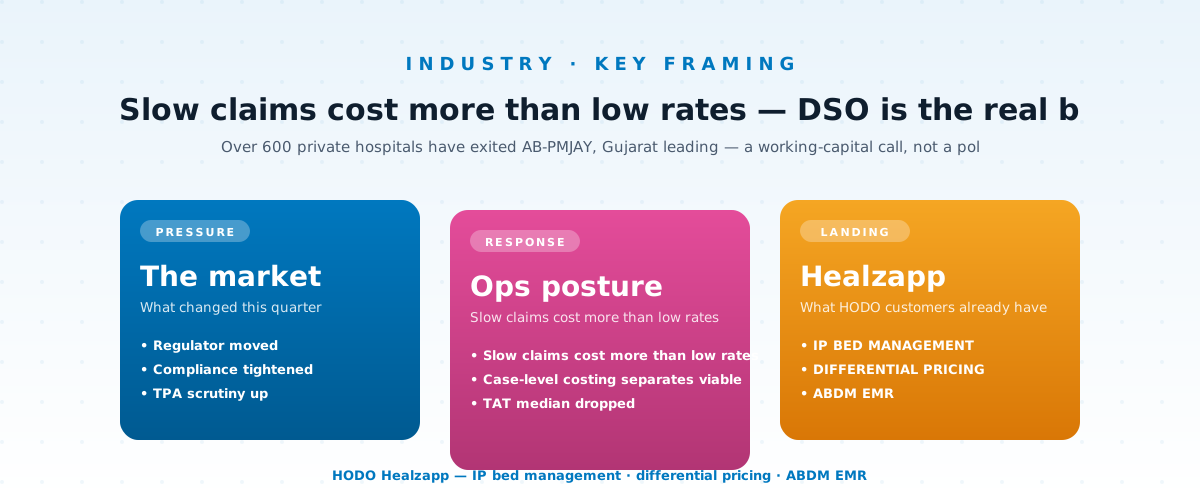
A PMJAY exit is only useful if the 20-35% volume gap it opens gets filled. Owners who have made the exit work talk about three replacements: local corporate tie-ups with tiered pricing built in, OPD-to-IP conversion campaigns via WhatsApp and patient apps, and expanding referral doctor and B2B lab networks around the hospital. The switch from scheme cases to a mixed private-pay and TPA book only works if the front-office can quote, bill and clear each payer type without manual overrides.
Multi-outlet chains have another lever: shift PMJAY case-load to the outlets where the state payment cycle is fastest, and keep loss-making packages out of the outlets where working capital is tight. That decision needs consolidated dashboards, not per-outlet spreadsheets emailed on the fifth of every month.
The PMJAY squeeze is a workflow problem before it is a policy problem, and the workflow lives inside the HIS. Hospitals running HODO Healzapp can lean on three features to protect the P&L regardless of which side of the exit decision they land on. Billing with payer-level tagging keeps PMJAY, TPA, corporate and private-pay realisations visible on one screen, so the CFO stops guessing at contribution margin. Tally integration closes the loop between clinical activity and finance, which is where case-level costing actually becomes possible. And Differential pricing lets owners protect scheme margins while quoting corporate and referral partners at defensible rates — the same workflow that helps replace lost PMJAY volume without eroding private-pay yield.
See how Healzapp handles this — book a 30-min demo.
See how Healzapp, Labzapp and EReazy fit your speciality in a free 30-minute demo.
Book a Free Demo