At Aarogya Manthan 2026, the Centre unveiled a set of digital tools aimed at faster insurance claim processing and more secure handling of patient health data, as reported by ETV Bharat. The announcements sit squarely inside the direction the Ayushman Bharat Digital Mission has been travelling for three years: claims move as structured data on shared rails, and records move only against a recorded consent. For a 100-bed hospital or a multi-outlet lab chain, the useful question is narrower than the policy question, what has to change at the registration desk, the billing counter and the records room before those rails start carrying real volume.
From portals to rails: what actually changes underneath
For most Indian hospitals, a claim today is a human artefact. Someone downloads a pre-authorisation form from a TPA portal, someone else scans the discharge summary, a third person emails a zip file, and a fourth chases the acknowledgement. Each payer has its own portal, its own field names and its own tolerance for missing paperwork. The work is not clinical and it is not billing, it is translation, and it is paid for out of the hospital's own margin.
An exchange-based model removes the translation layer but shifts the burden forward. When a claim leaves as a structured packet, patient identity, coverage, diagnosis coding, itemised charges, supporting documents, the payer's system can adjudicate it in hours instead of weeks. That speed is only available to hospitals whose source data is already structured. If the diagnosis lives in free text on a consultant's sheet, if the tariff line in the bill does not map to a standard code, or if the discharge summary exists only as a photograph, the packet cannot be assembled automatically and the hospital falls back to manual submission. The gap between hospitals that clear claims in 72 hours and hospitals that take 45 days will not be about payer relationships. It will be about how clean the data was at the point of capture.
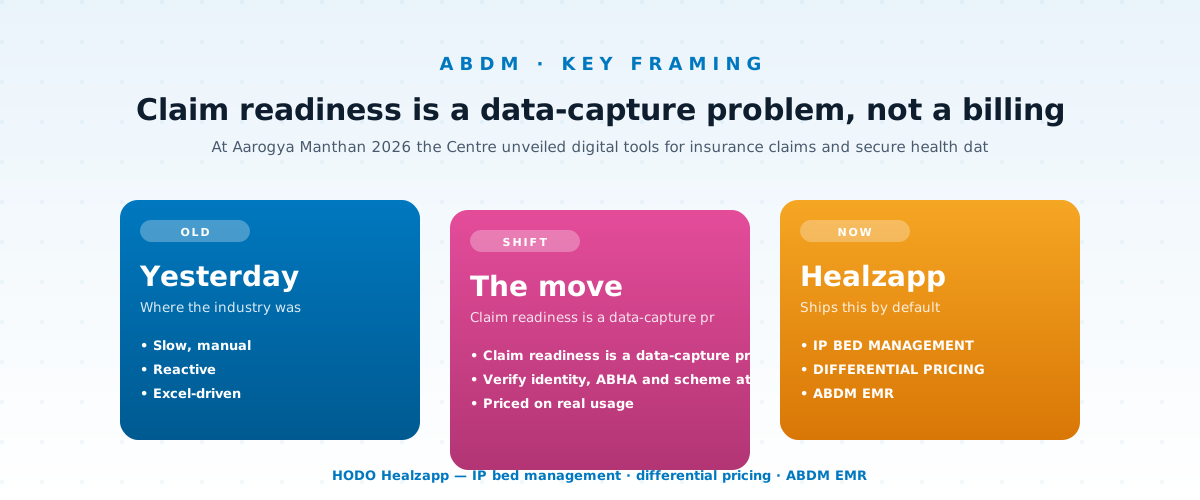
Claim readiness is a data-capture problem, not a billing one.
The registration desk decides claim quality
Almost every avoidable denial traces back to the first five minutes of a patient's visit. A name spelled differently from the policy document, a missing ABHA linkage, an unverified coverage limit, a scheme eligibility assumed rather than checked, all of these are cheap to fix at registration and expensive to fix after discharge, when the patient has gone home and the payer's clock is running.
Hospitals that have moved on this treat registration as a data-quality gate rather than a queue to be cleared. Identity is verified once and reused. ABHA creation or linkage is offered at the counter and its success rate is tracked per shift, not left to whoever remembers. Payer and scheme are captured as structured fields with a coverage check attached, so that the front office knows before admission whether the patient is cashless, partly covered or self-paying. Differential pricing for the relevant scheme or corporate tariff is applied automatically instead of being corrected by hand at discharge.
The measurable output is first-pass acceptance, the share of claims that go through without a query. Hospitals rarely track it because the number is embarrassing when first measured. It is also the single metric that most directly explains a hospital's receivables ageing, and it responds quickly to front-office discipline.
Consent stops being a signature on paper
The second half of the Aarogya Manthan announcements concerned secure health data. In practice this means a hospital must be able to answer three questions about any record it has shared: who asked for it, what the patient agreed to, and when that permission expires. A consent form in a physical file does not answer any of these in a form an auditor or a payer can verify.
This has quiet operational consequences. Discharge summaries and reports sent over WhatsApp need to be tied to a verified mobile number and a logged consent, not forwarded from a staff member's personal handset. Referral networks and corporate clients that receive patient data need their own logins with defined scope, rather than a shared mailbox. Records shared with a partner lab need to be traceable without exposing the patient's full identity to the partner.
None of this requires a new department. It requires the HIS to be the place where data leaves the building, so that the log exists as a by-product of normal work. Hospitals where reports leave through five different channels, email, WhatsApp, printouts, a portal, a courier, cannot produce that log at all, and under a consent-based regime that becomes a compliance exposure rather than an inconvenience.
Lab chains and referral networks sit on the same rails
Diagnostic chains are affected earlier than hospitals, because their volumes are higher and their margins per test are thinner. A 12-centre lab chain running 1,500 tests a day cannot absorb even a 3% rework rate on billing data. The same discipline applies with different nouns: samples barcoded at collection rather than at the processing lab, analyser results flowing in through machine interfacing instead of being typed, reports released against a verified contact, and TAT measured per centre rather than as a chain-wide average that hides the two outlets dragging everything down.
The referral layer deserves specific attention. Referring doctors, corporate clients and franchise partners each need visibility into their own patients and their own rate card, and nothing else. Where that is handled by phone calls and spreadsheets, every new partner adds fixed cost. Where it is handled by scoped portals with differential pricing per partner, partner count scales without adding back-office headcount, which is the actual constraint on how fast a chain can add outlets.
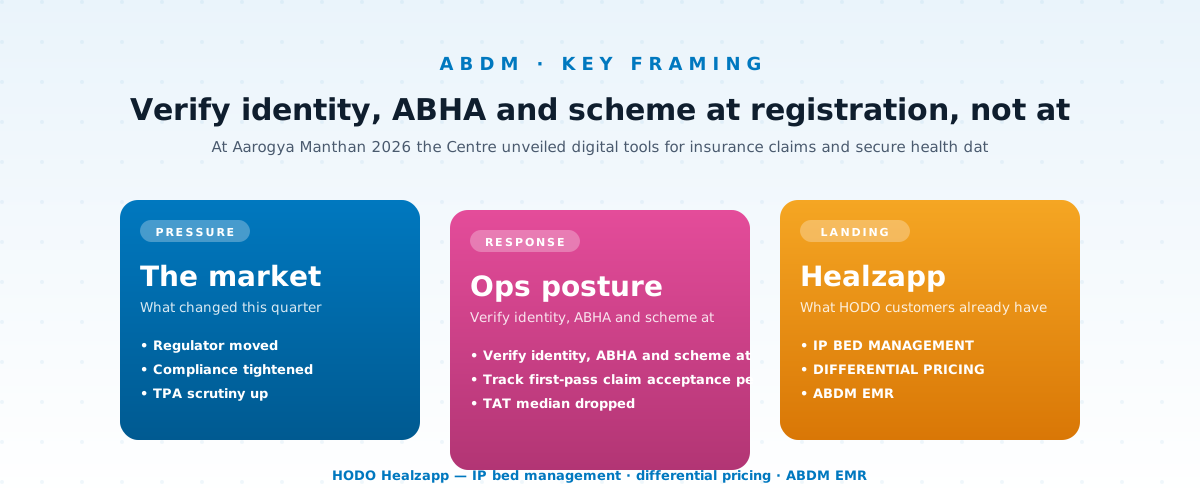
Verify identity, ABHA and scheme at registration, not at discharge.
The audit worth running this quarter
Four numbers are enough to know where a hospital or chain stands. First, ABHA linkage rate at registration, measured weekly per counter. Second, first-pass claim acceptance, split by payer and scheme. Third, the proportion of discharge summaries and reports that leave the organisation through a logged channel. Fourth, average days from discharge to claim submission, not to settlement, which depends on the payer, but to submission, which depends entirely on the hospital.
Each of these is a system question rather than a staffing question. A hospital with 140 pending claims does not need two more billing executives; it needs the data to be right when it is first entered, and it needs the submission packet to assemble itself. Aarogya Manthan 2026 has set the direction. The hospitals that benefit will be the ones whose records were already structured when the rails opened.
What this means for HODO customers
Readiness for structured claims and consent-based data sharing is a configuration question, not a project. In Healzapp, ABDM-compliant EMR keeps clinical records in a shareable, standards-aligned form rather than as free text that has to be re-keyed for every payer. Patient Management and Billing carry identity verification, scheme capture and differential pricing to the front office, so first-pass acceptance improves before a single claim is filed. For groups adding centres, Multi-outlet scale-up with one-click new-centre setup means the fifth branch inherits the same claim and consent discipline as the first, instead of inventing its own.