Medical Buyer reports that the Centre has allocated ₹27,000 crore for cancer care under AB-PMJAY, the largest single disease-area commitment the scheme has carried so far. For hospitals already empanelled, and for the ones now weighing empanelment, the headline number matters less than its shape. Oncology money does not arrive as one-off surgical packages; it arrives as long treatment cycles, repeated day-care admissions and claims that stretch across months.
Why the allocation changes the empanelment maths
Most ~100-bed hospitals built their PMJAY desk around predictable, single-event packages — a caesarean, a hernia repair, a cataract list, an orthopaedic fixation. Admission, procedure, discharge, claim. One pre-authorisation, one discharge summary, one settlement to chase. An oncology-weighted case mix breaks that rhythm completely. A single breast cancer patient may generate a diagnostic workup, a surgical package, six to eight chemotherapy cycles over five months, imaging at defined intervals, supportive-care admissions when counts drop, and a follow-up schedule that runs years past the last claim.
That means the operational question is not whether the hospital can treat the patient. It is whether the hospital's front office can hold one patient's financial and clinical thread together across twenty-plus touchpoints without losing a pre-authorisation, double-billing a consumable, or discovering at month-end that cycle four was never claimed. Hospitals that treat the allocation as a revenue opportunity without first fixing that thread will book the volume and then spend the next two quarters reconciling it. The ones that win on this money will be the ones whose HIS already carries a longitudinal patient record rather than a stack of unconnected visit entries.
There is a second, quieter implication. Cancer care pulls district-level patients towards whichever empanelled centre nearby can actually run a cycle calendar. For a 100-bed hospital in a tier-2 or tier-3 catchment, that is a genuine referral moat — but only if the scheduling and recall mechanics hold.
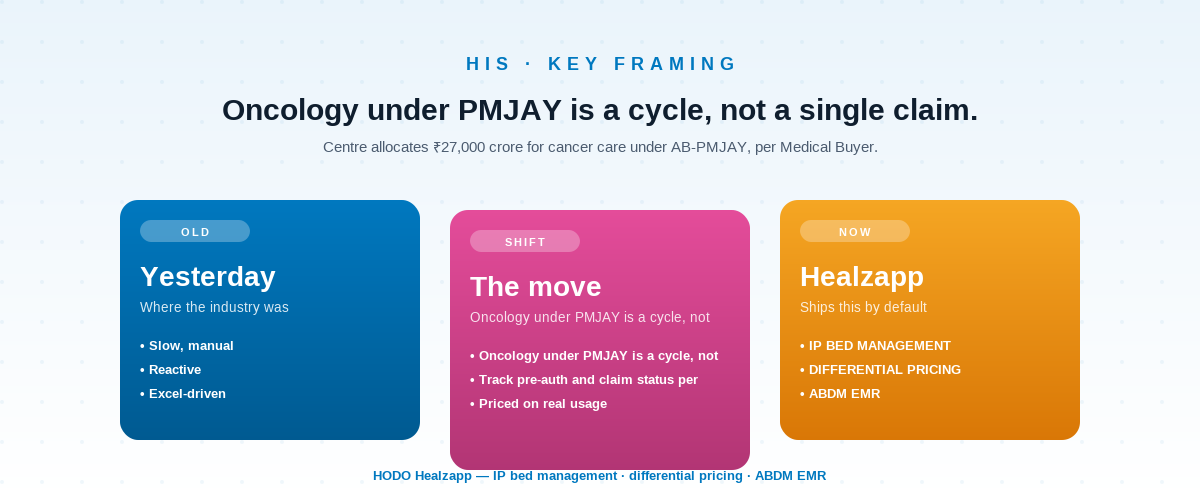
Oncology under PMJAY is a cycle, not a single claim.
Oncology is a cycle, not an episode
The practical unit of work in oncology is the cycle, and almost no hospital information system defaults to that view. Registration creates a patient. Admission creates an IP episode. Billing creates a bill. Nothing natively says: this is Mrs Nair's cycle 3 of 6, due 21 days after cycle 2, contingent on an absolute neutrophil count above threshold, under package code X, with pre-auth valid until a specific date.
Hospitals that run oncology well reconstruct that view manually — a counsellor with a spreadsheet, a WhatsApp group, a wall-mounted chemo calendar. It functions at ten patients and collapses at eighty. The failure modes are specific and expensive: a patient arrives for cycle 4 but the pharmacy has not indented the drug, because nobody linked the cycle calendar to Inventory. Or the patient does not arrive at all, drifts two months, and returns as a salvage case that costs the hospital far more than the package pays.
What fixes this is not a new oncology module bolted on the side. It is making the existing spine — Appointments, IP/OP, EMR, Pharmacy, Inventory — share one patient thread, so a scheduled cycle automatically implies a bed requirement, a drug indent, a lab prerequisite and a claim line. In Healzapp, the EMR carries AI-condensed history, which matters disproportionately here: an oncology consultant reviewing a patient at cycle 5 needs the arc of the last four cycles in thirty seconds, not fourteen scanned discharge summaries.
Pre-authorisation is where the margin leaks
PMJAY cashflow pain is rarely about rejection rates on clinical grounds. It is about documentation timing. A pre-authorisation that lapses between cycles, a discharge summary uploaded without the mandated investigation report attached, a package claimed under the wrong code because two clinically similar codes pay differently — each of these turns a treated patient into a 90-day receivable or a write-off.
Oncology multiplies the exposure because the same patient generates repeated claim events. One procedural gap in a surgical practice costs one claim. The same gap in a chemotherapy practice repeats every three weeks until somebody notices. Hospitals should therefore instrument the claim pipeline the way they instrument bed occupancy: a daily view of claims raised, claims pending document, claims pending TPA response, and claims aged beyond a threshold — owned by a named person, reviewed at the same morning meeting as the census.
The supporting discipline is machine-level traceability on investigations. When reports flow from analysers into the record through Machine Interfacing rather than being retyped, the attachment that a pre-auth or claim needs is already in the right place at the right timestamp. ABDM-compliant EMR helps on the same axis — a record structured for exchange is, in practice, a record that survives audit.
Day-care chemotherapy competes for the same beds
Chemotherapy is largely a day-care activity, and that is exactly why it quietly breaks bed planning at 100-bed scale. A chemo chair or day-care bed occupied for six hours does not show up in a conventional midnight census, so the hospital's occupancy number looks healthy while the day-care area is actually the constraint. Elective surgical lists get scheduled against beds that are functionally unavailable, and the resulting conflicts get resolved by whoever argues loudest at 9 am.
The fix is to make day-care capacity a first-class, visible resource — slots with start and end times, turnaround between patients, nurse-to-chair ratios, and a live map rather than a register. Hospitals running this properly can lift effective throughput substantially without adding physical beds, simply by sequencing short-infusion and long-infusion protocols into the same chair across a shift. That is an operations win, not a clinical one, and it is where IP bed management and Nursing Station workflows earn their keep.
Patient-side communication is the other half. Cycle adherence depends on the patient knowing the date, the fasting requirement and the pre-cycle blood test — and on the hospital knowing the result before the patient travels. WhatsApp/SMS report delivery and the Patient Health App turn that from a phone-call-per-patient job into an exception-handling job.
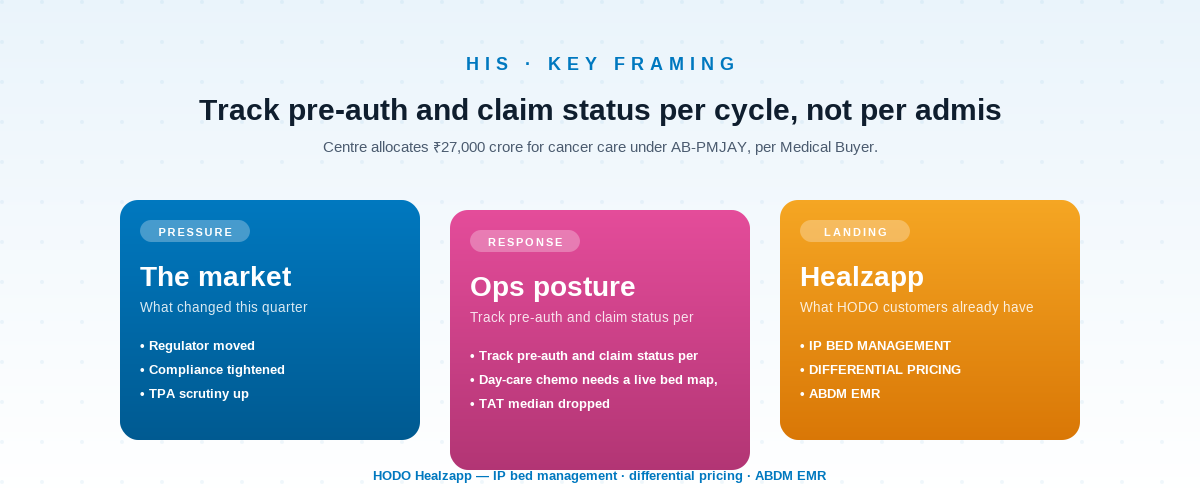
Track pre-auth and claim status per cycle, not per admission.
Costing per cycle, not per bill
Package rates are fixed; the hospital's cost is not. Oncology cost is dominated by drugs, consumables and nursing time, all of which vary by protocol and by patient weight and tolerance. A hospital that knows its margin per bill but not its cost per cycle cannot tell which protocols it is subsidising. After an allocation of this size, the empanelled hospitals that stay solvent will be the ones that track cost at protocol level and negotiate procurement accordingly — and that reconcile scheme receipts into accounts without a parallel manual ledger, which is where Tally integration and Differential pricing across scheme, corporate, insurance and cash patients stop being configuration details and start being margin.
What this means for HODO customers
An oncology-weighted case mix under AB-PMJAY is a longitudinal-record problem wearing a reimbursement costume. Healzapp addresses it on the spine rather than as an add-on: EMR (AI-condensed history) keeps a multi-cycle patient readable at the point of decision; IP bed management makes day-care and inpatient capacity visible as one live map instead of a midnight census; and Differential pricing with Tally integration keeps scheme, corporate and cash rates separated through to the books. For hospitals adding a cancer day-care unit as a new cost centre, multi-outlet scale-up with one-click new-centre setup avoids standing up a parallel system to run it.