
The National Health Authority is moving Ayushman Bharat PM-JAY claim adjudication onto an AI-driven engine, according to Medical Buyer's coverage of NHA's plans. For empanelled hospitals, the shift changes what a "clean" claim file looks like — and how quickly a sloppy one gets rejected. Owners running 50-500 bed set-ups need to audit their claim workflow now, not after the first rejection wave.
The Medical Buyer report describes an AI layer that reads claim documents, cross-checks package codes against clinical notes, flags documentation mismatches, and routes suspicious claims for human review. Adjudicators keep the final call, but the AI decides which files sail through and which get held up. The stated intent is faster payouts for compliant hospitals and tighter scrutiny on outliers.
Two things matter for hospital operators. First, adjudication turnaround will compress from weeks to days for well-documented claims — good for cashflow if your paperwork is in order. Second, the AI will surface patterns human adjudicators miss: repeat use of the same discharge summary template across unrelated cases, timing anomalies between admission and procedure, mismatches between the ICD code and the drugs billed. Hospitals that have quietly relied on adjudicator fatigue to push borderline claims through are about to lose that cushion.
The NHA has been building the data pipeline for this over the last two years — the PM-JAY portal already collects far more structured data than most hospitals realise. The AI layer is what turns that data into pre-authorisation and payment decisions at scale.
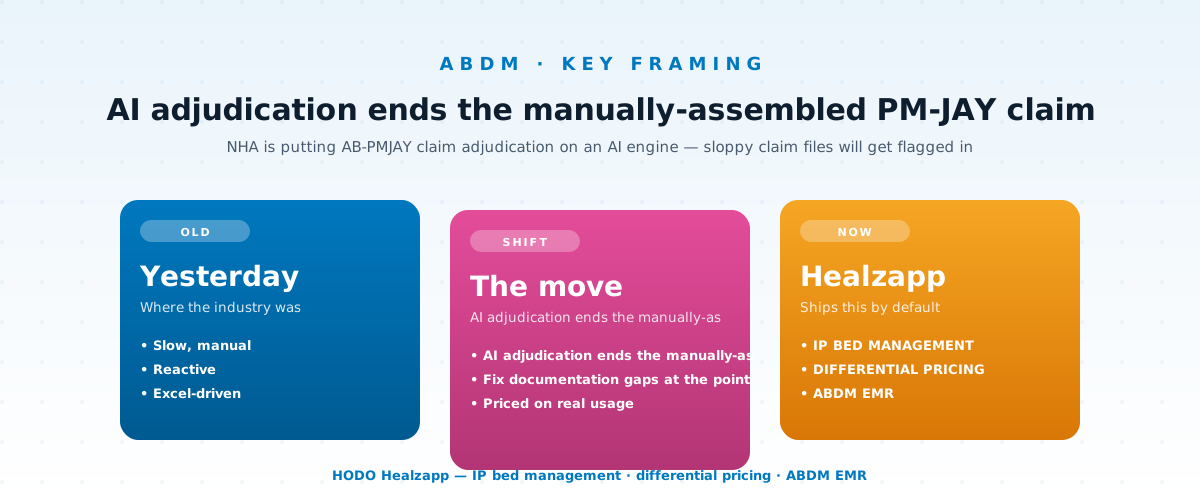
Most empanelled hospitals still assemble claim files as a manual last-mile task: the billing clerk pulls a discharge summary from the doctor, scans the investigation reports, matches them to the package code, and uploads the bundle. Handoffs are informal, corrections happen over WhatsApp, and the final PDF often contains typed narratives that no longer match the electronic case sheet.
An AI adjudicator will notice this immediately. If the discharge summary claims a laparoscopic cholecystectomy but the OT register logs an open procedure, the file gets flagged. If the pre-op investigation dates fall after the surgery date because someone entered them retrospectively, that is flagged too. Manual claim assembly produces exactly these inconsistencies at scale.
The fix is not more people checking claim files. It is a HIS that generates the claim bundle from the same source-of-truth records the clinician used at the bedside — so the discharge summary, the OT note, the pharmacy dispense log and the investigation reports all reference the same encounter timeline. Any hospital still running billing and EMR on separate stacks will find the AI catches every seam.
Three gaps recur across audits of PM-JAY rejections. First, pre-authorisation notes that copy generic clinical justifications instead of the specific patient's presentation — AI pattern-matches these across hospitals within days. Second, missing or backdated consent forms, especially for high-value packages where the consent needs to reference the specific procedure and its alternatives. Third, discharge summaries that skip the post-op course and jump straight to "patient stable, discharged" — an AI will read this as insufficient justification for the length-of-stay billed.
Fixing these gaps at the file-assembly stage is too late. They need to be closed at the point of care, with structured templates that force the clinician to enter the missing detail before the encounter can be closed. That is a workflow redesign, not a documentation drive.
Faster adjudication cuts both ways. Compliant hospitals will see PM-JAY receivables drop from 45-60 days to under 20 — a material working-capital release for a 200-bed hospital doing ₹2-4 crore of PM-JAY billing a month. Non-compliant hospitals will see their rejection rate spike and their cashflow tighten in the same window.
Owners should model both scenarios before Q3. Pull the last six months of PM-JAY claims, calculate your current rejection rate and average days-to-payment, and project what happens if rejections double while payment days halve. For most hospitals with mixed compliance, the net effect is neutral in month one and negative in month two as the rejected-claim backlog piles up.
The operational lever is claim-file quality at submission. Every claim submitted with a clean audit trail — timestamped clinical entries, matched investigation reports, structured discharge summary — moves to the fast lane. Every claim with gaps joins the queue for human review, which will get longer as the AI diverts more traffic to it.
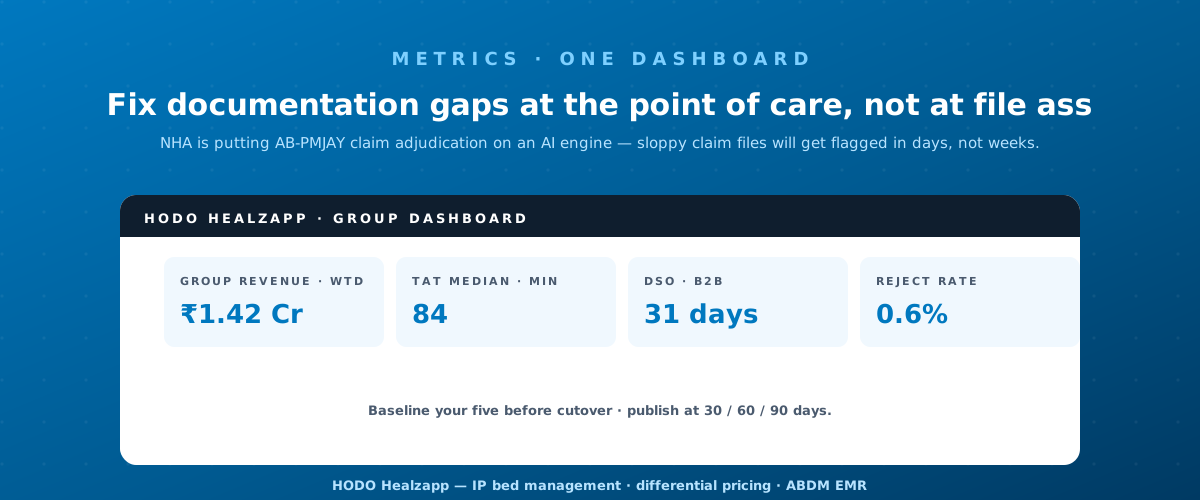
When the NHA's AI flags a claim, the hospital gets a limited window to respond with supporting documentation. The response has to include the original clinical entry timestamps, the user IDs of the staff who entered them, and the linked investigation and pharmacy records. Hospitals running loose HIS deployments — where entries can be edited without version history, or where billing entries are not tied to a specific clinician login — cannot produce this audit trail cleanly.
The fix is a HIS that treats every entry as immutable-with-audit: edits are versioned, timestamps are server-side, and the claim-file export includes the audit metadata by default. This is not a nice-to-have for PM-JAY hospitals from Q4 onwards. It is the difference between a 48-hour response and a rejected appeal.
Healzapp customers already have most of the plumbing this new adjudication regime requires. The ABDM-compliant EMR produces structured, timestamped clinical entries that map cleanly to PM-JAY documentation fields — the same records the AI adjudicator will scan. The Billing module ties every claim line to the source EMR entry, OT record and pharmacy dispense log, so the audit trail is built by default rather than assembled after the fact. And the EMR (AI-condensed history) feature gives clinicians a fast way to write discharge summaries that reflect the actual encounter timeline rather than a template.
Owners should still audit their PM-JseniorAY submission workflow this quarter — the tooling helps, but it does not remove the need for clinicians to enter complete notes at the point of care. The hospitals that come out of this transition ahead will be the ones that treat AI adjudication as a documentation discipline problem, not an IT project.
See how Healzapp handles this — book a 30-min demo.
See how Healzapp, Labzapp and EReazy fit your speciality in a free 30-minute demo.
Book a Free Demo