Union Health Minister JP Nadda told Parliament this week that more than 2,000 hospitals have been de-empanelled from Ayushman Bharat PMJAY and another 1,200 suspended, all for guideline violations, according to a report by ETHealthworld. Automated triggers on the National Health Authority's claim engine now flag suspicious claims within 24 hours of submission, and confirmed fraud is simply not paid. For hospital owners and administrators, the operational message is clear: the audit is no longer an annual event, it is a continuous back-end process.
What the numbers actually mean for a mid-sized hospital
Roughly 3,200 hospitals have been penalised in aggregate, a scale that pushes this from an outlier compliance story to a sector-wide realignment. For a 50-500 bed hospital, empanelment losses translate directly into lost inpatient volume in the districts where PMJAY drives 30-60% of admissions. Suspension freezes the pipeline of new authorisations while old cases continue to accrue queries; de-empanelment forces refund of contested amounts and often triggers state-level cross-audits. The NHA's own scoring model looks at claim rejection ratios, average length of stay against benchseemark packages, gender and age anomalies in specialty claims, and geographic clustering of high-value packages. Every one of these signals originates in the HIS. If bed-day entries, discharge summaries, and consumables logs are being reconciled retroactively at the billing counter, as they still are in many hospitals, the hospital is building its own de-empanelment case in the audit trail. The reform that matters is not "hire a compliance officer"; it is close every clinical event at the point of occurrence, in one system.
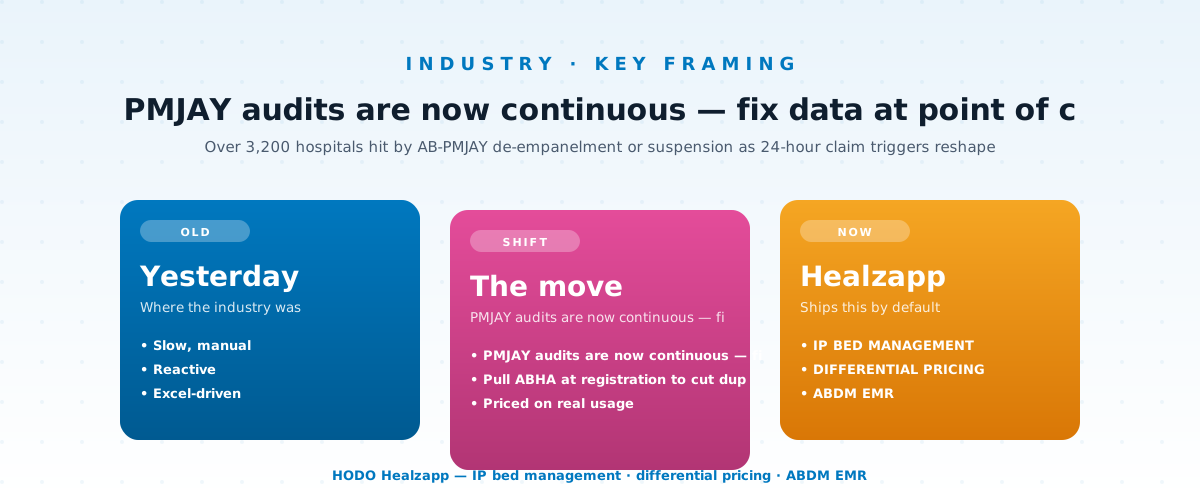
PMJAY audits are now continuous, fix data at point of care.
Why claims trigger inside 24 hours now
The 24-hour trigger window is not a threat, it is a diagnostic tool the hospital can use in its own favour, provided data reaches the claims engine clean. Common trigger patterns operators are seeing: duplicate submissions from the same UHID within a 30-day window, package selection inconsistent with the diagnosis code, ICU stays without matching nursing chart entries, and pharmacy consumption below package norm. These are not fraud in most cases; they are the natural output of a hospital where OP, IP, pharmacy and billing run on disconnected systems and someone stitches the claim file the night before submission. Once the trigger fires, the burden of proof sits with the hospital and the reversal window is tight. A single system that captures the encounter, the bed movements, the nursing notes, the pharmacy issue and the final bill in the same record cuts the trigger rate sharply, not by hiding anomalies, but by making the underlying clinical story defensible line by line.
The ABHA and ABDM linkage most hospitals are under-using
Nadda's briefing also flagged the volume of Ayushman Bharat Health Accounts and Ayushman card creation during the year. ABHA linkage at the point of registration is now the cheapest fraud-prevention control a hospital has: it removes the identity ambiguity that drives the majority of duplicate-claim triggers. Hospitals still running paper registration or non-ABDM EMRs are forcing their claims team to re-verify identity at submission time, which is both slower and legally weaker if the claim is challenged. Registration desks should be pulling ABHA at first contact, mapping it to the internal UHID, and letting the discharge summary carry the ABHA number into the claim payload automatically. The regulatory direction is one-way; hospitals that treat ABDM integration as a compliance checkbox rather than a workflow layer will keep paying the audit tax.
Cashflow discipline: treat the claim engine like a customer
The financial reading of the news is straightforward, every rejected claim is money already spent on drugs, consumables, staff hours and bed occupancy that will not return. A 5% PMJAY rejection rate on a hospital doing four crore rupees in annual scheme business is twenty lakh of un-recoverable working capital, not counting the cost of the appeal cycle. The claims team should be reviewing rejection reasons weekly, tagging them by root cause (documentation, coding, package mismatch, identity), and pushing corrections back into the point-of-entry workflow. Corporate and TPA logins and structured referral portals matter here because they externalise the same discipline: the referring doctor, the corporate partner or the outsourced lab is submitting data in the format the claim engine expects, not in a free-text note the billing clerk decodes later.
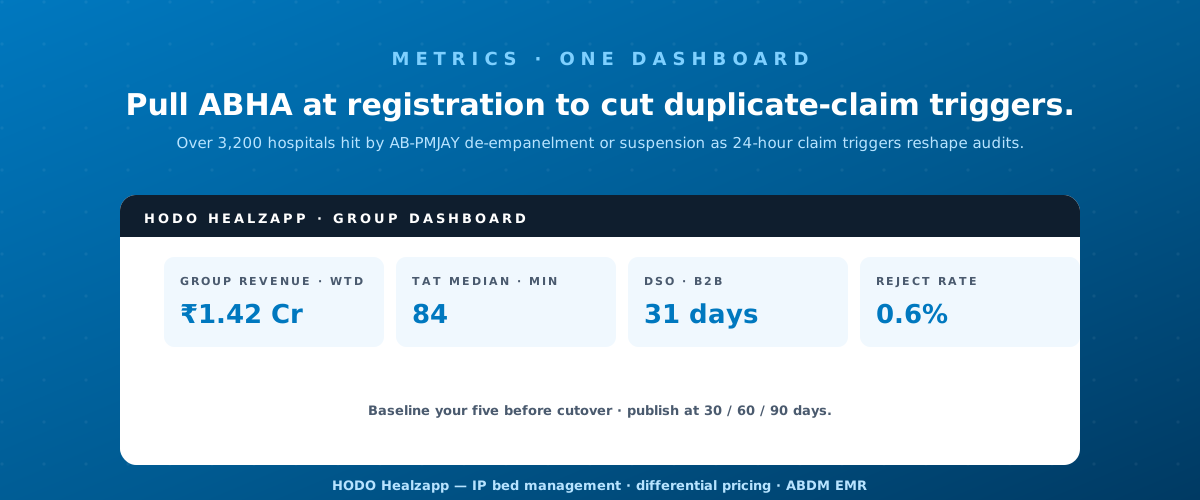
Pull ABHA at registration to cut duplicate-claim triggers.
Multi-outlet groups: standardise before you scale
For clinic and hospital chains adding outlets, the de-empanelment risk compounds per site. Each new centre inherits the parent's SOPs on paper but rarely on the ground; local billing habits, non-standard package selection, and outlet-specific EMR templates drift within months. A group with 12 outlets and heterogeneous systems is effectively running 12 different compliance postures. One-click new-centre setup on a common HIS spine is not just a rollout convenience, it is the mechanism by which a group ensures the same master data, same package library, same discharge summary template and same claim submission workflow at every site. When the NHA runs its clustering analysis, it will see one consistent hospital brand, not 12 outliers.
What this means for HODO customers
The de-empanelment wave is a data-discipline problem before it is a compliance problem, and Healzapp is built for exactly this stack. ABDM-compliant EMR pulls ABHA at registration and carries it through the encounter, so the claim payload is identity-clean by default. IP bed management paired with the Nursing Station module closes bed-day and nursing chart entries at the point of care rather than at the billing counter, removing the biggest single source of PMJAY trigger events. Multi-outlet scale-up with one-click new-centre setup ensures that groups adding sites do so on the same master data and the same claim workflow, so audit posture stays uniform as the estate grows.