Union Health Minister JP Nadda told Parliament this week that over 2,000 hospitals have been de-empanelled and 1,200 more suspended from Ayushman Bharat Pradhan Mantri Jan Arogya Yojana (AB-PMJAY) for guideline violations, according to a report in The Economic Times sourced via Google News. For hospital owners and administrators, the message is no longer subtle: documentation, billing hygiene, and ABDM linkage are now enforcement triggers, not paperwork. The next empanelment renewal cycle will be run against a much sharper data-audit lens than any previous round.
What actually gets a hospital de-empanelled
The National Health Authority's action is not a headline exercise. Field audits and data-triangulation across claim submissions, patient records, and bed occupancy reports are throwing up repeat offenders. The common failure patterns are familiar to any administrator who has sat through an NHA audit: package upcoding, ghost admissions, missing pre-authorisation documentation, discharge summaries that do not match the claimed procedure, and stay durations that fall outside the norm for the package. In a growing number of cases, hospitals were flagged for missing OP-to-IP conversion trails, or for IP admissions with no supporting investigation reports on file. None of these are clinical failures. They are record-keeping failures, and the NHA is now equipped to spot them in bulk.
The 2,000-plus de-empanelments and 1,200 suspensions also carry a second signal: recovery penalties. Hospitals under suspension are being asked to refund crores in disputed claim amounts before reinstatement is even discussed. For a 100-200 bed hospital carrying a healthy AB-PMJAY panel, a suspension can wipe out an entire quarter's cashflow and delay salary cycles for months.
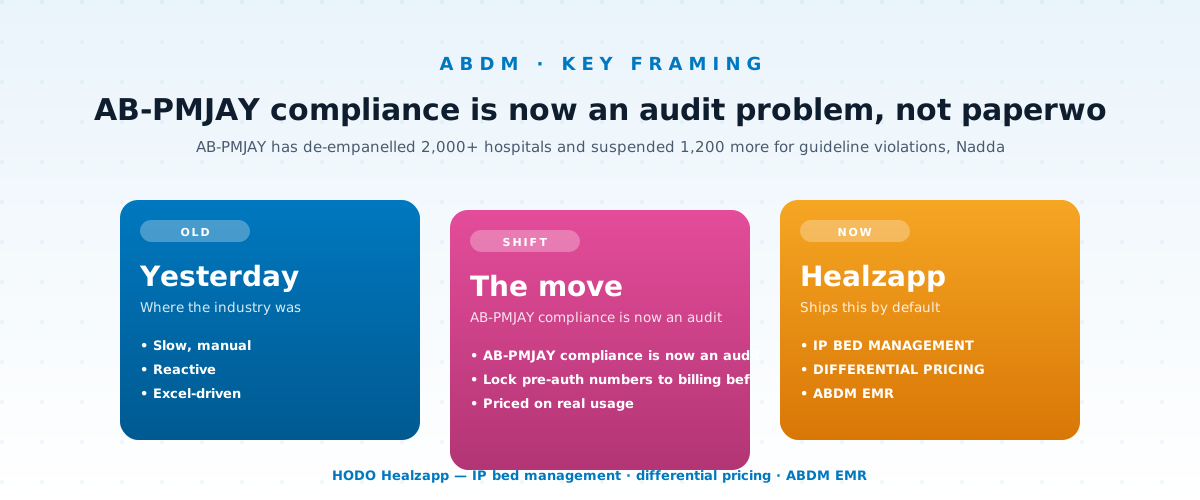
AB-PMJAY compliance is now an audit problem, not paperwork.
Why manual claim workflows keep failing the audit
Most hospitals still run AB-PMJAY workflows across three or four disconnected systems: a front-desk registration book, a billing module, a paper case sheet, and a claims-portal login used by one Arogya Mitra. When the NHA data-mining team pulls a hospital's 90-day claim history, gaps show up instantly, a discharge date that predates the last recorded vital, an ICU stay with no nursing chart, a package billed against a patient whseo ABHA ID was never linked, or an OT note that references a surgeon who was on leave that day.
The fix is not more staff. Hospitals that have added Arogya Mitras have discovered that documentation errors scale with headcount when the underlying system is not integrated. What audits reward is a single record, one patient, one admission ID, one linked ABHA number, one billing line, one discharge summary, and machine-generated timestamps that cannot be back-dated. Anything short of this leaves scope for a claim to be flagged, and once flagged, the burden of proof sits with the hospital.
The ABDM linkage is now non-negotiable
The de-empanelment wave has coincided with tighter NHA insistence that AB-PMJAY hospitals push case data to ABDM-compliant systems. ABHA ID capture at registration, consent-artefact logging, and health record push to the patient's Personal Health Record locker are moving from optional to expected. Hospitals still running non-ABDM EMRs are being told to migrate at their next empanelment renewal. Empanelment committees are also looking at Health Facility Registry (HFR) and Healthcare Professionals Registry (HPR) coverage, a hospital where only two of eighteen consultants are HPR-registered will find its renewal held up.
For hospital administrators, the practical read is that ABDM is no longer a digital-India nice-to-have. It is the audit backbone. When the NHA queries a claim, the first check is whether the corresponding case record exists in an ABDM-linked EMR with a matching ABHA-tagged patient. If it does not, the claim is treated as unverifiable, and unverifiable claims are what fills a de-empanelment file.
Cashflow discipline for hospitals still on the panel
Hospitals that stay on the AB-PMJAY panel through 2026 will need to run tighter internal controls than before. Three practices are becoming standard at hospitals that have survived recent audits without penalties. First, pre-authorisation is being locked to the billing module, no package can be billed unless the pre-auth number, package code, and pre-auth date are all present in the patient record. Second, discharge summaries are being generated from the EMR rather than typed separately, so the ICD codes, procedure notes, and stay dates in the claim match the clinical record exactly. Third, TPA and AB-PMJAY claims are being run through a single receivables dashboard, so the finance team knows within a day if a claim has been rejected, queried, or paid, instead of finding out ninety days later that a claim was never submitted.
For multi-outlet groups, the challenge multiplies. A five-hospital chain cannot rely on each unit's Arogya Mitra to file claims their own way. The claim template, ABHA linkage step, and discharge-summary format have to be identical across outlets, and finance has to see a consolidated claim pipeline in one place, not five spreadsheets that reconcile once a month.
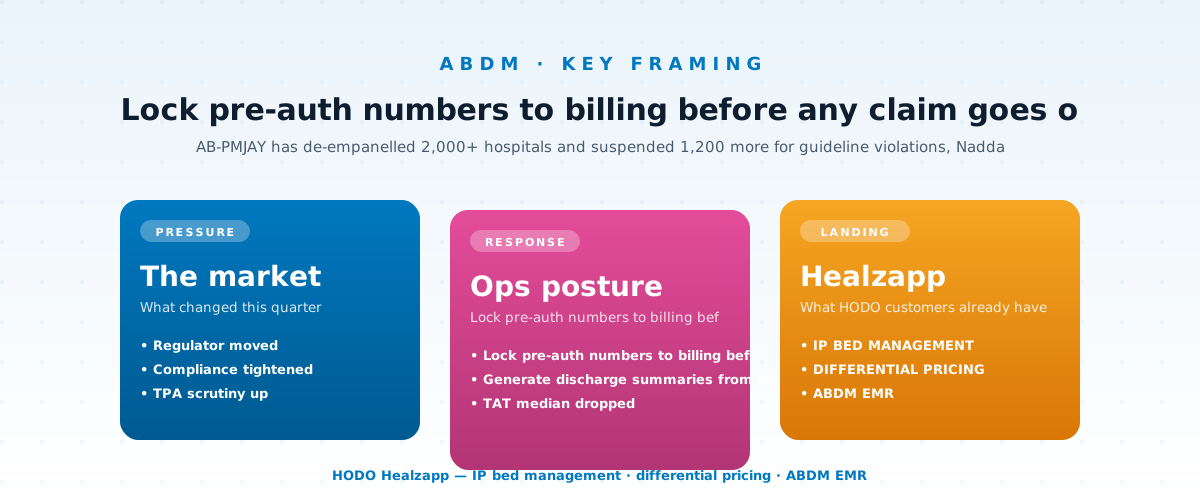
Lock pre-auth numbers to billing before any claim goes out.
What administrators should audit this month
Before the next NHA review cycle, administrators should run a short internal audit on the last ninety days of AB-PMJAY claims. The checklist is straightforward: what percentage of empanelled-package admissions have a matching ABHA ID captured at registration; what percentage of discharges have an EMR-generated summary attached to the claim file; how many pre-auths were raised on the day of admission versus retrospectively; how many claims are older than sixty days without payment or query action; and whether every consultant listed in the empanelment file is HPR-registered.
Any hospital that finds gaps in more than one of these categories is running compliance risk that the NHA will eventually spot. Fixing it is a systems problem, not a training problem, and the cost of a suspension now runs an order of magnitude above the cost of tightening the workflow.
What this means for HODO customers
Hospitals on HODO Healzapp already run their AB-PMJAY and TPA workflows on an ABDM-compliant EMR that captures ABHA IDs at registration, logs consent artefacts, and generates discharge summaries directly from the clinical record, so the claim file and the case record cannot drift apart. The Billing module links pre-authorisation numbers to package codes, which means a package claim cannot be raised without the supporting documentation the NHA now checks for. For hospital chains scaling AB-PMJAY across units, Multi-outlet scale-up with one-click new-centre setup ensures every new outlet inherits the same claim template, ABHA linkage step, and discharge format, removing the outlet-by-outlet variation that audits catch.