Union Health Minister JP Nadda has told Parliament that over 2,000 hospitals have been de-empanelled from Ayushman Bharat Pradhan Mantri Jan Arogya Yojana (AB-PMJAY) for violating scheme guidelines, according to The New Indian Express. Nearly 1,100 additional hospitals have been suspended and financial penalties above ₹120 crore have been levied. For any hospital owner already carrying a large PMJAY caseload, the message from the National Health Authority is now unambiguous: documentation and billing hygiene will be treated as a licensing condition, not a back-office nicety.
What actually triggered the de-empanelments
The reasons the NHA has been citing publicly follow a consistent grammar. Ghost billing for admissions that either did not happen or happened on a different date. Upcoding, billing a higher-tier package when the actual clinical work performed maps to a lower one. Admission without indication, where the OP consultation and investigations do not justify converting the patient to IP. Fake or mismatched beneficiaries, where the ABHA or PMJAY card holder is not the person on the OT register or nursing chart. And clinical-record contradictions, a discharge summary that names procedures the OT notes never recorded.
None of these are new categories of fraud. What is new is the pace of enforcement. NHA now runs continuseg data-triangulation on claim submissions, cross-checking length of stay against ICU package claimed, checking implant serial numbers against invoice trails, and reading discharge summaries against the OT logbook. A hospital that files 800 claims a month cannot manually reconcile every one. So the fraud vector is often not intent, it is drift between what the doctor wrote, what the billing team coded, and what the ward nurse charted.
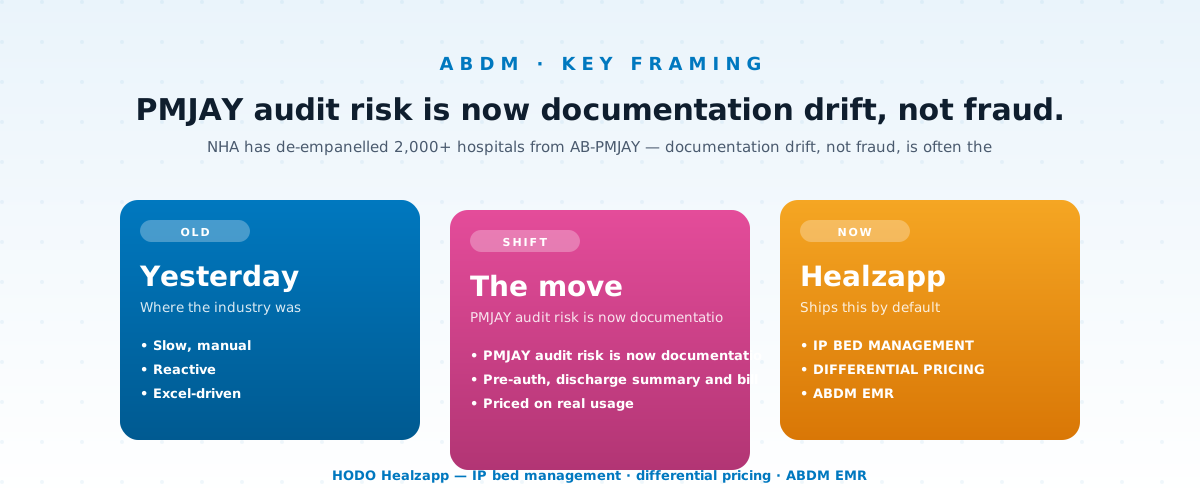
PMJAY audit risk is now documentation drift, not fraud.
The paper trail is now the primary audit surface
For empanelled hospitals, the audit surface is no longer the operation theatre or the ward, it is the file. Auditors read four documents in parallel: the pre-authorisation request, the discharge summary, the itemised bill, and the nursing or OT chart. Internal contradictions between any two of these is enough to freeze a claim and open an investigation. A discharge summary that says 'conservative management' while the bill claims a surgical package is the classic red flag. So is a nursing chart that shows the patient ambulatory on Day 1 of a supposedly ICU-grade admission.
The operational problem is that these four documents are usually authored by four different people, the consultant, the resident, the billing executive, and the ward nurse, on four different systems or paper registers. Unless the hseg forces them into a single record with cross-references, the drift is inevitable. Hospitals that have moved to a single HIS where the pre-auth, EMR, bill and nursing notes share a patient timeline have a structural advantage during audit. Those still stitching PDFs together on shared drives do not.
Cashflow risk: suspension freezes months of TPA claims
De-empanelment gets the headline, but suspension is what breaks a P&L. When NHA or the State Health Agency puts a hospital under suspension, in-flight claims stop settling and fresh admissions under the scheme are blocked. For a 150-bed hospital where PMJAY is 25-40% of monthly IP revenue, that translates directly into working-capital stress within 30-45 days. Staff salaries, consumable payments and Tally-side vendor cheques begin to slip. Consultants notice, and referrals start moving to competing hospitals.
The recovery cycle from suspension is not fast either. Reinstatement demands corrective-action documentation, sample re-audits and often physical inspection. That is 60-120 days of frozen cashflow in most cases. For multi-outlet groups, one suspended unit can drag the entire group's borrowing profile with its lender. The finance office therefore has a direct stake in whatever the medical records team is doing every morning, a linkage most hospitals still treat as somebody else's problem.
ABDM alignment is no longer optional plumbing
The Ayushman Bharat Digital Mission rails, ABHA numbers, health information exchange, standardised discharge summaries, are quietly becoming the substrate on which PMJAY enforcement runs. When a hospital's discharge summary is generated in an ABDM-compliant format, cross-linked to the patient's ABHA, and pushed to the Health Information Exchange, tampering it after the fact is far harder. That is precisely why the NHA is nudging empanelled hospitals to move onto ABDM-integrated HIS and EMR systems.
Hospitals that were early movers on ABDM integration have found an unexpected side benefit: their audit responses are shorter. When an auditor asks for the discharge summary of a case flagged three months ago, the ABDM-linked record is retrieved with its full amendment history intact. There is no argument about which version was final. For hospitals still on partly paper records, the same request triggers a two-day scramble through ward files.
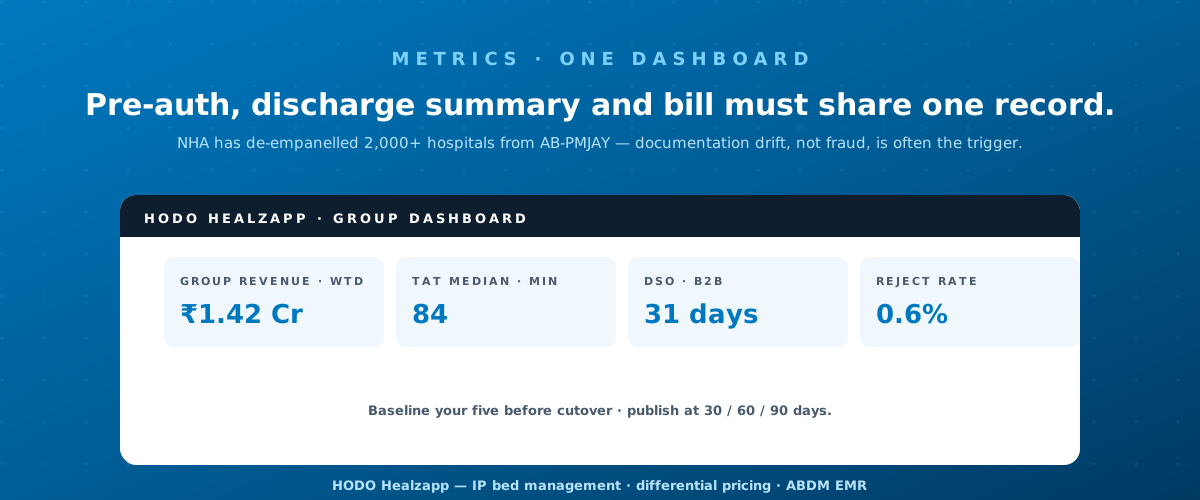
Pre-auth, discharge summary and bill must share one record.
Building an internal compliance loop before NHA does
The hospitals that have avoided the de-empanelment list are not the ones with better doctors, they are the ones running a concurrent internal audit before claims are filed. That usually means one dedicated auditor per 200 monthly PMJAY claims, sitting between the billing desk and the claims submission portal, checking pre-auth versus discharge versus bill on every file. It also means monthly random-sample audits of 5% of settled claims to catch drift patterns early. And it means an exception dashboard that flags admissions with unusually short length of stay, unusually high implant charges, or discharge summaries filed more than 24 hours after the physical discharge.
None of this requires new hires if the HIS surfaces the right exceptions. The compliance loop is not a policy binder, it is a workflow that runs every day in the billing office and every week in the medical records office. Hospitals that treat it as a project instead of a routine are the ones who make the news when NHA publishes its next de-empanelment tranche.
What this means for HODO customers
Hospitals running HODO Healzapp already have the primary documents on one timeline. Patient Management holds a single beneficiary record, the ABHA, PMJAY card and demographic data live in one place, which removes the mismatched-beneficiary category of audit failure. Billing is wired to the same EMR, so pre-auth, discharge summary and itemised bill draw from a shared clinical record instead of being retyped across systems, cutting the upcoding and contradiction risk that NHA auditors look for first. And the ABDM-compliant EMR means that when a claim is audited, the discharge summary produced is the same one shared to the ABHA-linked health record, with amendment history intact. For administrators watching the current enforcement cycle, the operational question is whether the HIS can survive a random-sample audit without a two-day file hunt.