Union Health Minister JP Nadda told the Lok Sabha this week that 2,359 hospitals have been de-empanelled from the Ayushman Bharat Pradhan Mantri Jan Arogya Yojana (AB-PMJAY) and another 1,200 suspended for violating scheme guidelines, according to a report by drugscontrol.org citing the National Health Authority. For hospital owners who count AB-PMJAY as a meaningful share of IP revenue, this is the largest single-year enforcement action the scheme has taken, and the audit patterns behind it are worth reading closely.
What actually triggered the action
The National Health Authority has moved past sample-based inspections and now runs triangulated audits, cross-checking hospital submissions against Aadhaar-linked beneficiary data, treatment package codes, discharge summaries and geo-tagged photographs. The commonest disqualification patterns cited in NHA communications are ghost admissions, upcoding of procedures, block-booking of packages the hospital is not equipped to deliver, and mismatch between the diagnosis on the pre-authorisation and the diagnosis on the discharge summary. A large chunk of the de-empanelments are also administrative, hospitals that failed to keep infrastructure declarations current, or could not produce the required specialist rosters during a physical audit. In several state batches, more than a quarter of the affected hospitals were suspended not for fraud but for documentation gaps. That distinction matters. Fraud is a legal exposure. Documentation gaps are an operational failure, and they are the failure most administrators can fix inside a single quarter, provided the HIS captures the evidence at the point of care rather than reconstructing it at claim-submission time.
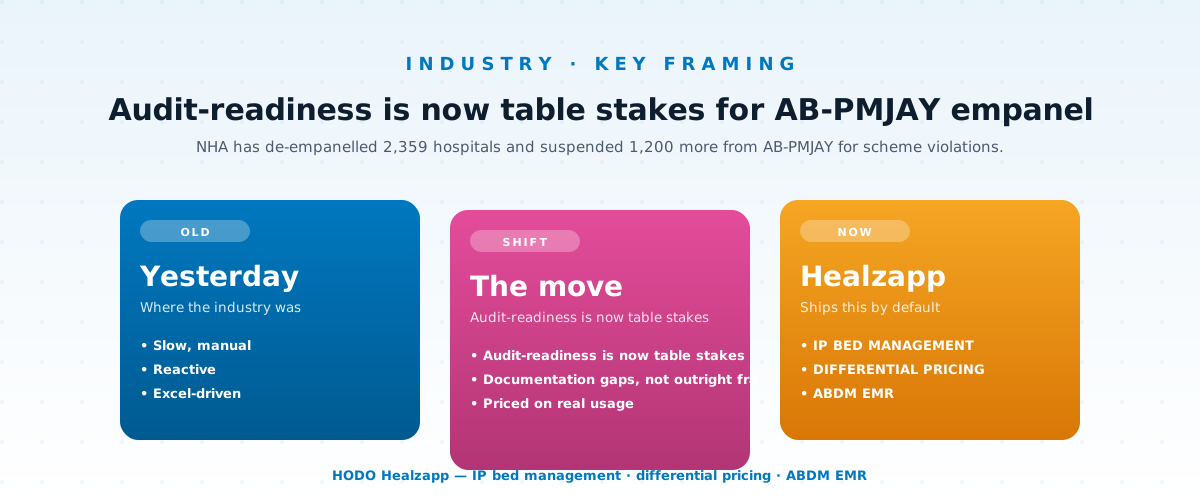
Audit-readiness is now table stakes for AB-PMJAY empanelment.
Where compliance quietly breaks down
Talk to any billing lead at a mid-sized empanelled hospital and the same pain points come up. The consulting physician's notes live in a paper file that reaches the medical records room three days after discharge. The pre-authorisation request is raised by a claims desk that has never seen the patient, using a diagnosis code the treating consultant would have written differently. The ICU stay is documented on nursing charts that are never digitised, so the length-of-stay claim cannot be defended if the NHA asks for hourly vitals. The OT register is a physical bound book, and the anaesthesia record is a separate sheet, neither reconciles with the surgical package that was billed. Every one of these is invisible on a good month. When the auditor lands, or when a random claim gets flagged, the hospital has fifteen days to produce a coherent evidence pack and usually cannot. This is where an HIS earns its licence fee, not by making claim submission faster, but by making the evidence trail so cheap to maintain that documentation is the default rather than the exception.
Documentation as the first line of defence
The regulatory shift is toward evidence-at-the-point-of-care. That means the consulting note, the nursing observation, the drug administration record and the discharge summary all need to be timestamped, user-attributed and stored in a form the NHA will accept without escalation. An ABDM-compliant EMR does more than tick the digital health record box, it produces the exact audit trail the scheme wants. Every entry carries a doctor's ID, a timestamp and a linkage back to the ABHA number of the patient. If the discharge summary is generated from structured EMR entries rather than typed up post-facto, the diagnosis on pre-auth and the diagnosis on discharge stay in lockstep by construction. Add to this the Nursing Station module, which forces vitals and medication entries to be logged in real time, and the ICU length-of-stay claim becomes defensible. Hospitals that still run parallel paper and digital records are the ones that get caught in audits, not because they are dishonest, but because their two record systems drift apart over any long admission.
Billing and pre-authorisation: the second exposure
Even with clean clinical documentation, the billing side has its own failure modes. Package selection is where most upcoding allegations begin, and it is usually not fraud, it is a coding clerk picking the highest-value package that plausibly fits, because there is no automated check against what the treating team actually did. Billing needs to be wired to the EMR so that the package proposed to the NHA is generated from the diagnosis and the procedure record, not typed independently by a claims desk. Differential pricing logic, running scheme rates, corporate rates and self-pay rates side by side without the biller having to remember which is which, cuts down on the second commonest audit finding, which is charging a patient co-pay on a scheme case. And Pharmacy and Inventory need to be integrated tightly enough that drugs issued during a scheme admission show up on the case sheet, not on a separate self-pay bill that later triggers a beneficiary complaint.
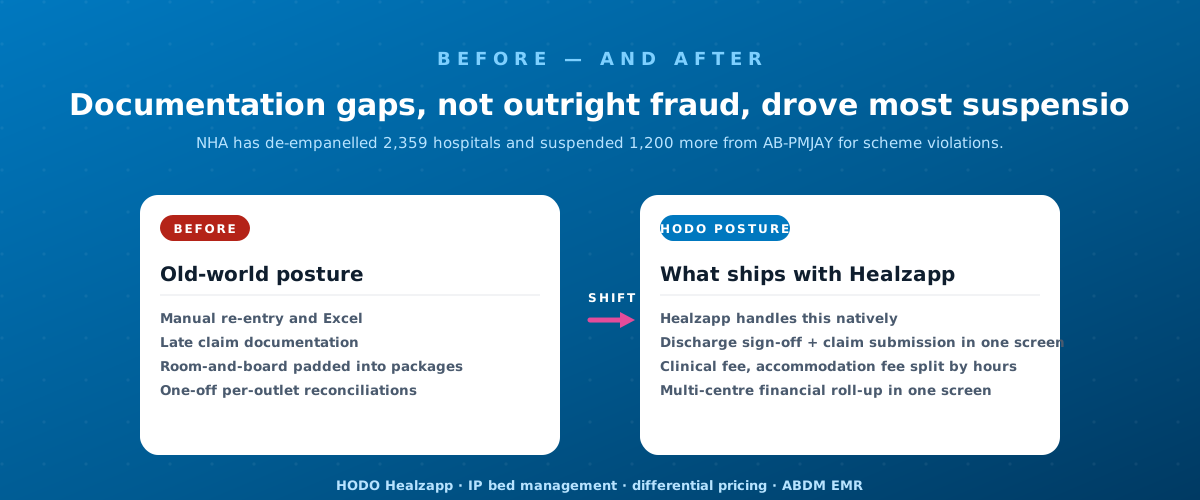
Documentation gaps, not outright fraud, drove most suspensions.
Multi-outlet chains: standardise or lose empanelment
For chains running five, ten or fifty outlets, the risk is not one bad hospital, it is that a single outlet's suspension cascades reputationally across the group. The NHA publishes de-empanelment lists by hospital name, and patients do not distinguish between a group's flagship and its newest acquisition. Chains need one HIS, one documentation SOP and one claims process across every centre, with the flexibility to onboard a new outlet without a six-month IT project. Standardised EMR templates, centralised claims oversight and a common package master are how a group of any size keeps its empanelment footprint intact. When the audit team walks into outlet number seventeen, they should see the same evidence structure they saw at outlet number one, otherwise the weakest centre defines the group's compliance posture.
What this means for HODO customers
Hospitals running HODO Healzapp already have the pieces this crackdown is testing for. The ABDM-compliant EMR gives the timestamped, user-attributed clinical record the NHA now expects, with discharge summaries generated from structured entries rather than typed after the fact. Billing is wired to the EMR so package selection reflects what was actually done, and Multi-outlet scale-up with one-click new-centre setup lets chains extend the same compliance posture to every new centre without rebuilding it from scratch. The de-empanelment wave is a filter, the hospitals that survive it will be the ones whose systems produce audit-ready records as a by-product of routine care, not as a scramble in the fortnight before an NHA inspection.