More than 2,000 hospitals have been de-empanelled from the Ayushman Bharat Pradhan Mantri Jan Arogya Yojana (AB-PMJAY) for violating scheme guidelines, ETV Bharat reported this week citing the National Health Authority. For hospital owners and administrators who depend on PMJAY volumes to keep beds occupied and cash cycles moving, the message is direct: empanelment is not a certificate you frame and forget. It is a live compliance posture that the NHA now audits with data.
What the National Health Authority actually did
The NHA action follows months of scrutiny that combined data analytics, field audits and beneficiary feedback. Hospitals were flagged for a mix of clinical and administrative violations, package upcoding, treatments that never happened, denial of care to eligible beneficiaries, poor infrastructure against empanelment norms, and, increasingly, gaps in the digital trail that PMJAY now demands. The 2,000+ number is not a one-off purge. State health agencies have been publishing periodic de-empanelment lists for the last two years, and the pattern is consistent: hospitals that treat PMJAY reimbursement as a paperwork exercise get caught by the data.
For the promoter of a 100-bed Tier-2 hospital, this is not an abstract regulatory story. PMJAY typically contributes 20-40% of the case mix in mid-tier private hospitals that serve semi-urban catchments. De-empanelment freezes pending claims, stops fresh referrals from the CSC-VLE network, and, depending on the state, can trigger a two-year cooling-off period. The financial hit is immediate. The reputational hit lingers, because the de-empanelled list is public and it circulates in every WhatsApp group of local health workers.
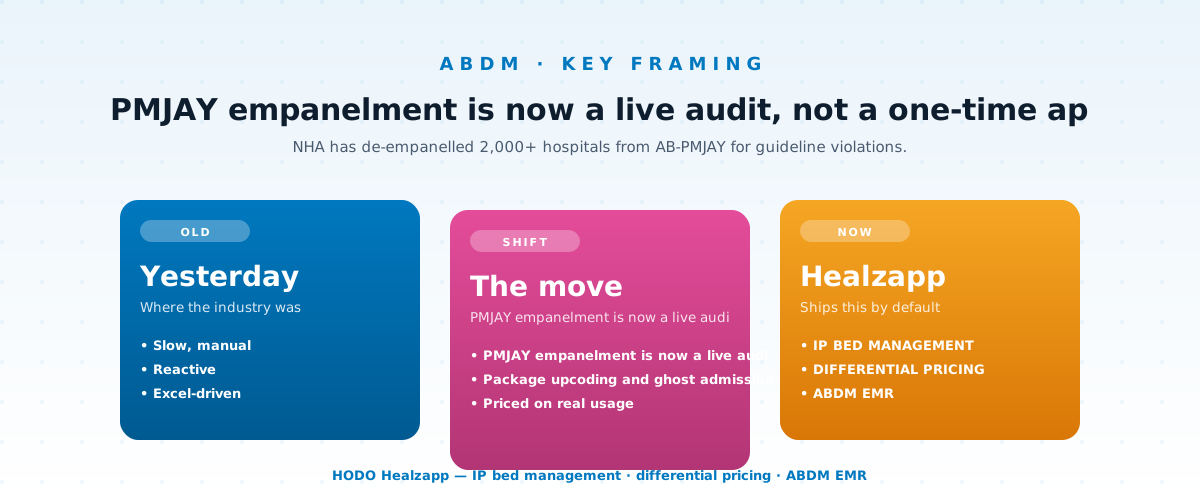
PMJAY empanelment is now a live audit, not a one-time approval.
The violations that keseq showing up
Across the various NHA and state agency notices, a handful of violations account for most de-empanelments. Package gaming, where a straightforward laparoscopic procedure is booked under a higher-priced open-surgery package, is the most cited. Ghost admissions, where a patient is billed for an inpatient stay that never happened, is the most punished. Denial of cashless care to eligible beneficiaries at the counter, often because the front desk is unsure of the package rate, ranks high in beneficiary complaints. Then come the infrastructure failures, an ICU without a functional ventilator on audit day, a blood bank tie-up that has lapsed, a cath-lab technician who has left without replacement.
The newer category, and the one operators underestimate, is documentation and digital compliance. The NHA now cross-checks TMS (Transaction Management System) claim data with ABDM-linked EMR records, discharge summaries, investigation reports, and photographic evidence of the patient in the ward. If the EMR does not carry a signed consent, if the discharge summary is a scanned handwritten note without ICD codes, if the investigation report is missing for a package that mandates it, the claim is queried, and repeat queries against the same hospital become a pattern that triggers a show-cause notice. Most hospitals do not fail one big audit. They accumulate small documentation debts across hundreds of claims and lose the empanelment on aggregate.
The cashflow shock nobody plans for
De-empanelment is not just a compliance event. It is a working-capital event. When the notice arrives, three things happen at once. Fresh admissions under PMJAY stop from the next working day. Claims already submitted enter an extended review, payment cycles that were running at 30-45 days can stretch to 90-120 days. And any claim that the audit surfaces as fraudulent gets clawed back, with penalties.
For a hospital where PMJAY was 30% of monthly billing, that is a sudden 30% revenue cliff, plus a receivables freeze on the last two months of PMJAY billing. Salary cycles, pharma vendor payments and equipment EMIs do not pause because the empanelment did. Promoters typically bridge the gap with short-term debt, but the interest cost erodes the margin that PMJAY was supposed to add in the first place. The re-empanelment process is not fast either. States require a fresh application, a corrective action plan, a physical re-inspection, and, for repeat offenders, a cooling-off period. Six to twelve months without PMJAY footfall in a catchment where the competition is also PMJAY-empanelled is enough to shift patient loyalty permanently.
Where the HIS earns its keep
Most of the violations that get hospitals de-empanelled are not medical decisions gone wrong. They are workflow gaps that a well-configured HIS should close by default. Package selection at the front desk should be tied to the ICD-10 provisional diagnosis and the procedure code, so counter staff cannot arbitrarily pick a higher-priced package. Consent capture at admission should be a blocking step, no admission slip prints until the digital consent is on file. Discharge summaries should be generated from the EMR, not typed after the fact, so the diagnosis, procedure, investigations and medications flow through without gaps.
The ABDM linkage is the newer control. Every PMJAY beneficiary should be onboarded with an ABHA number at the registration counter, and every clinical encounter, OP visit, IP admission, investigseq, discharge, should push a Health Information record to the ABDM gateway. This is what the NHA cross-references against the claim. A hospital that has been pushing clean ABDM records for the last six months has a defensible audit trail. A hospital that started ABDM only to satisfy the empanelment checkbox does not. The other under-used control is the audit log. Who cancelled a bill, who edited a discharge summary after submission, who overrode a package rate, every one of those actions should be timestamped and traceable to a user. When the NHA asks, the log is the answer.
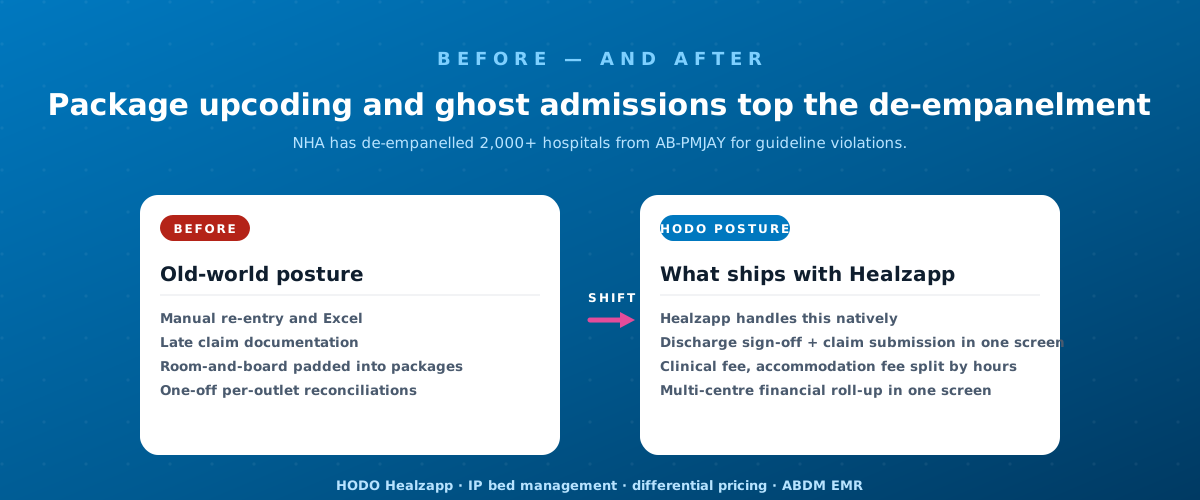
Package upcoding and ghost admissions top the de-empanelment list.
What this means for HODO customers
Hospitals running HODO Healzapp already have most of these controls sitting inside daily workflows, the question is whether the operations team has switched them on and made them mandatory. Three features are worth an internal audit this week.
ABDM-compliant EMR pushes each encounter to the ABDM gateway with the ABHA linkage, so the digital trail the NHA now cross-checks is built passively as clinicians work, not scrambled together at audit time. Confirm that OP, IP, discharge and investigation events are all firing, not just the registration event.
Billing and IP bed management together close the ghost-admission and package-gaming loopholes: bed allocation, nursing notes, medication administration and discharge trigger from the same patient record that the bill draws from, so a claim without a matching bed occupancy record cannot be raised.
For chains scaling to new outlets, Multi-outlet scale-up with one-click new-centre setup replicates the same compliance configuration to every new unit, so a new centre does not become the weak audit link that pulls the group's empanelment down with it.