ETV Bharat, citing National Health Authority sources, reports that the government is planning to expand the list of AB-PMJAY packages reserved for public hospitals from 23 to 112. On paper that is a public-sector allocation decision. In practice it reshapes case mix, claim volume and payer mix for every ~100-bed private hospital and lab chain that runs a meaningful share of its revenue through PM-JAY and TPA channels.
What the NHA signal actually says
The report describes an expansion of the reserved package list under Ayushman Bharat PM-JAY, from 23 procedure packages to 112. Reserved means those packages are to be claimed by government facilities, with empanelled private hospitals either excluded or admitted only by exception — typically where no capable public facility exists in the district. At the time of writing this is sourced to NHA officials rather than a published notification, and the exception criteria are not spelt out. It should be read as a direction of travel, not a settled rule.
Reserved lists are not new to PM-JAY. Earlier versions of the Health Benefit Package already carved out a small set of procedures for public facilities, mostly low-complexity, high-volume work that government hospitals could absorb without displacing anyone. Moving from 23 to 112 is a different order of magnitude. It signals that the scheme intends to push routine surgical and medical volume back into the public system and keep private empanelment concentrated on complexity that the public network cannot deliver at scale.
For a private hospital, the operational question is not political. It is simply this: which of the packages currently carrying the IP block are in the likely reserved set, and what replaces them in the bed-day plan if they go.
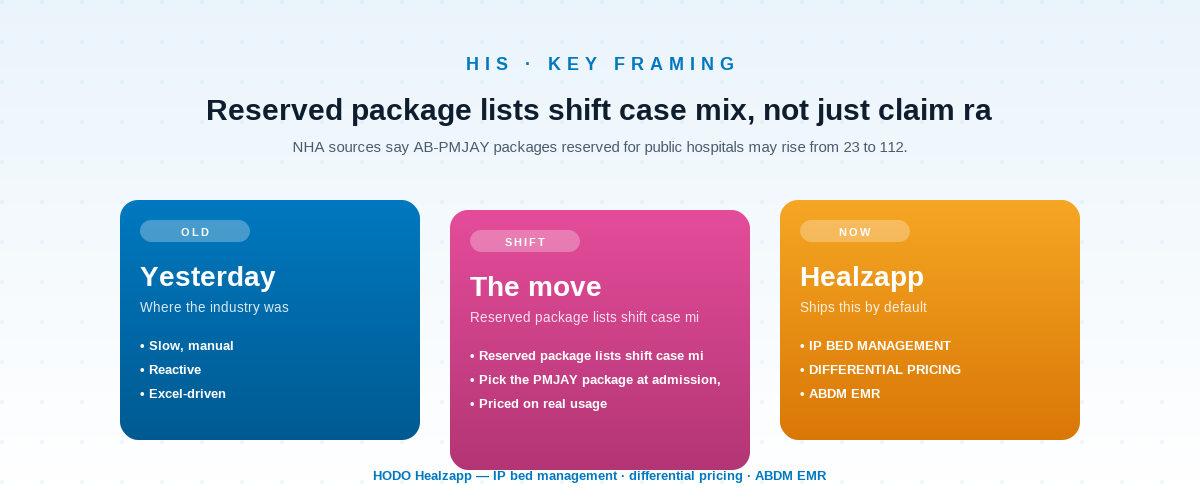
Reserved package lists shift case mix, not just claim rates.
Why a public-hospital list matters to private 100-bed hospitals
Most ~100-bed hospitals that depend on PM-JAY do not depend on it evenly. A handful of packages — commonly general surgery, obstetrics, ortho trauma, dialysis and medical management lines — carry the bulk of scheme admissions, and the rest of the empanelled list contributes marginally. If even three or four of those high-volume lines shift to reserved status, the hospital loses occupancy in a predictable band of beds and keeps every rupee of fixed cost attached to them.
The hospitals that absorb a change like this without drama are the ones that already know their occupancy and margin by package, by payer and by consultant. That is a reporting problem before it is a strategy problem. If the admission record stores the scheme package code against the IP episode, the exercise is a query. If package codes live only in the claim file maintained separately by the insurance desk, then nobody can answer what proportion of bed-days sits on a reserved-risk package, and the planning conversation stalls.
Lab chains and radiology networks feel the same shift one step downstream. Scheme admissions pull investigation volume with them. When an inpatient package moves out of the private network, the attached pathology and imaging workload moves with it — and the fixed cost of a machine does not.
The claims desk decides whether the rate is real
Package rate is a quoted number. Realised rate is what survives pre-authorisation, documentation scrutiny and deduction. As the reserved list widens, the packages left in private hands skew towards higher complexity — and higher complexity means more pre-auth queries, more implant and consumable justification, and more scope for partial disallowance.
Three claim-desk disciplines separate hospitals that collect from hospitals that chase. First, package selection at admission rather than at discharge, so the clinical documentation is built for the package being claimed instead of being retro-fitted to it. Second, a documentation bundle assembled as care happens — investigation reports, implant invoices, operative notes, discharge summary — rather than reconstructed from paper a week later. Third, an ageing view of submitted claims by payer, with rejection reasons coded and counted, so the same deduction reason does not repeat for six months unnoticed.
Hospitals running PM-JAY alongside four or five TPAs, a corporate panel and cash patients cannot do this on spreadsheets at any scale. The billing layer has to hold payer-specific rate tables, so that the same procedure prices correctly for a scheme patient, a corporate patient and a cash patient without the front office deciding it manually. That is a configuration question, and it is worth settling before the package list changes, not after.
Costing per bed-day, per package, per month
A reserved-list expansion is ultimately a repricing event. Beds freed from scheme admissions have to be refilled with cash, corporate or insurance work at a different rate and a different length of stay, and the hospital needs to know which of those is worth chasing. That requires cost per bed-day at ward level, not a hospital-wide average — which in turn requires pharmacy issues, consumables, investigations and OT time all posting to the same episode.
The same arithmetic applies to the lab side. Cost per test only becomes a decision input when reagent consumption, machine throughput and repeat rates are tracked against the test, and when partner and referral volumes are priced separately from walk-in volumes. A lab chain that discovers it has been running scheme-linked panels below cost usually discovers it from an annual audit. It should be visible monthly.
None of this is new advice. What the NHA report changes is the cost of not having it. A hospital that can model the margin effect of losing a package in an afternoon can renegotiate its consultant mix, its OT calendar and its corporate panel strategy while the notification is still in draft. A hospital that cannot will react after the quarter it loses.
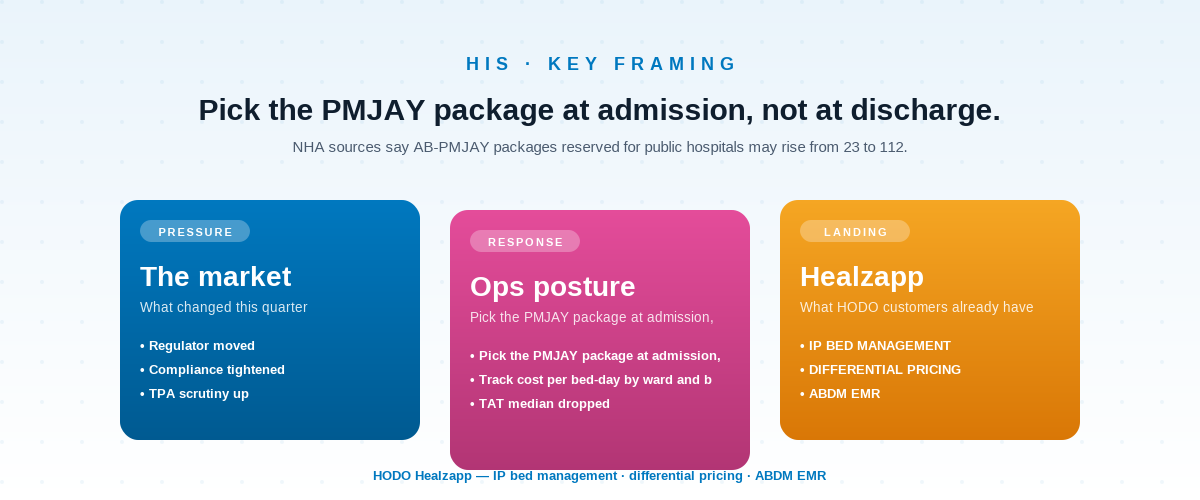
Pick the PMJAY package at admission, not at discharge.
Documentation that survives an audit
Scheme audit intensity tends to rise alongside scheme spending discipline. The practical defence is boring: complete, time-stamped, retrievable clinical records tied to the episode being claimed. Discharge summaries that reflect what was actually done. Investigation results attached as machine output rather than typed by hand. History that a reviewing clinician can read in a minute instead of reconstructing across twelve visits.
Hospitals with ABDM alignment already in place have an advantage here, because the record structure and consent trail demanded by ABDM overlap heavily with what a scheme auditor wants to see. Those still running a legacy HIS with clinical notes in free text and investigations in a disconnected lab system will carry audit exposure into a period when scrutiny is tightening. HIS replacement decisions that have been deferred for two years are easier to justify in that light.
What this means for HODO customers
HODO Healzapp was built for exactly this payer complexity. Billing holds payer-wise rate structures with Differential pricing, so scheme, TPA, corporate and cash rates coexist without the front office improvising at the counter. IP bed management gives occupancy and length-of-stay visibility by ward and by payer, which is the input a reserved-package shift actually demands. ABDM-compliant EMR keeps clinical documentation structured, time-stamped and retrievable for audit, with Machine Interfacing pulling analyser and imaging output into the same episode record instead of a parallel file.
A ~100-bed hospital with these three in place can answer the reserved-list question with a report rather than a committee. That is the whole difference between planning for a policy change and reacting to it.