ET Government reports NHA CEO RS Sharma putting the Ayushman Bharat Digital Mission's integration count at more than 800 healthcare providers — hospitals, labs, clinics and digital health companies wired into the national health stack. For operators still running pre-ABDM software, that figure is less a milestone and more a benchmark. The useful question is not whether 800 is a large number, but what the 801st integration costs and what it actually changes on the floor.
What the 800-provider figure counts — and what it does not
The integration count is drawn from providers that have cleared ABDM's certification milestones and registered in the Health Facility Registry. It is an infrastructure number. It says nothing about how many ABHA addresses a given facility links per day, how many diagnostic reports are published as FHIR bundles, or how many consent requests are honoured inside the stipulated window. A hospital can be fully integrated and still be publishing records for under five per cent of its outpatient footfall.
That gap matters because the operational benefit of ABDM — a patient arriving with linked history instead of a plastic bag of old films — only shows up at volume. Below a threshold, the registration desk is doing extra work for no clinical return, and staff quietly route around it.
So the first checklist item for any operator is an internal audit, not a vendor call. Pull three numbers for the last 30 days: ABHA created at registration, ABHA linked to an existing record, and health records successfully pushed per OP visit. If the third number is in low single digits as a percentage, the problem is workflow design, not certification status.
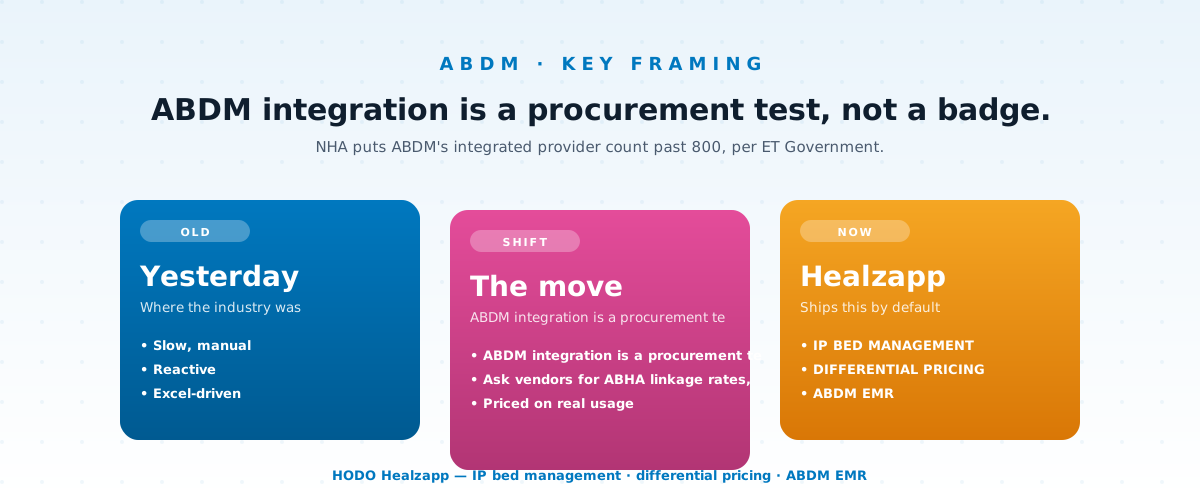
ABDM integration is a procurement test, not a badge.
ABDM compliance is a procurement clause, not an IT project
Most HIS vendors in India now claim ABDM readiness. The claim is cheap, because the certification sandbox is forgiving and production behaviour is not. Three distinctions are worth writing into a purchase order.
First, sandbox certification versus live production traffic. Ask for the production client list and the aggregate record-push volume, not the certificate PDF. HODO sits among the first 20 ABDM-integrated HealthTechs in India and is NRCeS listed — a starting point for diligence rather than the end of it, and the same diligence belongs on every shortlisted vendor.
Second, who owns registry hygiene. Health Facility Registry and Healthcare Professional Registry entries drift: doctors leave, departments change, a new centre opens. If the contract does not say who updates HFR and HPR, nobody does, and consent requests start failing for reasons the IT team cannot see.
Third, failure handling. ABDM calls fail — gateway timeouts, expired tokens, mismatched demographics. A system that silently drops failures produces a compliance figure that looks fine and a record trail full of holes. Insist on a retry queue and an exception report a front-office supervisor can read without help.
Where it breaks: the registration counter and the OP queue
A 100-bed hospital running 350 to 600 outpatients a day measures its registration desk in seconds per patient. ABHA capture loses when it is a separate screen reached after billing. It survives when it sits inside the same registration form the clerk already fills — scan-and-share QR first, mobile-OTP fallback second, skip with a reason code third.
The reason code is the detail that decides adoption. If clerks can skip without explanation, the skip rate climbs to whatever queue pressure demands, and no supervisor can tell whether the cause is patient refusal, a network outage or poor training. A mandatory skip reason turns an invisible problem into a daily report.
The second detail is where the patient is standing. Consent and linkage conversations go badly at a crowded counter and reasonably well in the waiting area, which argues for moving linkage into a token-based flow after registration rather than before it. Hospitals already running token displays and a patient-facing app have somewhere sensible to put that step.
None of this is ABDM-specific engineering. It is ordinary OP flow discipline, which is why hospitals with clean queue management often post better linkage rates than better-funded peers with messier counters.
Diagnostics and referrals carry a second load
Diagnostics is where ABDM record volume is easiest to generate and most often missed. An in-house lab produces far more discrete documents than the IP unit, and a lab report is a simpler artefact to publish than a discharge summary. Yet many hospital labs publish nothing, because the result leaves the analyser, becomes a PDF, goes out on WhatsApp and never passes through the layer that would publish it.
The fix is structural. Analyser output should enter the system as structured results rather than an attached image, which makes machine interfacing a prerequisite for ABDM reporting rather than a separate efficiency project. Once results are structured, publishing becomes a configuration decision.
Referral and outsource flows need the same attention. Samples sent to a reference lab, and reports coming back from one, belong in the same patient record as in-house results — otherwise the linked history has gaps exactly where the expensive tests sit. Operators running corporate tie-ups and referral doctors should check whether partner-originated reports reach the record at all, and whether partner pricing is being applied consistently while that data flows.
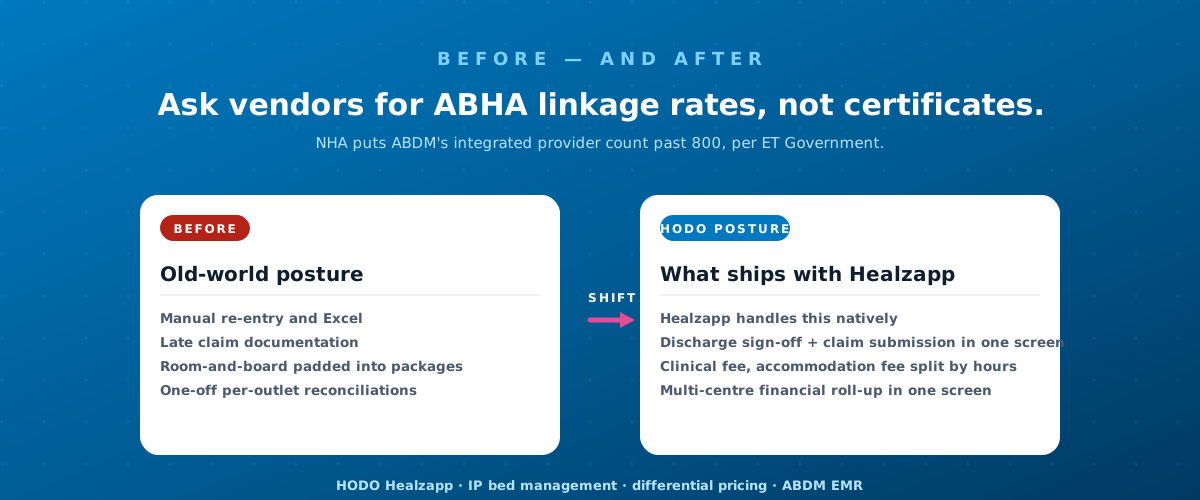
Ask vendors for ABHA linkage rates, not certificates.
The replacement decision: cashflow first, ABDM as tiebreaker
ABDM rarely justifies a HIS replacement on its own. Cashflow does. A 100-bed hospital with PMJAY and TPA exposure usually has more money stuck in claim rework than it will ever save on digital record exchange, and the board will read the business case accordingly.
The honest framing is that ABDM is the tiebreaker. When two systems are being compared on claim turnaround, bed occupancy visibility and pharmacy leakage, native ABDM behaviour settles it — because retrofitting the national stack onto a legacy system through a middleware bridge produces precisely the silent-failure pattern described above, and because the next round of mandates will assume the integration is already there.
Multi-outlet operators have a sharper version of the same calculation. Every new centre needs its own HFR entry, its own licence linkage and its own staff trained on the same registration flow. Chains that treat a new centre as a configuration event get through this cheaply; chains that re-implement per location pay the integration cost again and again. Ask each shortlisted vendor how long a second and third centre takes to bring live — then ask an existing customer the same question separately.
What this means for HODO customers
The 800-provider figure sets a floor, not a target. The operators who will benefit are the ones whose daily registration, lab and referral flows push records without anyone remembering to. In HODO Healzapp, that starts with ABDM-compliant EMR built into the same patient and OP flow the front office already uses, so linkage is a field in an existing form rather than an extra screen after billing. Machine Interfacing carries analyser results in as structured data, which is what makes lab reporting publishable instead of a PDF nobody can parse. And for chains, Multi-outlet scale-up with one-click new-centre setup keeps each additional location a configuration task rather than a fresh integration project, with B2B Referral / Outsource Lab / Corporate-partner logins keeping partner-originated reports inside the same record.