An OC Academy explainer circulating this week makes the case that the real payoff of the Ayushman Bharat Digital Mission is not the registration count but the data itself — longitudinal records that travel with a patient across facilities, and aggregate signals that planners and payers can act on. For diagnostic labs that framing is sharper than it first appears. Once a report stops being a PDF the lab hands over and becomes a record another clinician reads nine months later, the quality of a lab's data turns into an operational liability rather than a reporting formality.
Labs produce most of the structured data in a health record
Discharge summaries and prescriptions get the attention in ABDM conversations, but the bulk of machine-readable clinical data in any linked record comes from diagnostics. A mid-sized pathology lab running 3,000 to 5,000 reports a month is publishing tens of thousands of individual analyte values, each with a unit, a method and a reference range attached. Under the old model those values lived inside a PDF, were read once by the referring doctor, and then effectively disappeared. Under a data exchange model they persist, get compared against results from other labs, and are read by people who have never spoken to the lab that produced them.
That shift changes where the risk sits. A typing error in a haemoglobin value used to be caught by a doctor who knew the patient and called the lab. In a linked record the same error becomes a data point in a trend line, and the lab that produced it is not in the room when it is interpreted. Labs that treat ABDM participation as a compliance checkbox — register as a health information provider, publish the PDF, move on — will find that their internal data hygiene is now visible to everyone downstream. The labs that benefit are the ones whose LIMS already produced clean structured output for their own partner and corporate business.
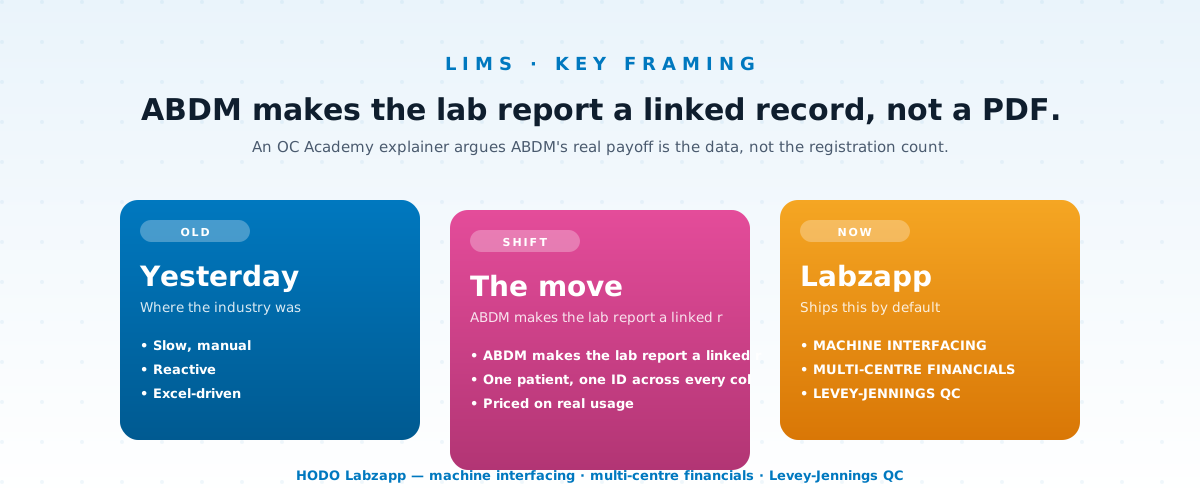
ABDM makes the lab report a linked record, not a PDF.
Identity breaks before data does
The most common failure in Indian lab chains is not wrong results. It is wrong patients. A single individual gets registered at the Thrissur collection centre with one mobile number, at the Kochi centre with a spouse's number, and at a camp with no number at all. Three internal patient IDs, three partial histories, and nothing to stitch them together. Linking an ABHA number to one of those three records does not fix the other two; it simply makes one fragment official.
Before worrying about ABDM linkage, labs should fix the registration desk and the franchise network. Practical steps: enforce de-duplication on mobile plus date of birth at the point of registration rather than cleaning up monthly; make the barcode the binding between sample and patient record, not a printed slip that can be re-stuck on the wrong vial; and reconcile registrations from franchisee-run collection centres into the central master daily, not at month-end when billing is being closed. Chains that run differential pricing per partner have an added reason to care — a duplicate patient record usually means a mis-applied rate card as well as a broken history. Identity discipline is unglamorous work, and it determines whether anything built on top of it holds.
A PDF is not data
Plenty of labs still have technologists reading values off an analyser screen and typing them into a form. That workflow produces a correct-looking report and an unreliable dataset. Transcription introduces errors at a rate that is tolerable when a human reads the report in context and intolerable when a machine compares it against a previous value from another lab. Direct machine interfacing removes the keystroke, carries the unit and method with the value, and leaves an audit trail of what the instrument actually reported.
Reference ranges deserve the same attention. When two labs report the same analyte against different ranges and neither range travels with the result, a stable patient can look like a deteriorating one in a longitudinal view. Labs should audit their master test catalogue for range, unit and method consistency across centres before they publish at scale, because corrections are far harder once results are sitting in records the lab does not control. Running Levey-Jennings QC on analysers is the other half of this: a value that is permanent and comparable had better be defensible. Quality control stops being an accreditation exercise and starts being the thing that keeps a lab's published data credible.
Outsourced tests still need provenance
Almost every Indian lab chain sends specialised work out — histopathology, molecular panels, rare hormone assays — to a reference lab, and almost every one of them reports the result under its own letterhead. That is normal practice and commercially sensible. It becomes a problem when the record is permanent and someone downstream needs to know which facility actually performed the assay, on which platform, under which accreditation scope.
The operational answer is to track the outsourced leg properly inside the LIMS rather than in a WhatsApp group and an Excel sheet. Partner-lab integration with anonymised sample tracking keeps the referral commercially confidential while preserving a clean internal chain of custody — which sample went where, when it was dispatched, when the result came back, and what was billed. That record is what lets a lab answer a query about a two-year-old report without a phone call to a vendor it may no longer work with. It also exposes the partner who routinely runs four days late, which is a rate-negotiation fact as much as a quality one.
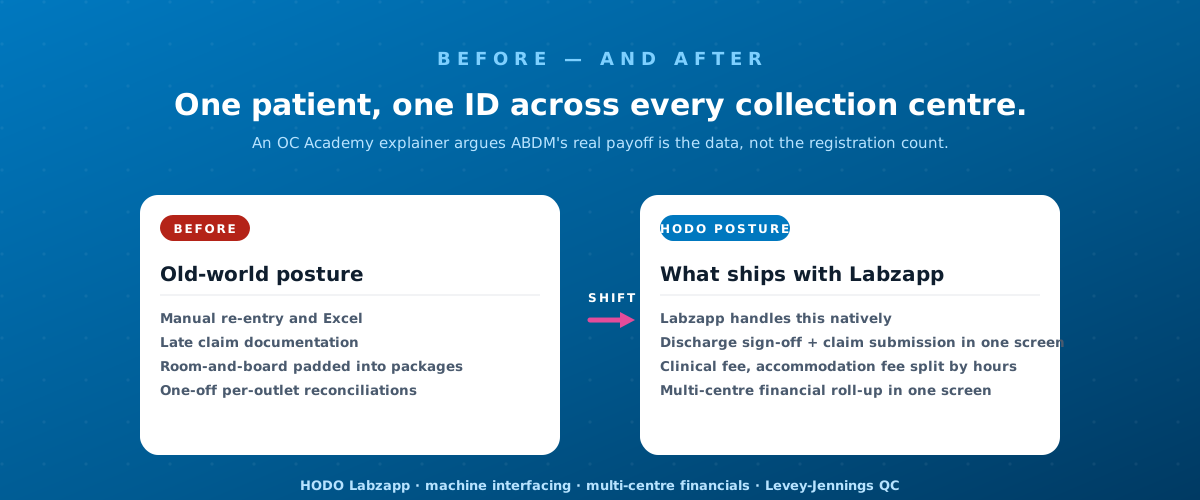
One patient, one ID across every collection centre.
Repeat tests, turnaround time and the revenue question
There is a commercial edge to data exchange that lab owners raise quickly and operators often dodge: if a consultant can see a complete blood count done eleven days ago at another lab, they may not order another one. Reduced duplicate testing is explicitly one of the stated benefits of a shared health record, and duplicate testing is real revenue for labs today. Pretending otherwise is not a strategy.
The realistic responses are operational. First, compete on turnaround time and reliability rather than on the referring doctor's lack of information — which requires TAT reporting that measures registration to report release per test and per centre, not an average that hides the slow 10%. Second, shift mix towards panels, preventive packages and corporate or partner volume where the buyer is contracted rather than incidental. Third, hold cost per test down as volume per patient flattens, which means watching reagent consumption, repeat-run rates and sample rejection as closely as top-line billing. Multi-centre financials that show contribution per centre and per partner make those decisions arguable instead of anecdotal. Labs with disciplined unit economics will absorb a dip in duplicate volume; labs running on it will not.
What this means for HODO customers
HODO was among the first 20 ABDM-integrated healthtechs in India and is NRCeS listed, so the integration plumbing is settled work. The harder part sits upstream in the lab, and that is where Labzapp is built to help. Barcoded samples bind the specimen to the right patient record from collection onward, including at franchisee-run centres. Machine interfacing removes manual transcription so published values carry the instrument's own output, units and method. Partner-lab integration with anonymised sample tracking keeps outsourced work auditable without exposing commercial relationships, and TAT reporting turns turnaround from a claim into a measured number per test, per centre and per partner. Together with automated SMS/WhatsApp/Email report delivery and multi-centre financials, that gives a lab chain data clean enough to publish and detailed enough to run on.