The National Health Authority has signed memoranda of understanding with IISc, IIT Kanpur and other institutions to advance BODH, its health data and analytics effort, as reported by Medical Buyer. The partners are being brought in to build research and modelling capability on top of the digital health records that hospitals and labs are already generating. For a 100-bed hospital or a regional lab chain, the consequence is narrow and specific: the records leaving your HIS are no longer only a compliance artefact. They are input to something that will be examined.
Research capacity is being built on data hospitals already send
ABDM has largely finished its registration phase. ABHA numbers exist in the hundreds of millions, health facility and professional registries are populated, and a long list of HealthTechs, HODO among the first twenty integrated, have been pushing records through the gateway for a few years now. What has been missing is serious analytical capacity on the other side of that pipe. Tie-ups with institutions of this calibre are a signal that the aggregate is about to be studied properly: cohorts, outcomes, utilisation patterns, regional variation.
Nothing in this changes a hospital's contractual obligation. No new module has to be purchased, no fresh certification is due. What changes is that the contents of the records being transmitted acquire an audience. A discharge summary that passes schema validation but contains a scanned image, a lab result with no units, a prescription with brand names and no salt, these have always been poor practice. They were simply invisible. Once analysis begins at scale, poor structure stops being invisible and starts being the reason a facility's data contributes nothing.
ABDM is now a data quality job, not a compliance tick-box.
The gap between ABDM-compliant and ABDM-useful
Most hospital IT teams treat ABDM as a binary. Either the integration works and bundles are accepted, or it does not. That is a reasonable way to run a go-live. It is a poor way to run the following three years.
A technically compliant record is one that the gateway accepts. A useful record is one where the diagnosis carries a code rather than a doctor's shorthand, the analyte is mapped to a standard identifier rather than the lab's internal test name, dosage and frequency are separate fields rather than one free-text line, and the whole bundle is attached to the correct ABHA rather than to a second profile created at the counter last Tuesday.
The distance between those two states is where most Indian hospitals currently sit. A valid FHIR wrapper around a PDF is the most common pattern in the market, and it is understandable, it is the fastest route to a successful integration certificate. It also produces a record that no analytical system can read. If a hospital wants its participation in national digital health to eventually translate into anything, benchmarking, payer negotiation, research collaboration, specialty case-mix evidence, the structure has to be real, and it has to be created at the point of capture. Nothing can be retrofitted later from a scanned summary.
Four places a 100-bed hospital leaks data quality
In practice, the damage happens in four predictable spots, and all four are front-desk and ward problems rather than IT problems.
Registration. The same patient arrives as a walk-in OP case in March, an IP admission in July and a lab-only visit in September, and acquires three UHIDs. Every downstream linkage breaks. Longitudinal history, which is the entire point of an ABHA-linked record, becomes three fragments. Deduplication has to happen at the moment of capture, mobile number, name phonetics, date of birth checked before a new ID is issued, because reconciliation afterwards is manual and never gets done.
Second, the discharge summary, typically typed at 11 pm by whichever resident is free, in prose, with the diagnosis stated as a phrase. If the system does not force a coded primary diagnosis at that moment, it will never be coded.
Third, lab results entered by hand from an analyser printout. Transcription errors aside, manual entry loses units, reference ranges and flags, and the result arrives as a number in a text field. Direct analyser interfacing removes the problem entirely rather than policing it.
Fourth, pharmacy and prescription data recorded as brand names with no generic mapping, which makes the record unreadable to anyone outside the hospital and unusable for any utilisation study.
Labs carry the heaviest structured-data load
By record volume this is mostly a laboratory story. A 100-bed hospital generates perhaps forty discharge summaries a week and several thousand individual test results. A lab chain running six collection centres against one processing hub generates far more. Diagnostic data is also the easiest to structure well, because analysers already emit structured output, the only question is whether the LIMS consumes it or whether a technician retypes it.
Labs that have barcoded samples end-to-end, analysers interfaced directly, and TAT measured per test rather than per report are already producing research-grade output almost as a side effect. Those running on spreadsheets and manual entry are producing records that will be excluded from any serious dataset. The gap widens for chains with partner-lab arrangements, where outsourced tests return as PDFs from the reference lab and get attached to the patient record as an image. If a meaningful share of a chain's menu is outsourced, that is a meaningful share of its data contribution lost, unless partner integration pulls results back as data rather than paper.
Report delivery over WhatsApp or SMS is convenient and patients like it, but it should not be confused with structured transmission. One is a patient service, the other is the record.
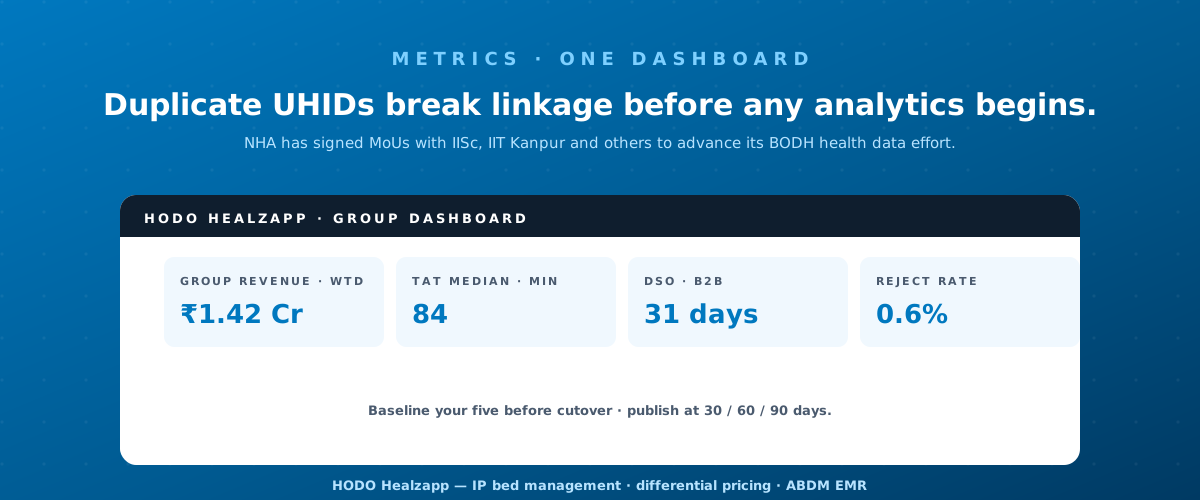
Duplicate UHIDs break linkage before any analytics begins.
A monthly data review that takes twenty minutes
This does not need a project. It needs five numbers reviewed once a month by one named person, usually the medical records officer or the quality lead already preparing NABH documentation.
Duplicate patient ratio, new IDs created for patients who already existed. ABHA linkage rate, what share of registrations carry a verified ABHA. Interfaced result share, results arriving from analysers versus typed in. Coded diagnosis share, discharge summaries leaving with a coded primary diagnosis. Bundle rejection rate, records the gateway refused, and why.
Each of these is a single query against the HIS. Each one has an obvious owner and an obvious fix. A hospital that moves interfaced result share from 40 per cent to 90 per cent over two quarters has improved its data contribution more than any policy document will, and has also removed a transcription risk that NABH assessors ask about anyway. The same discipline applies when a group opens its third or fourth centre: whatever capture standard the new unit inherits on day one is the standard it will keep.
What this means for HODO customers
The BODH tie-ups do not create a new compliance deadline. They change what good looks like. Hospitals and lab chains whose records are structured at source will have something to show when benchmarking and research access arrive; those sending valid wrappers around images will not.
Healzapp's ABDM-compliant EMR handles the India-specific transmission layer, but the more consequential pieces sit upstream of it, Machine Interfacing, which takes analyser output into the record without a technician retyping it, and Patient Management, where duplicate identities are caught at the counter rather than reconciled a year later. For clinicians working with long histories, EMR (AI-condensed history) makes a well-structured record worth reading at the bedside, which is what sustains the discipline. For groups scaling outlets, Multi-outlet scale-up with one-click new-centre setup carries the same capture rules into every new unit instead of letting each one invent its own.