Jammu & Kashmir's Chief Secretary this week directed officials to accelerate the creation of comprehensive digital health records for every citizen under the Ayushman Bharat Digital Mission, per thenorthlines.com. The instruction is a state-level signal, but the operational load lands on private hospitals, clinic chains and diagnostic centres that are expected to push linked records into the ABHA-based Personal Health Record. For hospital owners and MDs, the question is no longer whether ABDM adoption matters, it is whether the front office, EMR and discharge workflow are set up to produce a linkable record on every visit without adding steps for the receptionist or the consultant.
What the directive actually asks operators to do
The Chief Secretary's brief covered ABHA number creation, verified linkage of records, and a district-wise dashboard of coverage. When state administrations start tracking coverage numerically, empanelled hospitals become the reporting unit, coverage is measured through the facilities that create and link records, not through citizens who walk in and sign up on the app. That reframes the ask. Every OP registration desk, every IP admission clerk and every diagnostic reception counter is now, effectively, an ABDM data entry point.
The practical implication: if ABHA capture is a separate screen after the patient is already registered, it will not happen at scale. Front-office staff optimise for queue length. A hospital that wants to hit 80%+ ABHA linkage needs the ABHA field embedded in the first registration form, with a fallback to on-the-spot creation using Aadhaar or mobile OTP. Anything that adds a second workflow will be quietly skipped during peak hours, and the linkage percentage the state dashboard shows will not move.
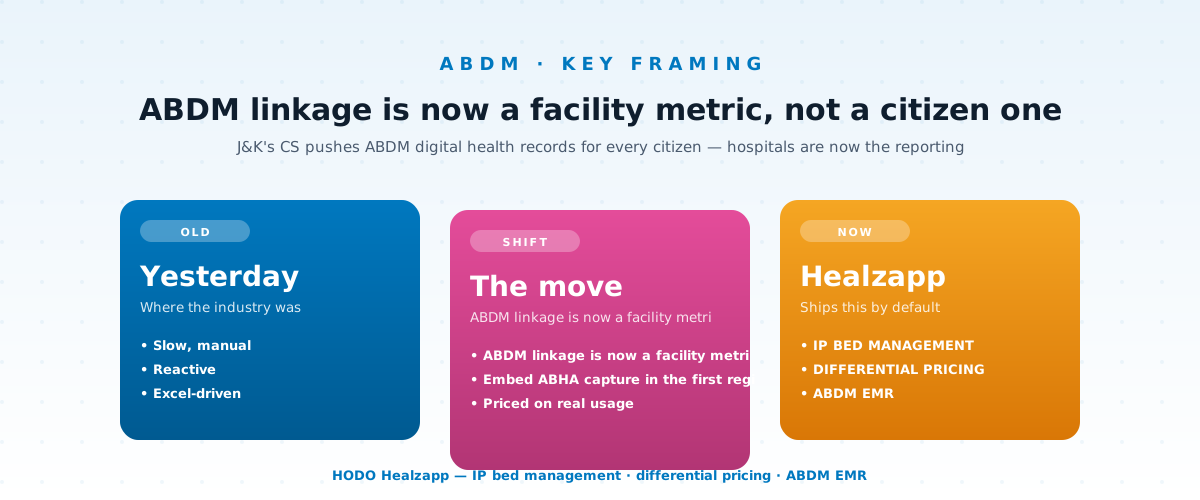
ABDM linkage is now a facility metric, not a citizen one.
Why linkage is harder than record creation
Creating an ABHA number takes under a minute. Linking every subsequent encounter, OP consult, lab report, radiology image, discharge summary, to that same ABHA and pushing it to the Health Information Exchange is where most hospitals stall. This is a HIS architecture problem, not a policy problem.
Three failure patterns are common. First, the ABHA field is captured only at first registration and does not propagate to lab orders, so pathology reports never get linked to the citizen record. Second, the discharge summary is generated as a scanned PDF outside the EMR, so there is no structured document to push into the exchange. Third, the consent artefact is stored on paper, so any pull request from another provider gets rejected at the consent manager. Operators need a HIS where ABHA capture at registration writes down to every downstream module, orders, results, prescriptions, discharge, with a single ABDM consent framework governing every push.
The consent and audit trail question boards will ask next
Once state health authorities publish coverage dashboards, the follow-on question is data governance. Auditors and boards will want to see who accessed which record, under which consent artefact, for how long, and for what purpose. Hospitals that treat ABDM as a marketing badge, 'we are ABDM-integrated', without instrumenting consent logs will fail the first serious audit.
For a 200-bed hospital, this is not hypothetical. Insurance TPAs, corporate wellness partners and referring doctors all pull patient data. Each pull needs a consent artefact tied to the ABHA number, a purpose code, and a retention window. If the HIS cannot produce that log on demand for a random sample of 50 discharges, the hospital is exposed. The MD's monthly review pack should include a consent-log audit report alongside the linkage percentage, not instead of it.
The cost-per-record math operators should run
There is a business case buried in this that most CFOs miss. A linked longitudinal record reduces repeat investigations. Anecdotal data from ABDM sandboxes suggests 8-14% of outpatient investigations are duplicative because prior reports are not accessible at the point of consult. In a diagnostic chain doing 3,000 tests a day, even a 5% reduction in redundant tests moves the P&L, but only if the referring physician can actually pull the prior report during the consultation.
That pulls TAT and report-delivery infrastructure into the ABDM conversation. If the lab publishes reports only as PDFs sent by email 12 hours later, the referring doctor will re-order the test rather than wait. Structured, ABDM-linked reports delivered inside the consultation window are what actually close the loop. The MD who wants ABDM to pay for itself needs to measure the gap between report finalisation and clinician access in minutes, and target that number aggressively.
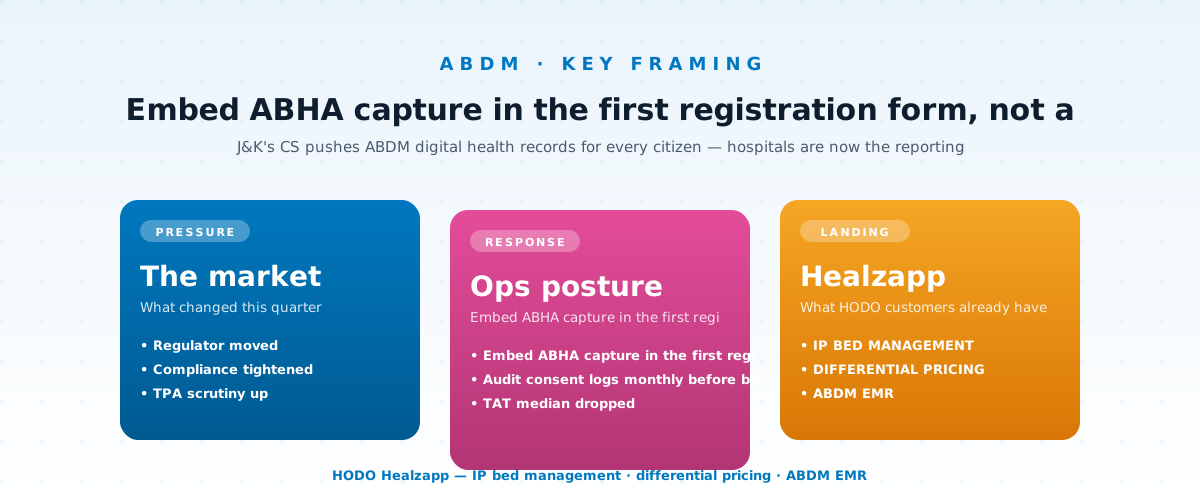
Embed ABHA capture in the first registration form, not a second screen.
What multi-outlet chains need to plan for now
For clinic chains and diagnostic groups scaling to new outlets, ABDM readiness has to be baked into the new-centre setup checklist. Every new outlet needs the HFR (Health Facility Registry) ID linked, the HPR (Health Professional Registry) IDs of consulting doctors mapped in the HIS, and the consent manager endpoints configured before the first patient walks in. Retrofitting this across 20 outlets is painful; doing it once at rollout is trivial.
The corollary is vendor selection. Any HIS or LIMS RFP written in 2026 without ABDM linkage, HFR/HPR mapping, structured discharge summary generation and consent artefact storage as line-item requirements is a legacy RFP. Ask vendors for a live demonstration of a full patient journey, registration to discharge, with the ABHA linkage visible at every step, and ask for the consent audit report to be pulled live from a demo dataset.
What this means for HODO customers
HODO Healzapp was built inside the ABDM framework from the ground up, HODO is among the first 20 ABDM-integrated HealthTechs in India and is NRCeS listed. The ABDM-compliant EMR captures ABHA at first registration and propagates it through OP, IP, pharmacy and discharge, so the linkage percentage becomes a system property rather than a staff behaviour to nag about. The EMR (AI-condensed history) module surfaces prior records at the point of consult, which is what actually reduces duplicate investigations and moves the cost-per-patient number. And the Patient Health App gives the citizen a native view of their own longitudinal record, with consent artefacts and pull history visible, which is what state coverage dashboards will eventually measure hospitals against.