
Union Health Minister J P Nadda has launched the Drug Registry under the Ayushman Bharat Digital Mission (ABDM), a move that will standardise how medicines are catalogued, prescribed and reported across India's health ecosystem, as reported by Express Pharma. For hospital owners and administrators, this is not a downstream regulatory notice to be filed away — it will force a cleanup of pharmacy master data, prescription templates and dispensing workflows across every outlet.
The Drug Registry gives India a single, government-maintained reference of medicines — brand name, generic name, strength, dosage form, manufacturer, packaging. Until now, every HIS, LIMS, pharmacy and e-prescription tool in the country has built its own drug master, often with duplicates, typos and outdated SKUs. The registry replaces that fragmentation with a common vocabulary that ABDM-linked systems are expected to align to.
For an administrator, three things follow. First, the drug master in the HIS pharmacy module will need to be reconciled against the registry — expect duplicates, orphan SKUs and legacy brand codes that no longer resolve. Second, e-prescriptions that flow into the ABHA record will be validated against registry entries, which means non-standard entries get rejected or flagged. Third, downstream reporting — pharmacovigilance, adverse event capture, insurance claims that itemise drugs — will start being read against the registseed against the registry rather than against each hospital's private list.
Most Indian hospitals with 50-500 beds are running a pharmacy master that was seeded years ago and grown by hand. A single molecule may exist as five entries — the branded version, the generic, the loose spelling, the discontinued strength, the vendor-specific pack size. Purchase orders sit against one entry, dispensing sits against another, and the MIS runs on a third.
When the Drug Registry becomes the reference, the messiness surfaces. Batch tracking that spans multiple master entries for the same medicine will not map cleanly. Reorder points calculated on one entry will miss the other. Insurance claims that quote a legacy brand code that no longer exists in the registry will bounce.
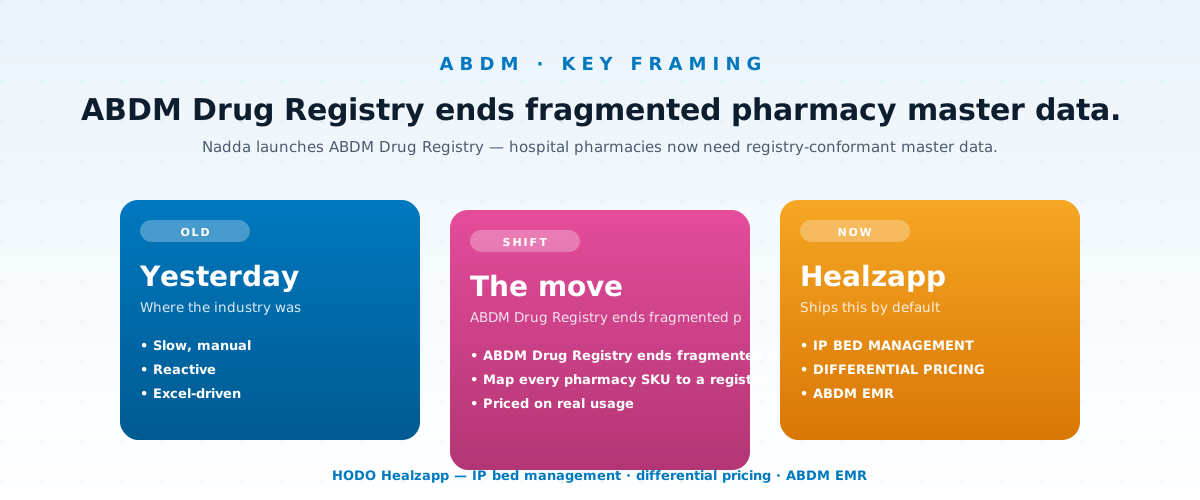
The fix is not glamorous. It is a mapping exercise: every SKU in the pharmacy master gets an ABDM registry ID, aliases get retired, and future procurement gets a check that the new SKU already resolves to a registry entry. This is painful the first time and cheap forever after — provided the HIS supports it natively rather than through spreadsheet exports.
Under the registry, an e-prescription that quotes 'Crocin 500' must resolve to the paracetamol tablet entry in the government catalogue. Free-text prescribing — still common in Indian OPDs — will need a controlled dropdown, or a suggest-and-map layer that translates a doctor's shorthand into a registry-conformant entry before it gets stamped into the EMR.
That has workflow consequences. Consultants who rely on saved favourites, order sets and shortcut templates will need those libraries re-pointed at registry IDs. EMR modules that condense patient history will start doing so against a normalised drug vocabulary, which is actually useful: cross-visit and cross-hospital drug histories become comparable for the first time.
Administrators should push their HIS vendor for a firm timeline on registry mapping, a UI that shows the doctor when a prescription entry is off-registry, and an audit report that tells them how many prescriptions in the last month failed conformance.
For a hospital group or diagnostic chain with 10 or 50 outlets, drug master fragmentation is not a single problem — it is that problem multiplied. Each outlet has typically added its own entries, and consolidated reporting has been quietly forgiving of the drift.
The Drug Registry removes that forgiveness. Group MIS that rolls up drug spend, formulary compliance, generic-substitution rates and vendor concentration will now be expected to reconcile against a single national vocabulary. Groups that plan to open new centres this year will want that mapping done before rollout — bringing a new outlet online against a clean, registry-conformant master is cheap; retrofitting later is not.
The corollary is procurement leverage. Once the group's spend is visible against standard registry entries, vendor negotiation becomes sharper — a purchase head can see exactly how much paracetamol 500 the group buys across all outlets and stop paying three prices for the same SKU.
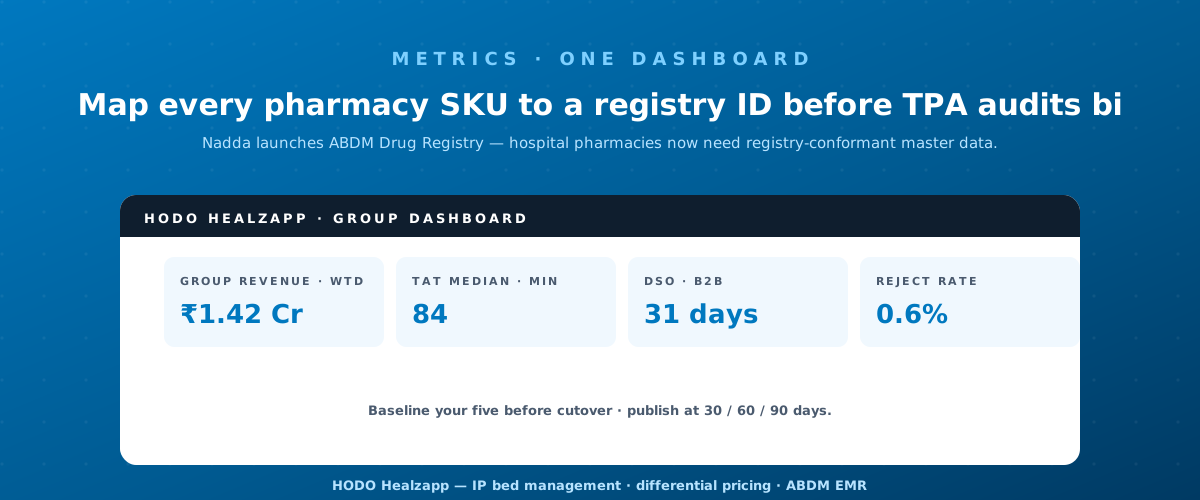
TPA and insurance workflows in India already lose money to itemisation disputes — a claim gets held up because the pharmacy line item on the bill does not match the discharge summary or the payer's own drug list. The Drug Registry gives everyone in the chain — hospital, TPA, insurer, ABDM — a single reference to argue against.
Practically, this means claim rejection rates on drug line items should fall for hospitals that align early. It also means audit exposure rises for hospitals that do not — a TPA reviewer can now flag every entry that does not resolve to a registry ID as suspect. Cashflow from insurance is already the tightest lever in most 50-500 bed hospitals; the ones that get their pharmacy master registry-conformant this year will collect faster than the ones that wait.
The Drug Registry is going to be enforced through the modules hospitals already use daily. HODO Healzapp customers will see the impact land first in the Pharmacy module, where the drug master will be reconciled against ABDM registry IDs and dispensing lines will start carrying the standardised entry. The ABDM-compliant EMR already handles ABHA linkage and consent — extending prescription entries to conform to the registry is the next layer, and existing consultation templates can be re-pointed without disrupting OPD flow. Groups running the Multi-outlet scale-up with one-click new-centre setup get a compounding benefit: new outlets inherit a registry-aligned master from day one, which removes the retrofit cost that older centres are about to face.
See how Healzapp handles this — book a 30-min demo.
See how Healzapp, Labzapp and EReazy fit your speciality in a free 30-minute demo.
Book a Free Demo