According to Medical Buyer, the National Health Authority (NHA) has set up a digital academy to streamline how electronic medical records (EMR) and hospital information systems (HIS) integrate under the Ayushman Bharat Digital Mission. For a 100-bed hospital or a regional lab chain, the question is changing. It used to be “are you ABDM-ready?” Now it is “does the integration hold up at the front desk, on the ward and at the lab bench?” Operators who run this as a workflow project, not a compliance checkbox, will see the benefit first.
Why NHA is investing in integration capacity
ABDM's building blocks have been live for some time: ABHA numbers, the Health Facility Registry, the Healthcare Professionals Registry and consent-based record exchange. The specification has rarely been the gap. The gap is between a certified software build and a busy Monday OP session, when a registration clerk has 40 patients waiting and an ABHA verification OTP never arrives.
Setting up a dedicated academy suggests the NHA sees integration as a skills problem as much as a technology problem. Hospital IT teams, HIS vendors and administrators all need to understand the milestones the same way. These cover creating and linking ABHA at registration, sharing records as a health information provider, and fetching prior records with patient consent as a health information user. Each milestone involves a different department and a different staff role.
This matters most for mid-sized hospitals, which rarely have a large in-house IT cell. Integration knowledge usually sits with one systems person or with the vendor. When that person leaves, ABDM workflows slowly break down. ABHA linking rates fall and records stop flowing, and nobody notices until an audit, an insurer query or a scheme review.
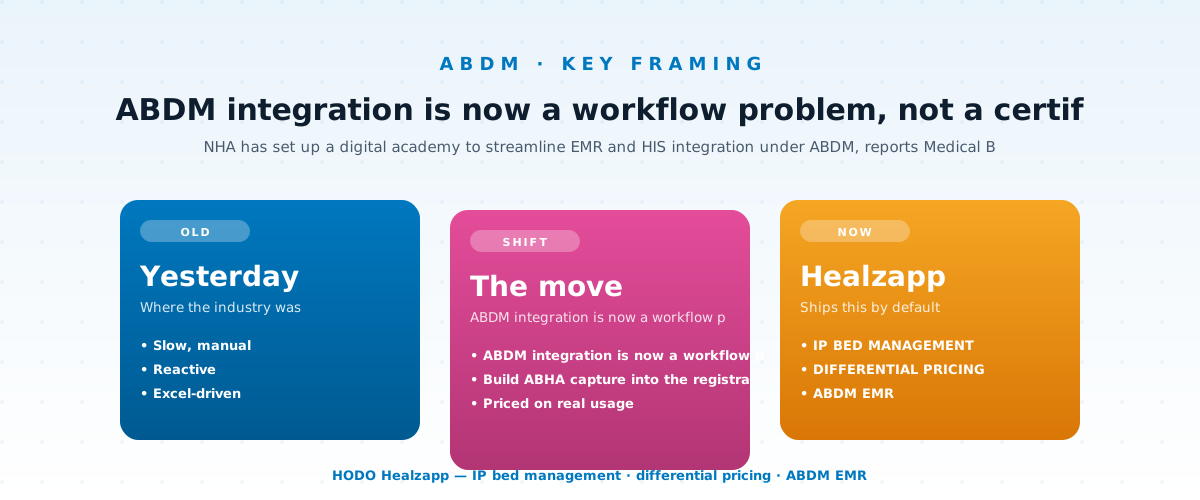
ABDM integration is now a workflow problem, not a certificate.
Where integration breaks inside a 100-bed hospital
In hospitals of this size, most ABDM integration failures are not API failures. They happen at the handoffs between modules and people:
Front desk: ABHA capture gets skipped during peak OP hours. The patient's record exists in the HIS but is never linked, and walk-ins who get registered again create duplicate patient IDs.
OP consultation: doctors write notes in free-text fields or on paper, so there is no structured data to share when a consent request arrives.
IP and discharge: discharge summaries are written in a word processor outside the HIS, so they never become part of the shareable record.
Laboratory: technicians retype results from analysers by hand. This adds TAT and transcription errors before the report can even be shared.
Billing and TPA desk: PMJAY and TPA claims need clinical documents that are spread across modules. Staff assemble claim packets by hand, and cashflow slows down.
A certificate fixes none of these. They get fixed when the HIS makes the ABDM-compliant path the default, meaning it is the fastest way for a clerk, nurse or doctor to finish the task instead of an extra step. An NHA academy can teach staff why these steps matter. The software has to make them easy.
What to ask your HIS vendor after this announcement
With the NHA building formal capacity for EMR and HIS integration, hospital buyers should expect more from their vendors. Before any HIS renewal or replacement, put these five questions to the vendor in writing:
Which ABDM milestones does the product support today, and is it listed in the relevant NHA and NRCeS registries?
Is ABHA capture part of the registration screen, or does the front desk have to open a separate module?
Do lab results come directly from analysers, or do technicians retype them?
Does one EMR serve OP, IP, lab and pharmacy, or are separate databases joined by an overnight sync?
When a new outlet or collection centre opens, how long does it take to go live with the same ABDM configuration?
A vague answer to any of these usually points to integration debt, and the hospital will pay for it in staff hours, not the vendor. Some hospitals run two or three disconnected systems, such as one for billing, one for the lab and one for records. For them, ABDM integration costs go up with every module, because each system needs its own linking logic and its own staff training.
The lab chain and multi-outlet angle
Indian diagnostic chains and hospitals with satellite collection centres face the same problem on a bigger scale. Every new outlet brings registration staff who must capture ABHA correctly, analysers that must be connected, and referral doctors who expect reports on WhatsApp within hours.
If only the head office team understands integration, rollout can only move as fast as that team can travel and train. If integration is set up centrally in the HIS and copied to every centre, a new outlet has working ABDM workflows from day one. Staff trained at the academy can then spend their time on exceptions instead of setup.
There is a revenue angle too. Consent-based record sharing lets referring clinicians and corporate partners see a patient's earlier investigations. That cuts down disputes over repeat tests and strengthens B2B referral relationships. A lab chain competing on TAT and cost per test gains an edge when its reports flow cleanly into a patient's ABHA-linked record. Corporate and insurance clients who value clean documentation notice the difference.
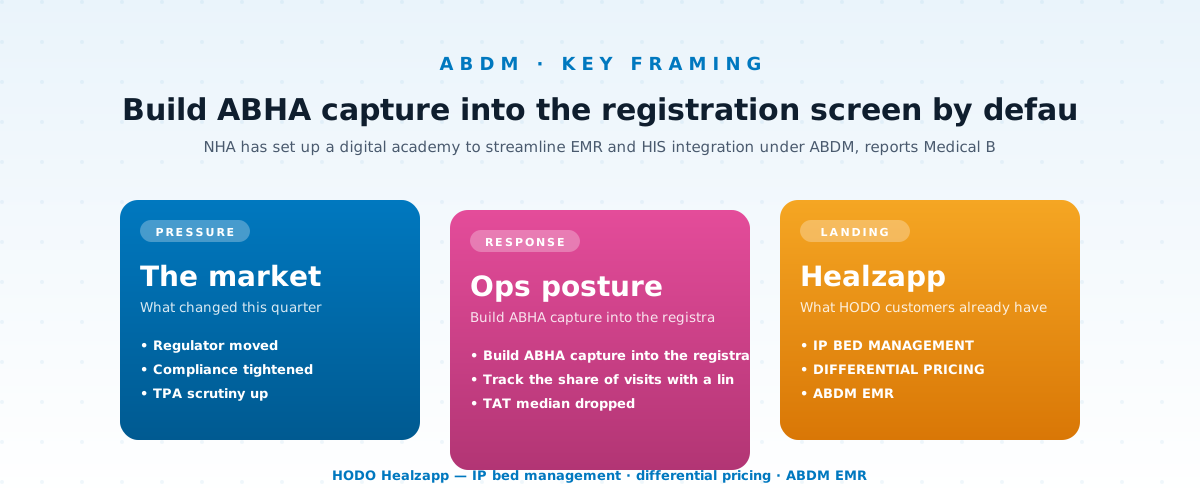
Build ABHA capture into the registration screen by default.
A 90-day integration plan for administrators
Hospitals do not need to wait for the academy's modules to get started. A practical 90-day plan looks like this:
Days 1–30, baseline: measure the share of OP and IP registrations with a linked ABHA, the number of duplicate patient IDs, and the percentage of lab results entered by hand. Name one owner for ABDM integration outside the IT team, usually the medical records or quality lead.
Days 31–60, fix the defaults: move ABHA capture into the standard registration flow, write discharge summaries inside the EMR, and connect high-volume analysers so results come in without retyping.
Days 61–90, train and monitor: enrol front-desk, nursing and lab supervisors in NHA training as it becomes available. Publish a weekly dashboard of linking rates by department, and compare TPA and scheme claim turnaround with the baseline.
The key metric is not whether the hospital counts as “integrated”. It is the share of today's patient visits that produced a linked, shareable, structured record. That number ties directly to NABH documentation readiness, claim turnaround and patient retention.
What this means for HODO customers
HODO was one of the first 20 ABDM-integrated HealthTechs in India and is NRCeS listed. More than 500 client outlets and over 11M patient visits run on its platforms. For 100-bed hospitals and lab chains, Healzapp is built so that the compliant path is also the everyday path.
The ABDM-compliant EMR sits inside the same Patient Management, IP/OP and Billing workflows staff already use, so linking and record sharing do not need a separate tool. Machine Interfacing pulls analyser results straight into the patient record. That removes retyping and shortens TAT before reports go out through WhatsApp/SMS report delivery. For groups opening new centres, Multi-outlet scale-up with one-click new-centre setup copies the configuration to each outlet, so a new branch does not have to set up integration from scratch.
The NHA academy will improve integration skills across the ecosystem. The first hospitals to benefit will be those whose HIS already turns that knowledge into default workflows.