
Medical Dialogues reported this week that the National Medical Commission has served show-cause notices to 18 medical colleges across Madhya Pradesh over lapses in their Hospital Management Information System integration with the Ayushman Bharat Digital Mission. The regulator's move confirms what health-tech vendors have been telling hospital administrators for six quarters: ABDM linkage has stopped being an aspirational tick-box and is now an enforceable line item. Enforcement has arrived first at teaching institutions, but the direction of travel is clear for every 50-500 bed hospital and multi-outlet chain in the country.
The NMC notice, per the Medical Dialogues report, does not target clinical performance. It targets plumbing — HMIS uptake, ABHA-linked records, encounter data flow to the Health Facility Registry, and audit trails for every OP and IP touchpoint. Teaching hospitals were meant to be early adopters and reference sites; instead, patchy HMIS deployment and inconsistent ABDM push have left the ministry with reporting gaps it can no longer explain away. What matters for hospital owners reading this outside Madhya Pradesh is the escalation pattern. The ABDM programme has followed a predictable arc: voluntary onboarding, then advisory circulars, then empanelment-linked pressure through PMJAY and state schemes, and now formal notices from a statutory regulator. Every previous stage came with a 12-18 month grace window before the next stage bit. That window has closed. A private 250-bed hospital chasing TPA panels, or a diagnostic chain applying for state scheme empanelment, should assume the same audit rigour will be applied within the next two cycles.
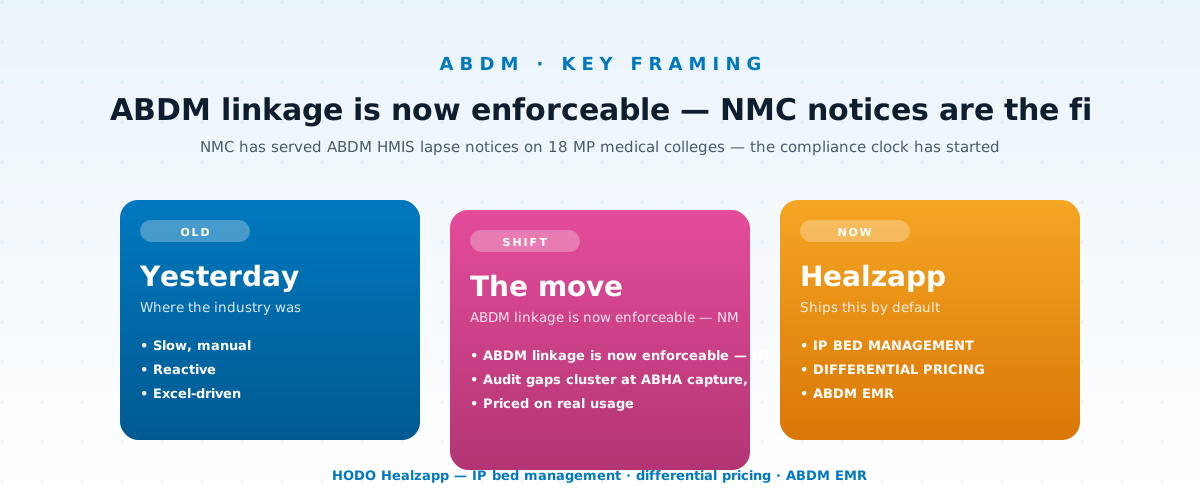
Administrators who have not yet been through an ABDM audit tend to picture the compliance failure as a single system outage. It is rarely that clean. The common failure modes stack up quietly across a working week. Front-desk staff skip ABHA number capture at OP registration because the field is optional and slows down queue movement. Discharge summaries sit in the treating consultant's queue for 48-72 hours before being pushed as a FHIR bundle to the Personal Health Records app, breaking the timely-record-availability clause. Billing and the EMR run on separate identifiers, so the Health Facility ID never makes it onto the encounter. Consent capture for record sharing is buried three screens deep, and front-desk staff learn to click through it without reading. Individually, each is a two-minute annoyance. Aggregated across 300 OP visits a day, they produce exactly the audit gap the NMC is now citing. The fix is not more training memos — it is a workflow that makes the compliant path the fastest path.
For hospitals running a HIS purchased before 2021, ABDM compliance is a retrofit problem. Middleware has to translate proprietary schemas into FHIR R4 bundles, ABHA APIs need to be wired into registration, consent artefacts have to be stored with legal-grade timestamps, and the whole chain needs uptime SLAs the original vendor never signed up for. Cost estimates from three chains that have gone through the exercise land between Rs 18 lakh and Rs 42 lakh in year one, plus a permanent 8-12% increase in HIS support fees. That is before the operational cost of parallel data entry during the cutover. Hospitals still on paper or on hybrid Excel-plus-basic-HIS setups are, counterintuitively, in a better position — they can pick a HIS that treats ABDM as a first-class data model rather than a bolt-on. The decision framework for a hospital board this quarter is not whether to integrate with ABDM; it is whether to pay the retrofit tax or to replatform.
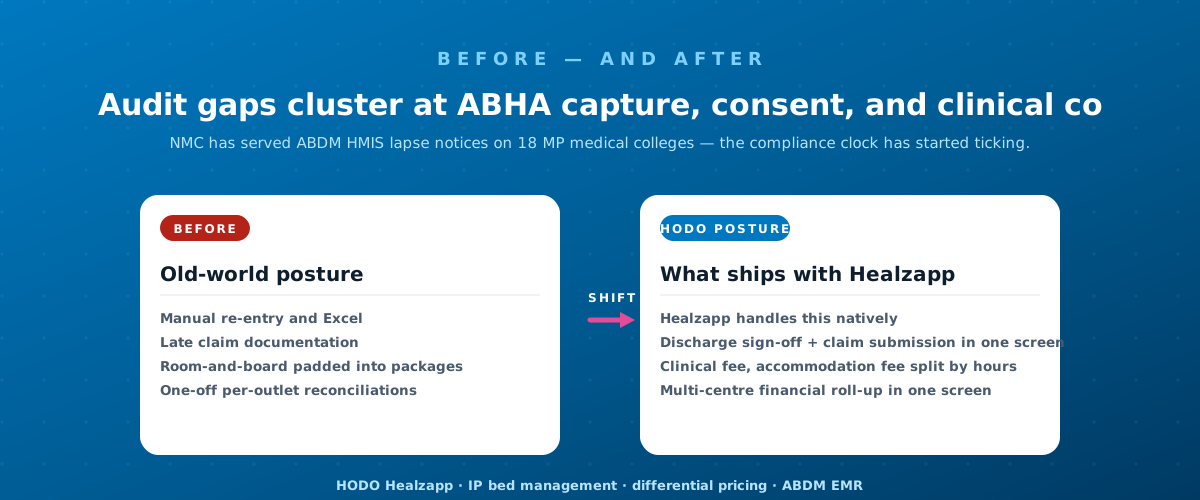
A working ABDM push has five links: patient identity resolution against ABHA, encounter capture at OP or IP, structured clinical documentation on the EMR, consent artefact generation and storage, and the outbound FHIR bundle to the health information exchange. A break at any link stalls the chain. In field audits, the two links that fail most often are clinical documentation and consent. Consultants write free-text notes that do not map to SNOMED CT or ICD-11 codes, so the FHIR bundle carries a hollow payload. Consent workflows built as pop-up modals get dismissed by front-desk staff on behalf of the patient — a technical pass, a legal failure. Solving both requires the EMR to constrain what the consultant types and the front-desk workflow to force the patient's own hand on consent capture. Vendor selection should be judged against these two specific points, not against a generic ABDM-ready claim on the sales deck.
A single hospital dealing with ABDM has one Health Facility ID, one consent manager registration, and one audit surface. A five-outlet clinic chain has five of each, plus the joins between them when a patient visits more than one outlet. Chains that grew by acquisition have a further problem: each acquired outlet arrived with its own HIS or booking tool, and the ABDM linkage now has to be replicated across mismatched stacks. The cost curve for compliance is not linear with outlet count — it is closer to quadratic, because every outlet added multiplies the integration testing burden. The chains that will get through the next 18 months cleanly are the ones running one HIS across every outlet, with new-centre onboarding measured in days rather than quarters. For a chain planning three new outlets in FY26, the vendor conversation this quarter should be about how the tenth outlet gets stood up, not the third.
Healzapp was built into the first cohort of 20 ABDM-integrated HealthTechs in India, and the compliance workflow sits inside the core HIS rather than beside it. Three features map directly to the failure modes the NMC notice cited. The ABDM-compliant EMR handles ABHA linkage at registration, FHIR bundle generation on encounter close, and consent artefact storage as a single flow — closing the exact gaseed
For hospitals running a HIS purchased before 2021, ABDM compliance is a retrofit problem. Middleware has to translate proprietary schemas into FHIR R4 bundles, ABHA APIs need to be wired into registration, consent artefacts have to be stored with legal-grade timestamps, and the whole chain needs uptime SLAs the original vendor never signed up for. Cost estimates from three chains that have gone through the exercise land between Rs 18 lakh and Rs 42 lakh in year one, plus a permanent 8-12% increase in HIS support fees. That is before the operational cost of parallel data entry during the cutover. Hospitals still on paper or on hybrid Excel-plus-basic-HIS setups are, counterintuitively, in a better position — they can pick a HIS that treats ABDM as a first-class data model rather than a bolt-on. The decision framework for a hospital board this quarter is not whether to integrate with ABDM; it is whether to pay the retrofit tax or to replatform.
A working ABDM push has five links: patient identity resolution against ABHA, encounter capture at OP or IP, structured clinical documentation on the EMR, consent artefact generation and storage, and the outbound FHIR bundle to the health information exchange. A break at any link stalls the chain. In field audits, the two links that fail most often are clinical documentation and consent. Consultants write free-text notes that do not map to SNOMED CT or ICD-11 codes, so the FHIR bundle carries a hollow payload. Consent workflows built as pop-up modals get dismissed by front-desk staff on behalf of the patient — a technical pass, a legal failure. Solving both requires the EMR to constrain what the consultant types and the front-desk workflow to force the patient's own hand on consent capture. Vendor selection should be judged against these two specific points, not against a generic ABDM-ready claim on the sales deck.
A single hospital dealing with ABDM has one Health Facility ID, one consent manager registration, and one audit surface. A five-outlet clinic chain has five of each, plus the joins between them when a patient visits more than one outlet. Chains that grew by acquisition have a further problem: each acquired outlet arrived with its own HIS or booking tool, and the ABDM linkage now has to be replicated across mismatched stacks. The cost curve for compliance is not linear with outlet count — it is closer to quadratic, because every outlet added multiplies the integration testing burden. The chains that will get through the next 18 months cleanly are the ones running one HIS across every outlet, with new-centre onboarding measured in days rather than quarters. For a chain planning three new outlets in FY26, the vendor conversation this quarter should be about how the tenth outlet gets stood up, not the third.
Healzapp was built into the first cohort of 20 ABDM-integrated HealthTechs in India, and the compliance workflow sits inside the core HIS rather than beside it. Three features map directly to the failure modes the NMC notice cited. The ABDM-compliant EMR handles ABHA linkage at registration, FHIR bundle generation on encounter close, and consent artefact storage as a single flow — closing the exact gaps the MP notice cited. The EMR (AI-condensed history) module addresses the clinical documentation link by structuring consultant notes into codeable elements at write time, so the outbound FHIR payload arrives with content rather than free text. For chains, the Multi-outlet scale-up with one-click new-centre setup means the compliance boilerplate — Health Facility ID registration, consent manager wiring, audit trail configuration — replicates across outlets without a per-site integration project. The MP notice is a shot across the bow for every hospital and chain that has been treating ABDM as a next-year problem. The regulatory clock is running.
See how Healzapp handles this — book a 30-min demo.
See how Healzapp, Labzapp and EReazy fit your speciality in a free 30-minute demo.
Book a Free Demo