AHM & Dufferin Hospital in Kanpur has become the first hospital in Uttar Pradesh to run 100% online admission and discharge under the Ayushman Bharat Digital Mission, per Digital Health News. The claim looks like a compliance box being ticked, but for hospital administrators the interesting story sits underneath, how does a government facility with the usual constraints on IT budget, staff training and legacy paper flow actually get every admission and every discharge onto ABDM rails? The operational lift is bigger than the headline suggests.
What "100% online" actually means on the ground
Most Indian hospitals that describe themselves as ABDM-integrated are still running parallel paper. An ABHA ID is captured at the counter, a linking record is filed, and the actual admission form, consent, treatment sheet and discharge summary continue on paper for the medico-legal file. Getting to 100% means the front desk cannot issue an IP number without an ABHA link, the ward cannot admit a patient without a digital consent, and the pharmacy cannot bill against an IP number without the electronic prescription being posted. Every workflow that used to have a paper fallback has to lose the fallback. For a district-level hospital with 300-plus daily admissions, that is a change-management project as much as a software project. Kanpur's milestone matters because it demonstrates the workflow, not because the underlying technology is novel. The tech has been available for two years. The bottleneck was always the transition plan and the willingness of a medical superintendent to enforce a no-paper rule on shift-in-charge nurses.
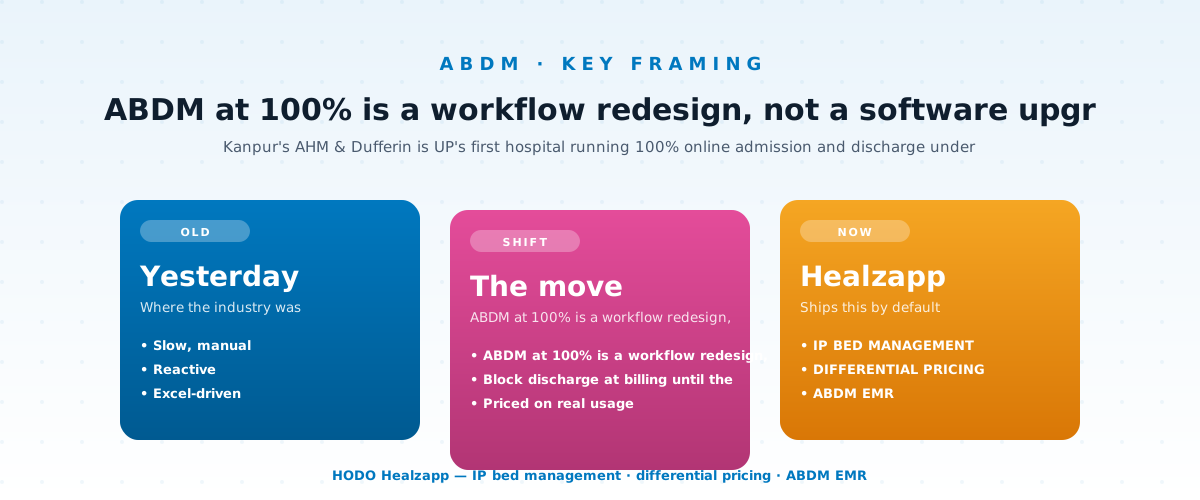
ABDM at 100% is a workflow redesign, not a software upgrade.
Why discharge is the harder half
Admission under ABDM is comparatively simple, capture the ABHA, verify the patient, create the IP episode, link it to the health record. Discharge is where hospitals stall. A compliant discharge event requires a structured discharge summary, itemised final bill, medication list and follow-up instructions, all published back to the patient's ABHA locker within a defined TAT. If any of these are handled offline, say the consultant dictates the summary and it is typed the next day, the discharge is not really online. The Kanpur playbook appears to be that discharge is blocked at the billing counter until the summary is signed and posted. That single control point is what turns policy into practice. Hospitals that want to replicate this need to redesign discharge as a checklist owned by one system, not a hand-off between three departments with three different sign-off books. Cutting the average discharge lag from four hours to under ninety minutes usually falls out of the same redesign, which frees bed hours the hospital was quietly losing.
The insurance and TPA cashflow angle
An online admission-discharge chain also has direct working-capital consequences. TPAs increasingly ask for digitally signed discharge summaries, itemised bills mapped to procedure codes and ABHA-linked identity, the same artefacts ABDM asks for. Hospitals that build the workflow once for ABDM get the TPA claim package as a by-product. The gap between discharge and claim submission drops from three days to the same shift, and the resubmission rate falls because the data is validated at capture rather than at claim review. For a hospital doing ₹3 crore a month in cashless business, tightening the discharge-to-submission window by 48 hours moves roughly ₹20 lakh from receivable to bank. That is the number administrators should be looking at when they cost an ABDM rollout, not the licence fee, and not the training bill. The compliance argument gets the project signed off; the cashflow argument is what keeps the medical superintendent from quietly re-authorising paper discharges after month three.
Where multi-department orchestration breaks
The wards, nursing station, pharmacy, lab and billing counter each own a slice of the admission-discharge chain. In most hospitals these slices sit in different systems, or in the same HIS but with different users writing to different tables and no single event that says "this patient is now discharged". The Kanpur model works because there is one system of record, one IP number and every downstream action, final medication reconciliation, bed release, housekeeping turnaround, ABHA push, is triggered off the same status change. Hospitals that run best-of-breed pharmacy and lab modules bolted onto a thin HIS have to build integration middleware to reach the same result, and that middleware usually breaks at the next module upgrade. The operational lesson is that ABDM readiness is a data-model problem before it is a compliance problem. If IP bed status, billing status and clinical status live in three tables that update at different times, no policy layer on top will get you to 100%. Admins evaluating vendors should ask to see a live state diagram of the IP episode, not a compliance certificate.
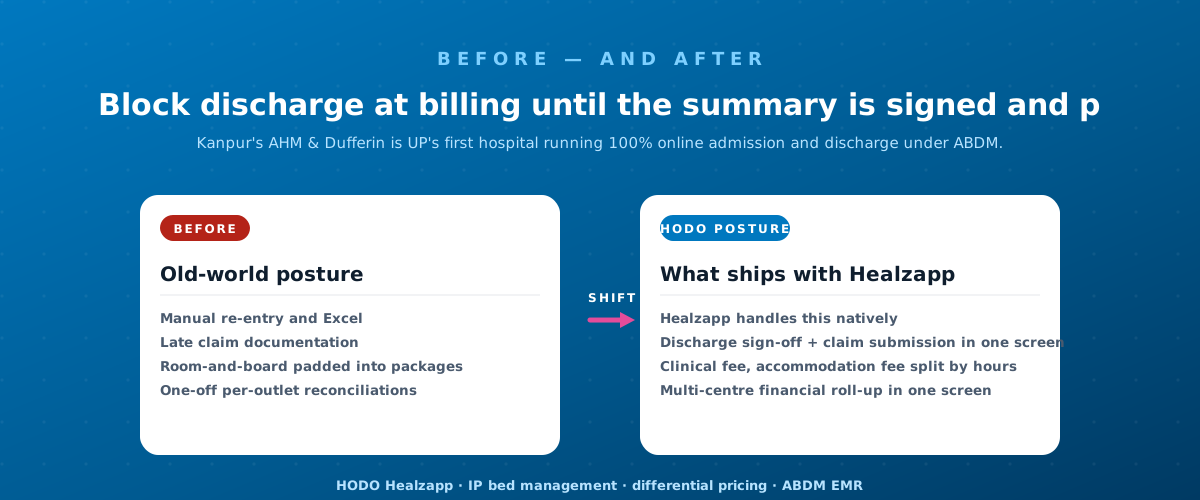
Block discharge at billing until the summary is signed and posted.
Change management: the invisible line item
Three roles carry the load in a fully online admission-discharge workflow, the front desk (ABHA verification and consent), the ward clerk (event posting) and the consultant (structured discharge summary). Each of them has a strong incentive to fall back to paper the moment the system throws a delay. Which means the deployment plan needs latency SLAs on the HIS itself, sub-two-second response on the admission screen, sub-five-second on the discharge summary publish, and a live dashboard the medical superintendent can see. If the online rate drops below 95% in any shift, someone needs to know within the hour. Kanpur is the first because its administration treated this as an operations KPI, not an IT project. Hospitals looking to copy the playbook should budget for two full-time trainers on the ward floor for the first six weeks, and expect the first month to run at 60-70% online while muscle memory shifts. Rolling this out over an existing HIS is far cheaper than replacing the HIS mid-flight.
What this means for HODO customers
The Kanpur example maps directly onto the Healzapp stack. ABDM-compliant EMR handles the ABHA linking, consent capture and discharge summary publish inside the same clinical workflow the doctor is already using, there is no separate ABDM screen to open, which is what keeps consultants on the system instead of dictating to a typist. IP bed management owns the admission-to-discharge state machine, so bed release, housekeeping turnaround and ABHA push fire off a single status change rather than three uncoordinated events. Billing is wired to the discharge state, which is what allows the "no discharge without signed summary" control the Kanpur workflow depends on. Together these three modules give an administrator the same operational shape UP's first ABDM hospital built by hand, without the six-month middleware project or the parallel-paper transition.