
The National Health Authority (NHA) has convened a national review meeting with state health secretaries to chart the next phase of the Ayushman Bharat PM-JAY and Ayushman Bharat Digital Mission (ABDM), as reported by India Gazette. The roadmap signals tighter coupling between insurance claims processing and digital health record adoption. For hospital and diagnostic chain operators, the ABHA-linkage, claim-turnaround, and record-portability work that felt optional last year now moves onto the compliance critical path.
The joint review brought Union and state officials into the same room to align on PM-JAY expansion targets, empanelment quality, and the pace at which hospitals are pushing records into the ABDM stack. Two threads matter for administrators. First, the Centre wants the digital rails — ABHA IDs, Health Facility Registry entries, Health Professional Registry mappings — to be actually usable inside empanelled hospitals, not merely registered. Second, states have been asked to tighten scrutiny of claim documentation, particularly around discharge summaries, prescriptions, and diagnostic reports linked to the beneficiary's ABHA. The tone of the meeting suggests that hospitals treating ABDM compliance as a one-time onboarding exercise will find the next round of audits uncomfortable. The next phase is less about signing up and more about steady-state throughput: how many episodes get linked, how quickly discharge documents are uploaded, how consistently the same beneficiary's records surface across outlets.
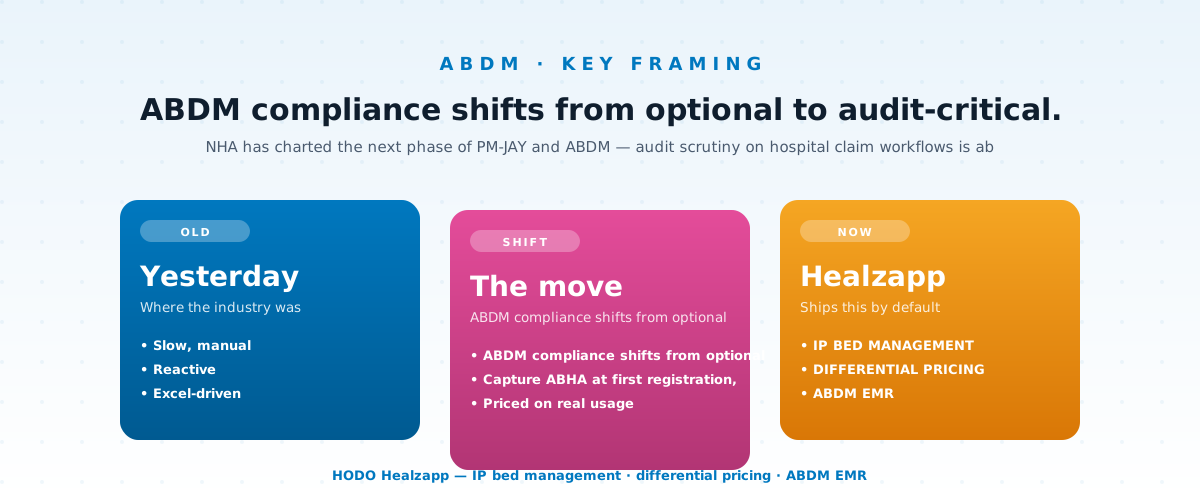
PM-JAY reimbursement has always been a working-capital pressure point for empanelled hospitals — approvals delayed, claims rejected on documentation gaps, resubseemissions eating weeks. The next-phase roadmap points toward faster adjudication windows, but only for claims that come in clean: correct beneficiary linkage, structured clinical notes, coded procedures, complete discharge summary attached at submission. Hospitals that still assemble PM-JAY files manually — running between the TPA desk, the medical records room, and the billing counter — will see the gap widen between them and hospitals that have wired the workflow end-to-end. The maths is unforgiving: a 50-bed hospital doing 40 PM-JAY discharges a month with even a 15% resubmission rate loses roughly six claims per cycle to rework. At an average package of Rs 25,000, that is Rs 1.5 lakh stuck in float every month, plus one FTE's worth of clerical time absorbed by follow-ups.
Front-desk staff at most Indian hospitals are still asking patients whether they carry an ABHA ID, then filing that response in a free-text field that no downstream system reads. That has to end. Under the next phase, ABHA capture at registration needs to be mandatory-by-design, with the ID pulled into every subsequent episode — OP visit, IP admission, pharmacy transaction, lab order, discharge — without re-entry. The consent artefact for record sharing has to be logged, timestamped, and retrievable during audit. This is a workflow problem more than a technology problem: the HIS must prompt for ABHA at the first patient touchpoint, offer to create one via the demographic-based flow if the patient does not carry it, and then propagate that identifier across every module. Registration desks that treat ABHA as an optional extra field are the single largest source of downstream claim rejections and reconciliation overhead.
For clinic chains and diagnostic networks running five, fifteen, or fifty outlets, the ABDM roadmap surfaces a governance problem: outlet-level variance. One outlet captures ABHA on 90% of registrations, another on 20%, because the workflows were configured separately or the staff were trained differently. States are now looking at outlet-level compliance metrics, not just organisation-level averages. That forces central IT and operations teams to standardise: one registration schema, one consent capture screen, one discharge summary template, replicated across every centre from day one. When a new outlet opens, it should inherit the compliant configuration automatically — not go through a three-month settling-in period during which its ABDM numbers drag down the group average. This is where the hidden operational cost of ad-hoc, per-outlet setup becomes visible in the compliance dashboard rather than the finance report.
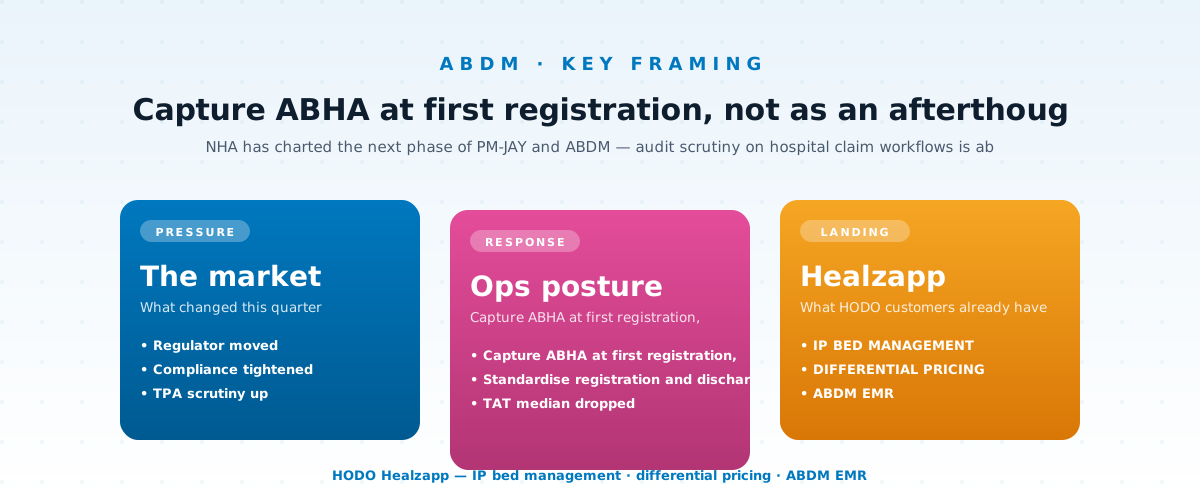
The metrics that matter for the next phase are unglamorous: percentage of episodes with ABHA linked at first touch, average time from discharge to document upload, percentage of claims accepted first-pass, days sales outstanding on PM-JAY receivables. Administrators who cannot pull these numbers on a weekly cadence are flying blind. TAT on discharge summary generation is often the choke point — if the summary sits with the treating consultant for 48 hours after discharge, the claim window has already slipped. The fix is structural: templated discharge summaries pre-populated from the EMR, WhatsApp-based nudges to the consultant, and an escalation queue that surfaces stuck cases to the medical superintendent. Same logic applies on the diagnostic side: reports that sit in the LIMS queue past their TAT threshold need to trigger an alert before the referring hospital chases.
Hospitals and clinics already running HODO Healzapp have three levers to pull immediately. The ABDM-compliant EMR module handles ABHA capture, consent artefacts, and health record push into the ABDM stack — the compliance plumbing that the next-phase audit cycle will inspect. The Patient Management module ties ABHA at registration into every downstream episode, so the same identifier flows through OP, IP, pharmacy, and billing without re-entry, cutting the manual reconciliation that produces most claim rejections. For chains opening new centres, Multi-outlet scale-up with one-click new-centre setup ensures every new outlet inherits the compliant registration, consent, and discharge workflow from day one — no three-month drift dragging down group compliance numbers.
See how HODO Healzapp handles this — book a 30-min demo.
See how Healzapp, Labzapp and EReazy fit your speciality in a free 30-minute demo.
Book a Free Demo