
The Centre and the States have just completed a two-day review of Ayushman Bharat PM-JAY and ABDM implementation in Kolkata, with beneficiary coverage, healthcare delivery, financial protection and digital health integration on the agenda, as reported by Express Healthcare. For a 100-bed hospital in a district town, or a lab chain running eight collection centres, a meeting at that level is not policy news — it is advance notice about what gets measured next. And measurement always lands on the provider's own records.
Every national review of a scheme like PM-JAY produces the same downstream effect: State Health Agencies tighten the questions they ask empanelled hospitals. Package-wise case volumes, pre-authorisation turnaround, documentation completeness, discharge summaries, length of stay against package norms — these move from occasional audit items to routine queries. The same applies to ABDM. Once digital health integration is listed alongside financial protection as a review theme, the follow-up is not "are you integrated?" but "how many of last month's encounters carry a linked health record?"
Hospitals that run their scheme work in parallel systems feel this immediately. The billing desk raises the bill in the HIS. The TPA/PMJAY desk re-enters the same case in a portal. The medical records department pulls discharge summaries from a third place. Each handoff is a re-keying opportunity, and re-keying is where claim rejections are born. When the reporting load goes up, the cost of that parallel setup stops being an irritation and becomes a measurable cash problem — because a rejected claim at a 100-bed hospital is not one claim, it is a week of a clerk's time plus a delayed receipt.
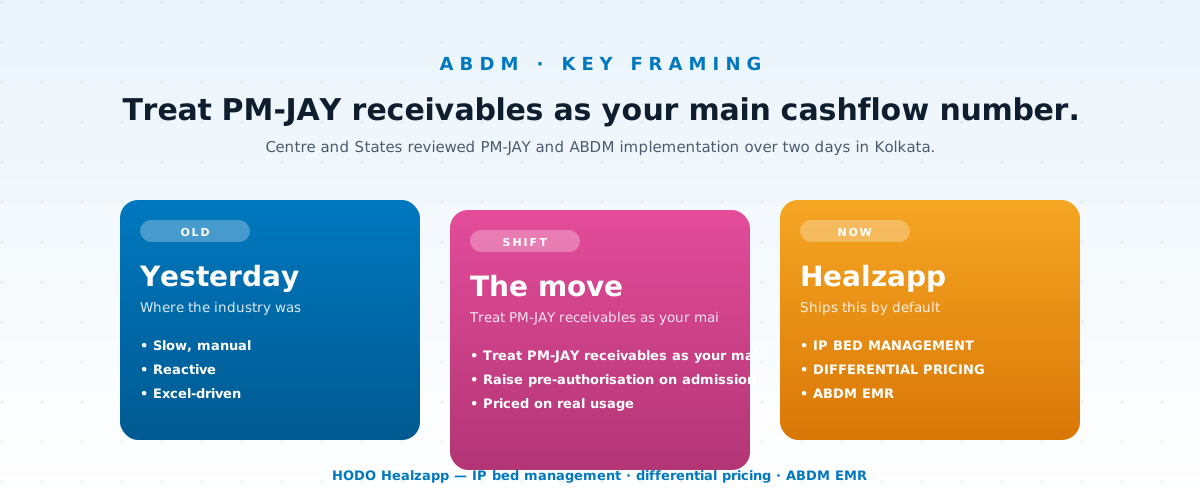
"Financial protection" in the review's language means the patient should not pay out of pocket. Read from the provider side, it means the hospital carries the receivable until the scheme pays. For a ~100-bed hospital where PM-JAY and state scheme cases can account for 30–60% of IP volume, days-in-receivables is the single most important operational number in the building — more consequential than bed occupancy on most months.
The levers are unglamorous and entirely operational. Pre-authorisation raised on day of admission rather than day two. Package selected before the patient is shifted to the ward, not after discharge when the case sheet is already closed. Implant and consumable charges captured at the point of use instead of reconstructed from the nursing notes. Query response within the stipulated window, which requires somebody to actually see the query the day it arrives.
None of this is achievable if scheme cases are tracked on a shared spreadsheet. What works is a single admission record that carries payer type from registration onwards, so that the ward, the pharmacy counter and the billing desk all know the case is a scheme case and price it accordingly. Differential pricing by payer is not a convenience feature here; it is the only way to stop cash tariffs leaking into scheme bills and triggering deductions.
A large number of Indian hospitals have an ABDM milestone certificate and very little day-to-day ABHA linkage. That gap was tolerable while the programme was in adoption mode. With digital health integration now a standing review item, the useful question for a hospital CIO or administrator is narrower: what percentage of OP registrations in the last 30 days captured an ABHA, and what percentage of discharges produced a linked record?
Getting that number above a token level is a front-desk workflow problem, not an IT project. ABHA capture has to sit inside the registration screen the receptionist already uses, with verification taking seconds, not a separate portal tab. Record linking has to happen as a by-product of discharge, not as a monthly catch-up exercise. And consent handling has to be logged where an auditor can see it without the hospital assembling evidence by hand.
Lab chains face a related version of this. A diagnostic chain feeding reports to multiple empanelled hospitals needs its report output to be identifiable, timestamped and traceable per referring centre. When a hospital's scheme claim is queried on diagnostic evidence, the lab's turnaround record becomes part of the hospital's defence. Labs that cannot produce TAT evidence per referrer end up absorbing the blame.
Wider beneficiary coverage — including the 70-plus cohort added to PM-JAY — shows up first at the OP counter, not in the wards. More walk-ins, more eligibility checks, more patients who need their entitlement explained before they will agree to a procedure. The front office absorbs this entirely, and front-office capacity at a 100-bed hospital is usually two or three people.
The operational response is to take queue management and eligibility explanation off the counter. Token-based OP flow with visible display reduces the crowd at the desk by removing the reason people stand there. Appointment slots for high-volume specialities smooth the morning peak. Report delivery over WhatsApp and SMS removes an entire category of return visit — patients coming back only to collect a printout. Each of these is a small intervention, and together they decide whether added coverage translates to throughput or to a longer queue and a worse NABH patient-experience score.
There is also a bed-side consequence. Scheme packages have expected length-of-stay norms. Hospitals that cannot see live bed status and expected discharge dates end up either blocking beds past package norms, which is unpaid occupancy, or discharging against the clinical plan, which is a readmission. Visibility of bed status by ward and expected discharge is what keeps both outcomes off the table.
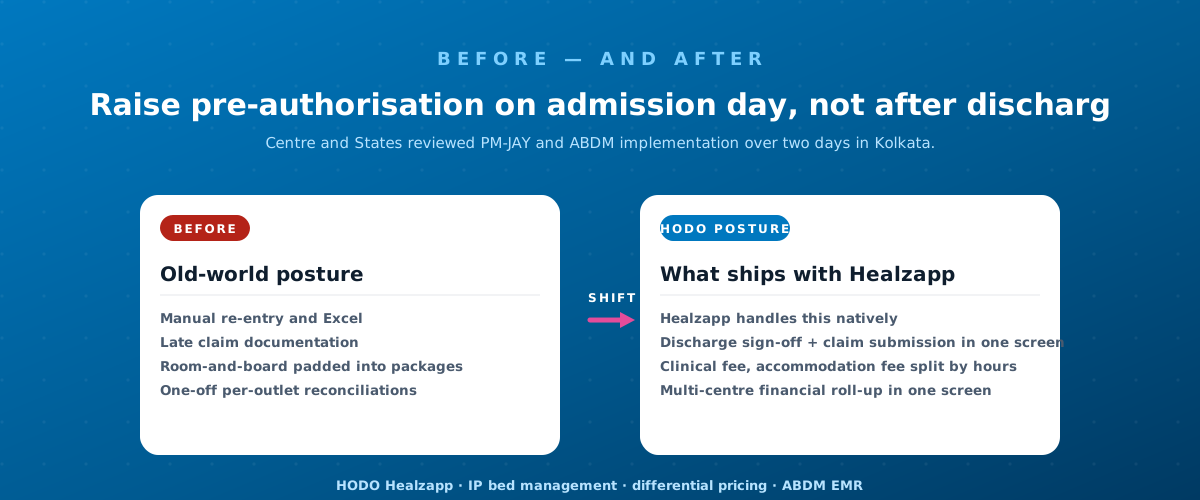
The thread running through the Kolkata review is that the provider's own records are now the evidence. That rewards hospitals and lab chains running one system of record over those running three. In HODO Healzapp, ABDM-compliant EMR keeps ABHA capture and record linking inside the registration and discharge flow the staff already use, so integration produces a daily audit trail rather than a one-time certificate. Billing with Differential pricing keeps PM-JAY, TPA, corporate and cash tariffs separate at the point of charge capture, which is where most claim deductions are created. IP bed management gives ward-wise occupancy and expected discharge visibility against package norms, and Tally integration closes the loop between claim receipts and the books without a monthly re-entry exercise. For chains, Multi-outlet scale-up with one-click new-centre setup means a new centre starts out with the same payer masters and reporting structure as the rest, rather than becoming the outlet that cannot produce numbers when the State Health Agency asks.
See how Healzapp handles this — book a 30-min demo.
Source of the news hook: https://www.expresshealthcare.in/news/ab-pm-jay-and-abdm-implementation-reviewed-by-centre-and-states-at-national-meeting/455791/
See how Healzapp, Labzapp and EReazy fit your speciality in a free 30-minute demo.
Book a Free Demo