
The Centre and the States have sat down for a joint national review of Ayushman Bharat PM-JAY and Ayushman Bharat Digital Mission implementation, as reported by Express Healthcare. Review meetings of this kind rarely change a scheme overnight, but they do change what gets asked of empanelled hospitals in the quarters that follow — usually in the form of tighter claim scrutiny, stricter documentation, and higher expectations on digital records. For a 100-bed hospital or a multi-outlet lab chain, that is an operations question long before it is a policy question.
Reviews at this level work through a fairly standard agenda: scheme utilisation by State, claim turnaround and pending payments, fraud and abuse flags, State Health Agency capacity, and ABDM adoption numbers — ABHA creation, health facility registry listings, and the volume of records actually linked to patient accounts. None of that is new. What changes afterwards is the pressure applied downstream.
In practice, empanelled hospitals tend to see three things follow a national review. Documentation standards get read more strictly, so a discharge summary that was accepted last year gets queried this year. Audit sampling increases, which means older claims can be reopened. And ABDM participation stops being a certificate on the wall and starts being counted — States are asked to report linked-record volumes, and empanelled facilities are the obvious place to source them from.
The hospitals that absorb this comfortably are the ones where the scheme runs inside the HIS. The ones that struggle are running PM-JAY as a parallel manual process: a dedicated TPA desk with its own spreadsheets, a separate folder of scanned documents, and a claims executive whose personal knowledge is the only working index. That arrangement survives an ordinary quarter. It does not survive an audit cycle or the resignation of one experienced staff member.
In many 100-bed hospitals, scheme patients are 30 to 60 per cent of inpatient volume, and that revenue arrives late by design. The lifecycle is long: pre-authorisation, treatment, discharge summary, claim submission, query cycle, approval, payment. Every handoff adds days, and the hospital controls only some of them.
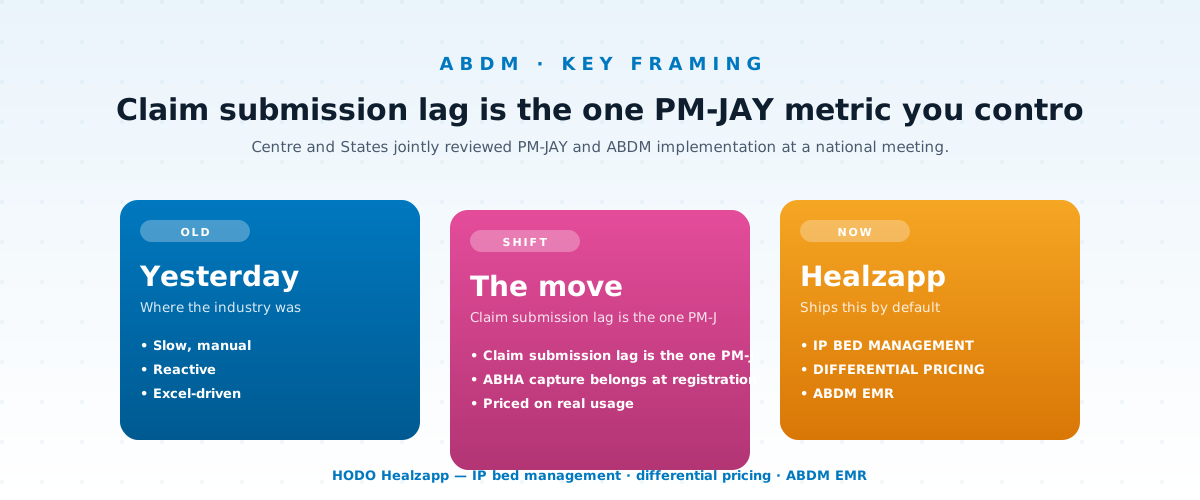
The portion fully within hospital control is claim submission lag — the gap between discharge and submission. Most hospitals do not measure it. When it is measured, the figure is frequently a week or more, because the claim waits on a discharge summary that waits on a consultant signature that waits on a ward round. That delay is self-inflicted working capital drag.
The second controllable number is the query and rejection rate, broken down by cause. Package code mismatch, a procedure documented differently from the package claimed, missing investigation reports, missing implant details, and admission notes that do not justify the length of stay account for most denials. These are repeatable failure modes, which means they are fixable with templates and checks at the point of entry rather than at the point of appeal.
A useful monthly view for a hospital of this size is small: claim submission lag by department, first-pass approval rate by package, query causes ranked by frequency, and days-to-payment by scheme. Four numbers. Most finance teams can produce total scheme revenue but not these four.
Integration itself is the easy part and is largely a solved problem — HODO was among the first 20 ABDM-integrated HealthTechs in India, is NRCeS listed, and is listed on the Telemedicine Registry. The harder part is what the hospital does every day after integration.
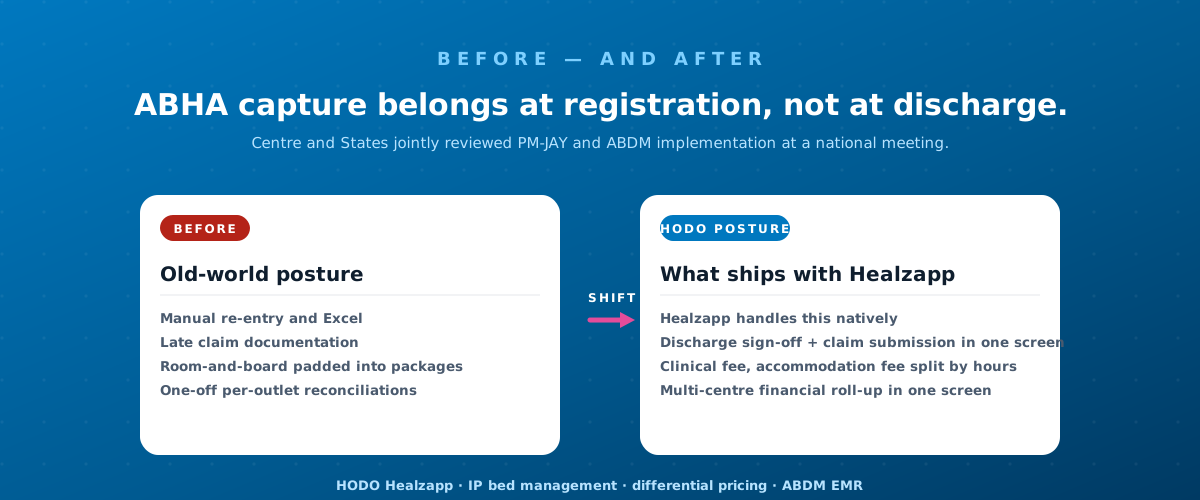
ABHA capture belongs at the registration counter, during the first conversation, not at discharge when the patient is in a hurry and the front office is under load. A hospital that retrofits ABHA creation at discharge will show a weak linkage rate indefinitely, because discharge is the worst possible moment to ask for a number and a consent.
Record linkage also exposes EMR discipline. Linking is only worth something if what gets linked is structured — a diagnosis coded rather than typed into free text, investigations attached to the visit rather than filed as loose scans, a discharge summary generated from the record rather than retyped in a word processor. Hospitals that keep the real clinical record on paper and treat the EMR as a billing shell will push empty envelopes into the ABDM network and gain nothing back from it.
There is a payoff for getting this right, and it is not regulatory. A patient returning after eight months with records already attached saves consultant time at every visit. AI-condensed history turns three years of visits into something a consultant can absorb in the first minute of an OP consultation, which is where throughput is actually won or lost.
Scheme workload concentrates at registration and billing. A PM-JAY patient needs eligibility verification, ABHA capture, scheme tagging, and a billing path different from a cash or insurance patient. Run that on a counter designed for cash patients and the OP queue backs up for everybody.
Duplicate registration is the quiet cost. The same patient registered three times across two years produces a split history, a broken linkage, and a claim that cannot cite prior treatment. Deduplication at the point of registration — phone number, ABHA and existing MRN searched before a new record is created — removes a problem that is far more expensive to clean up later.
Billing is the other pressure point, because a 100-bed hospital runs several price lists at once: cash, PM-JAY packages, State scheme rates, TPA tariffs and corporate contracts. Pricing handled in the system rather than by a cashier's judgement is what keeps leakage out and the audit trail in.
Bed management ties straight back to claims. Length of stay drives package justification, and a bed occupancy view that is accurate at 10 a.m. rather than reconstructed at month-end lets the duty manager see which scheme patients are pending discharge paperwork. That is the same list the claims desk needs.
Diagnostic chains serving empanelled hospitals carry part of this load without carrying the claim. Scheme packages bundle investigations, and when a hospital outsources a test, the report has to come back fast enough and documented well enough to survive a claim query months later. A report delivered as a photograph on WhatsApp with no record in the lab system is a denial waiting to happen.
For a multi-outlet lab chain the practical requirements are unglamorous: barcoded samples so chain of custody is provable, machine interfacing so results are not retyped, TAT reporting per outlet and per test group so the slow link is visible, and partner-lab integration so outsourced work is tracked rather than trusted. Add per-partner rates, because what a scheme hospital pays is not what a walk-in pays, and manual rate handling across ten outlets does not hold.
Lab chains also sit closest to the cost-per-test question that scheme-heavy hospitals are forced to ask. When package rates are fixed, the only remaining lever is cost of delivery — and that is a reporting problem, not a negotiation problem.
A national review does not create new work. It exposes work that was already being done badly. The hospitals and lab chains that come out of the next audit cycle intact are the ones where scheme workflow, clinical record and billing sit in a single system rather than three.
HODO Healzapp treats the Indian scheme stack as part of normal operations rather than a bolt-on. ABDM-compliant EMR keeps ABHA capture and record linkage inside registration and clinical documentation instead of a separate portal exercise. Differential pricing runs cash, PM-JAY package, TPA and corporate rates side by side with the audit trail preserved. Multi-outlet scale-up with one-click new-centre setup carries the same scheme configuration to a second or third centre without anyone rebuilding it. Lab chains on Labzapp get the matching half — barcoded samples, machine interfacing and TAT reporting — so outsourced investigations stand up to a claim query raised long after the patient has gone home.
See how Healzapp handles this — book a 30-min demo.
See how Healzapp, Labzapp and EReazy fit your speciality in a free 30-minute demo.
Book a Free Demo