The Times of India reports that Ayushman Bharat Digital Mission has crossed 25 crore OPD registrations via QR-based scan-and-share, with hospitals across metros and Tier-2 cities cutting front-desk data entry to under a minute per patient. The headline number matters less than the operational shift it implies: the registration counter is no longer the bottleneck it was two years ago. For hospital owners and administrators, the sharper question is whether the rest of the OPD workflow, billing, token, consult, prescription, has kept pace with a front desk that now clears patients four times faster.
The 25-crore signal, decoded
ABDM's scan-and-share flow lets a patient generate a token by scanning a facility QR code on the ABHA app, pushing demographics and ABHA ID directly into the hospital's HIS through a FHIR payload. The 25-crore milestone, reported this month, signals adoption has moved past pilot phase in most private-sector hospitals of 100 beds and above. Public-sector uptake is uneven but rising steadily. The relevant data point for administrators is the median registration time, down from four to six minutes per new patient to under 45 seconds where the HIS accepts the payload cleanly. That collapse changes the queuing math at the front desk, but it also shifts the pressure point deeper into the workflow. The bottleneck is now the consultation room and the billing counter, not the registration window. Owners who assume the QR is a one-time win are missing the second-order redesign the shift demands.
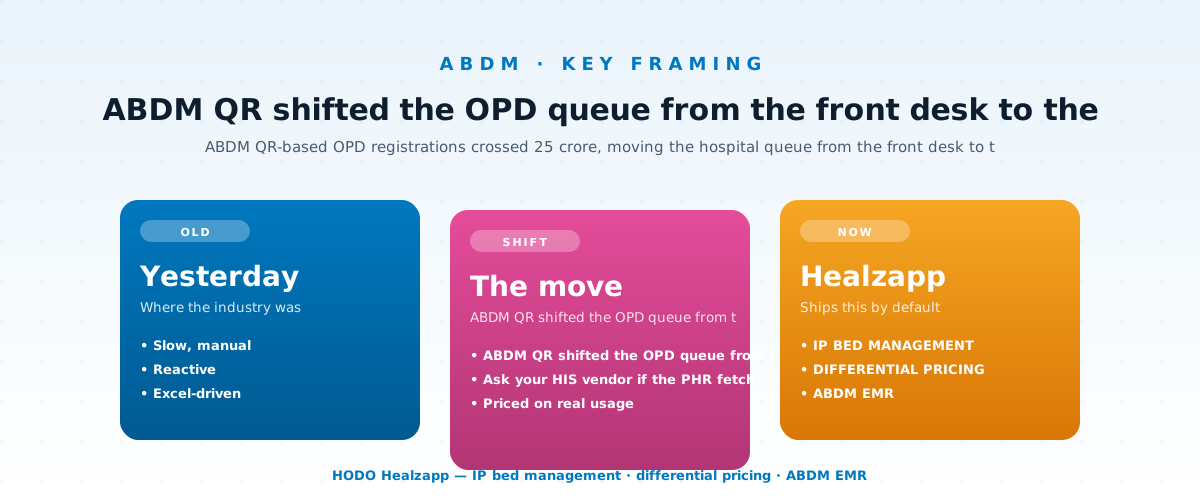
ABDM QR shifted the OPD queue from the front desk to the consult room.
Why queues still form despite QR
Three failure modes account for almost all of the residual OPD queuing that hospital MDs report post-ABDM rollout. First, the HIS accepts the ABHA payload but does not auto-map it to an existing MRN, forcing the front desk into a manual dedupe step that eats the time savings. Second, the token generated by the ABHA app does not sync with the display board in the OPD wing, so patients still walk up to the counter to ask for their turn, recreating the queue the QR was meant to remove. Third, the consultant's screen loads a blank EMR because the ABHA-linked prior history from other facilities has not been fetched. The consultation then runs long as the doctor asks the patient to repeat medications and allergies. Each of these is fixable but requires the HIS vendor to have built the ABDM handshake beyond the minimum M1/M2 certification checkbox.
The ABHA-linkage gap on the HIS side
Most HIS platforms marketed as ABDM-compliant in India today handle the scan-and-share ingest but stop short of the health record fetch, the piece that makes the ABHA ID clinically useful in the consult room. For an administrator evaluating vendors, the sharper question is not whether the platform is ABDM-integrated but whether it pulls the linked PHR bundle from Consent Manager before the patient reaches the doctor, and what the fallback is if the fetch times out. A 200-bed hospital running 800 OPD footfalls a day sees measurable consult-time reduction only when the linked history is on the screen before the patient sits down. Otherwise the front-desk gain is real but the downstream compression does not happen, and total door-to-prescription time stays flat on the dashboard.
Throughput math for a QR-first OPD
The economics are worth working through. A 250-bed multi-speciality hospital with 1,200 OPD footfalls and a 15-counter front desk was previously spending about 90 counter-hours a day on registration alone. QR ingest at 70% penetration drops that to roughly 35 counter-hours, freeing 55 hours for billing, insurance pre-auth, and pharmacy pickup, the counters that actually block patient exit. The saving does not show up on the P&L as a headcount cut; it shows up as reduced consultant idle time between patients, reduced overtime for billing staff, and a measurable drop in the patient-waiting-more-than-30-minutes complaint that drives NABH audit scores down. For a chain running five or more outlets, the compound effect on staff-cost-per-patient is between 8% and 14% based on operator surveys quoted alongside the TOI report. That is the number to take to the vendor conversation.
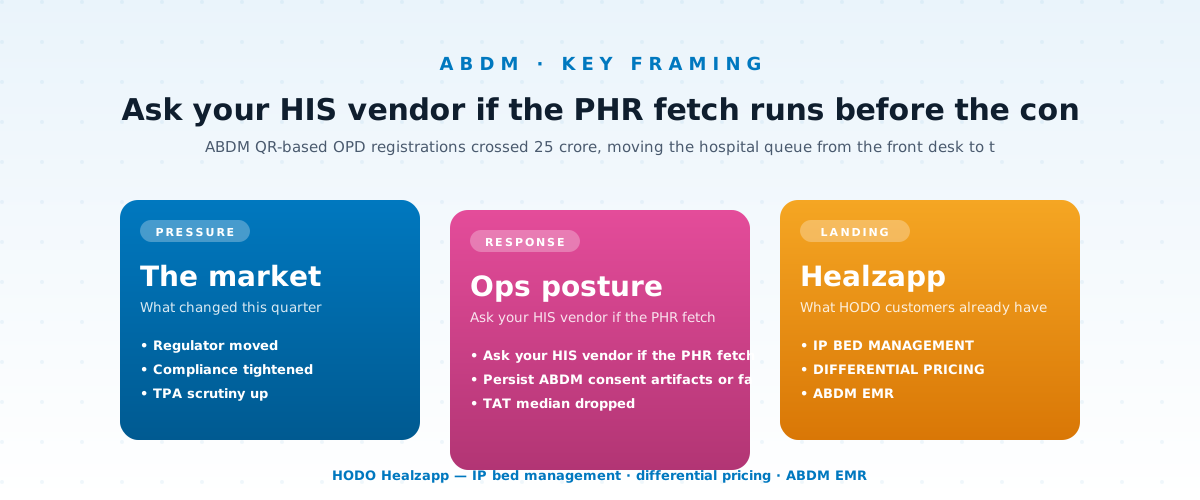
Ask your HIS vendor if the PHR fetch runs before the consult begins.
Compliance and audit angles operators miss
ABDM registrations carry a consent artifact that most front desks are not currently archiving to hospital storage. This becomes a problem at two moments: NABH surveillance visits where the auditor asks for the consent chain, and any DPDP-triggered patient request for erasure of demographic data. A hospital that has been running QR ingest for 12 months without persisting the consent trail is technically non-compliant even though it is transacting on ABDM successfully. Administrators should ask their HIS team for a monthly consent-artifact report and confirm it is being stored in the same audit vault as the eSign records. The other quiet compliance issue is the ABHA-to-MRN mapping log, regulators are beginning to ask for the deterministic rule the hospital used, and manual dedupe is not an acceptable answer at audit.
What this means for HODO customers
Hospitals running HODO Healzapp already ingest the ABHA scan-and-share payload through the ABDM-compliant EMR module, with the linked-PHR fetch running before the patient token is called in the consult room. The Patient Management module deterministically maps the ABHA ID to the existing MRN using a configurable rule set, eliminating the manual dedupe step that undoes the QR time savings elsewhere. Token sync to the TV Token Display in the OPD wing closes the queue-recreation gap that most implementations miss. For multi-outlet operators, the same configuration propagates via one-click new-centre setup, so a new branch inherits the ABDM handshake without a fresh integration project.