The National Health Authority's chief executive has laid out digital healthcare priorities and reviewed Ayushman Bharat Digital Mission implementation across the Northeast states, as reported by Digital Health News. The headline is routine; the subtext is not. State-level implementation reviews are steadily moving the test from how many ABHA numbers a facility has collected to whether patient records actually move — and that shift lands squarely on the hospital information system.
What an implementation review actually tests
When the NHA reviews a state's ABDM progress, the questions are narrower than the press summary suggests. Registry work — Health Facility Registry entries, Health Professional Registry enrolments for consultants and nurses — is table stakes and usually complete on paper. The harder line items are ABHA creation at the point of registration, how many of those ABHAs are actually linked to a care context, and whether any record was pushed into the patient's longitudinal view afterwards. A hospital can show thousands of ABHA numbers collected and still sit on a single-digit linkage rate, because collection happens at the counter while linkage happens inside the HIS.
The Northeast is a useful test bed for exactly that reason. Facilities are dispersed, bandwidth is inconsistent, and IT headcount per hospital is thin — often one or two people who also handle biomedical complaints and the billing printer. Those are the same constraints a 100-bed hospital in a district town in Maharashtra, Odisha or Tamil Nadu works under. Whichever workaround survives in Shillong or Agartala is usually the workaround that survives everywhere else. Administrators tracking ABDM should read state review coverage less as regional news and more as a preview of the questions their own State Health Agency will ask at the next round, with the same metrics: linkage per 100 OP registrations, consent-fulfilment latency, and share of visits with a record actually published.
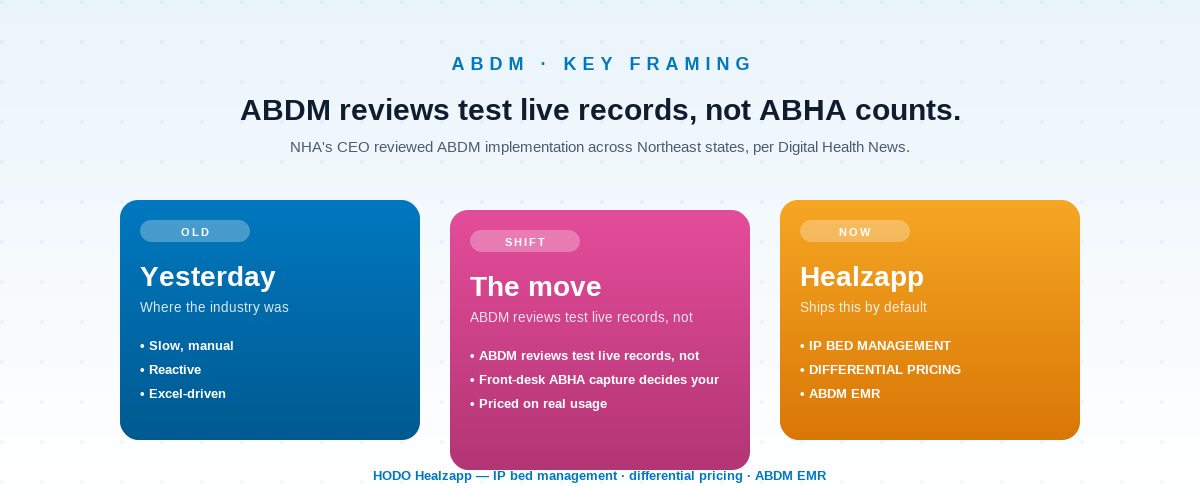
ABDM reviews test live records, not ABHA counts.
The registration counter sets the ceiling
ABDM performance is largely decided in the first ninety seconds of a visit. During the morning OP peak, a front-desk operator facing a forty-person queue will skip anything that adds a second screen. If ABHA capture lives in a separate browser tab — a portal login, a scan-and-share token pasted across by hand — it gets skipped, and no amount of circular-driven enthusiasm from the management will change that. If it lives inside the same registration screen the operator already uses, with the ABHA stored against the patient record and reused on every repeat visit, linkage becomes a by-product of normal work rather than a parallel task.
Three practical fixes recur across hospitals that score well. First, move capture upstream: ask for ABHA or Aadhaar-linked identity at the appointment stage, so walk-in counter load drops and only genuine walk-ins need fresh creation. Second, handle demographic mismatch deliberately — name spelling variants, initials versus expanded surnames, and shared family mobile numbers are the main causes of duplicate ABHAs and failed verification, and the HIS should flag a probable duplicate before creating a second identity. Third, take pressure off the counter itself. Queue display and orderly token flow mean staff are not working against a crowd pressing at the window, which is when identity shortcuts get taken. ABDM compliance, in practice, is a front-office throughput problem wearing a policy label.
Record quality decides whether linkage means anything
Linking a care context and publishing an empty shell are two different things. The record types that matter to a 100-bed hospital are the OP consultation note, the discharge summary, the diagnostic report and the prescription. A scanned PDF of a handwritten discharge summary can satisfy a validator and still be clinically useless to the next doctor who opens it — and useless to the hospital itself when a TPA queries the claim nine weeks later.
That pushes the real work back to point-of-care capture. The consultant has to type or dictate into the EMR during the consultation rather than at the end of the shift. Vitals, intake-output and medication administration have to be recorded at the nursing station, not transcribed from paper at discharge. Pharmacy dispensing lines have to come from the same system that generated the prescription, or the medication list in the published record will not match what the patient actually received. None of this is new clinical practice; it is a question of whether the software makes structured entry faster than paper for the people doing it under time pressure.
There is an immediate internal payoff too. Once records are structured, a returning patient's history can be condensed into something a consultant can absorb in the thirty seconds available, instead of scrolling through eighteen months of visit entries. The compliance artefact and the clinical convenience come from the same data discipline.
Where the diagnostics arm snaps the chain
In most 100-bed hospitals and lab chains, the weakest link in the ABDM record chain is diagnostics. Analyser results get read off a printout and retyped into the HIS, which introduces transcription error, inflates turnaround time, and leaves the published diagnostic report lagging the actual result by hours. Direct interfacing between analysers and the system removes that step and makes TAT measurable per test rather than anecdotal per complaint.
Outsourced and referred tests are the second gap. Where samples go to a partner lab or a reference lab, results frequently come back by email or WhatsApp to a coordinator, and the structured record never closes. Partner and referral logins that let the outside lab post results directly into the originating order keep attribution clean and stop a coordinator's inbox from becoming the system of record. The third gap is delivery: if the patient receives the report over WhatsApp or SMS but nothing reaches the longitudinal record, the hospital has solved patient experience and failed the review. Both paths should fire from the same verified result, not from two separate manual actions by two separate staff members.
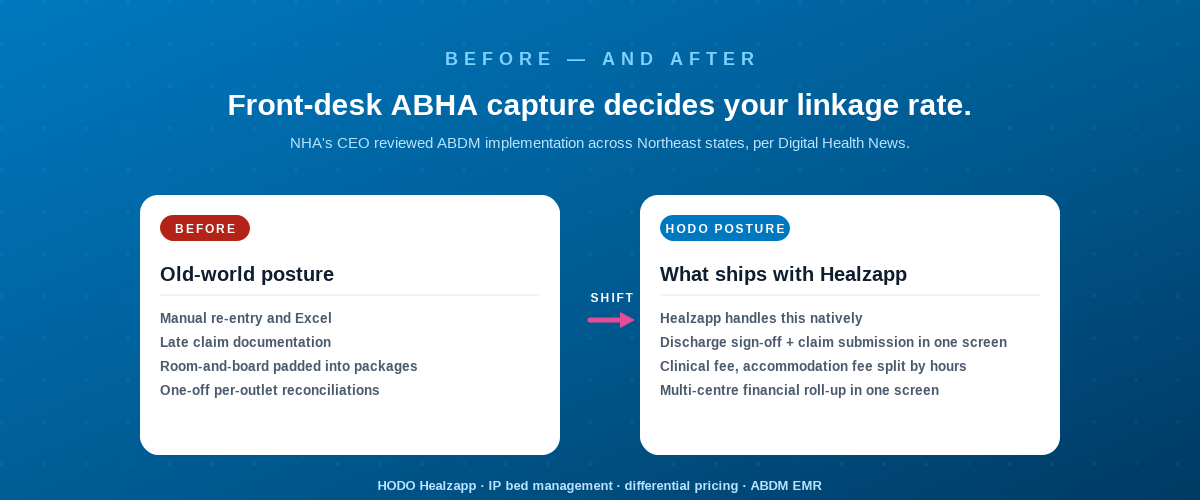
Front-desk ABHA capture decides your linkage rate.
Scheme cashflow runs on the same data
The operational case for cleaning this up is not the review scorecard — it is cashflow. PMJAY and TPA claim denials cluster around documentation defects: missing discharge summary detail, diagnostic reports that do not tie to the billed line item, implant and consumable records that cannot be evidenced. A hospital running structured capture end to end can assemble a claim file from the record rather than reconstructing it from three departments. Package pricing for scheme patients, corporate rates and cash rates also need to sit on separate price lists in the same billing engine, so that a scheme patient's bill is not manually discounted at the counter and then disputed in audit. Finance reconciliation closes faster when billing exports into the accounting ledger directly instead of being re-keyed monthly. The ABDM record and the claim file are substantially the same dataset, assembled for two different readers.
What this means for HODO customers
HODO Healzapp was built for exactly this shape of hospital — around 100 beds, mixed IP and OP load, an in-house lab, scheme and TPA exposure, and a small IT team. Its ABDM-compliant EMR handles identity, linkage and record publishing inside the same screens the registration desk and consultants already use, rather than as a bolt-on portal. EMR (AI-condensed history) turns the structured record back into something clinically usable at the point of care, which is what keeps doctors entering data. Machine Interfacing closes the diagnostics gap so reports are published from analyser output instead of retyped, and B2B Referral / Outsource Lab / Corporate-partner logins keep outsourced results inside the record chain. HODO has been building hospital and lab software since 2013 from Trivandrum, was among the first 20 ABDM-integrated HealthTechs in India, and is NRCeS and Telemedicine Registry listed — so the compliance surface is maintained as the standards move, not re-engineered at each review cycle.