ET HealthWorld reports that the Union Health Secretary has urged India to leverage its existing digital health infrastructure for the sharing of health records and, specifically, for cancer-screening data. The framing is worth noting: the ask is not for a new registry but for Ayushman Bharat Digital Mission plumbing to start carrying data that hospitals and labs already generate every day. For a 100-bed hospital or a multi-outlet lab chain, that quietly shifts the question from "are we ABDM-registered" to "can our HIS hand over a usable record without a clerk re-typing it".
From ABDM registration to actual retrieval
The infrastructure already exists — ABHA identifiers, the Health Facility Registry, the Healthcare Professional Registry, and consent-based exchange through the Health Information Exchange and Consent Manager. What is thin is the traffic running over it. Many hospitals treated ABDM as a registration exercise bolted onto empanelment paperwork: completed once, filed, and left alone.
The operational test is narrower and harder. When a patient screened at a district-town hospital in Kerala walks into a tertiary centre in Bengaluru eight months later, can the first facility's system hand over that screening record as structured, linked data? If the screening note sits as a scanned PDF attached to a visit, it is technically shareable and practically unusable. A mammography impression, a Pap smear grade or an oral-cavity screening finding needs to be coded, dated, attributed to a named clinician and tied to a follow-up action before it is of any use to a doctor outside the building.
That is an EMR design question, not a compliance question. Hospitals running legacy HIS installations where the EMR is effectively a free-text box plus a file upload will find that ABDM registration does not help them, because there is nothing structured to share in the first place.
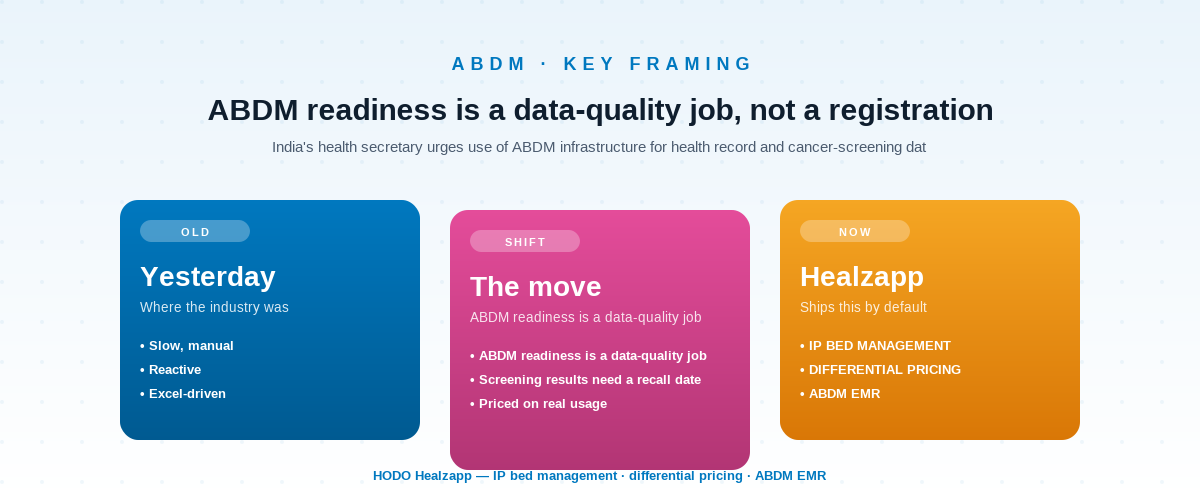
ABDM readiness is a data-quality job, not a registration tick.
Screening data is a calendar, not a document
A diagnostic episode closes. A screening programme does not. A negative screen creates an obligation — recall in twelve, twenty-four or thirty-six months, depending on the test and the risk profile. An abnormal screen creates a shorter and more urgent loop: confirmatory test, biopsy, referral, staging, treatment decision.
Most hospitals measure OP throughput and bed occupancy. Screening is measured by something else entirely: recall compliance and loss to follow-up. A 100-bed hospital running a weekend camp can generate three hundred results in two days, and if no one owns the next-due date, those results decay into stored files. The data was collected, reported and billed. It produced no clinical outcome and no second visit.
This is where record sharing and revenue quietly align. A screening record that carries a next-due date, an owner and a contact channel becomes a scheduled OP visit. A screening record that carries only a result becomes dead storage. Operators evaluating HIS vendors on the back of this policy push should ask a plain question: can the system hold a recall date against a patient, surface it to a counsellor in a worklist, and log the attempt to reach them? If follow-up lives in a separate spreadsheet maintained by one coordinator, the programme does not survive that coordinator leaving.
Where the handoff breaks in a 100-bed hospital
Trace a single screening patient through a typical setup. Registration counter captures demographics. Clinician writes an order on paper. The patient carries the slip to the lab or imaging desk, where details are keyed in again. The analyser produces a value that is transcribed into the report template. The report is printed, handed over, and the counselling conversation happens with a paper copy. Nothing in that chain is linked by identifier; it is linked by the patient physically walking the document around.
Each re-entry point is a place where the record stops being shareable. A name spelled differently at the lab desk breaks the link. A result transcribed by hand carries transcription risk that no downstream system can detect. Barcoded sample flow and direct analyser integration remove two of those re-entry points outright, which matters more for ABDM compliance than any amount of registry paperwork — a record that was never re-typed is a record that can be exchanged with confidence.
There is also a documentation angle for hospitals running screening under PMJAY and TPA packages. Claims for screening and confirmatory pathways need an auditable trail linking order, sample, result, clinician and date. Hospitals that assembled that trail manually for each claim already know the cost in administrative hours. Structured capture at source converts that from a reconstruction exercise into a report.
ABDM-ready starts at the registration counter
The weakest link in most Indian hospital deployments is not the integration layer. It is the front desk at 10:15 am with twenty people in the queue. ABHA capture is an optional-feeling extra step, and under queue pressure optional steps get skipped. Nothing downstream can be shared for a patient whose ABHA was never linked.
So the practical fixes are operational rather than technical. Queue load at registration has to come down — token-based flow and clear display reduce the crowding that makes staff cut corners. ABHA capture has to sit inside the normal registration screen rather than in a separate portal that requires a second login. Consent has to be recorded as part of the visit, not chased later. And the receptionist needs to see, on the same screen, whether this patient already has a linked record from a previous visit, so repeat patients are not re-registered as new ones.
Duplicate patient records are the silent killer of longitudinal data. A hospital with three entries for the same person has three partial histories and no shareable record. Deduplication at registration, driven by mobile number and ABHA lookup, is unglamorous work that determines whether the rest of the policy ambition is achievable at facility level.
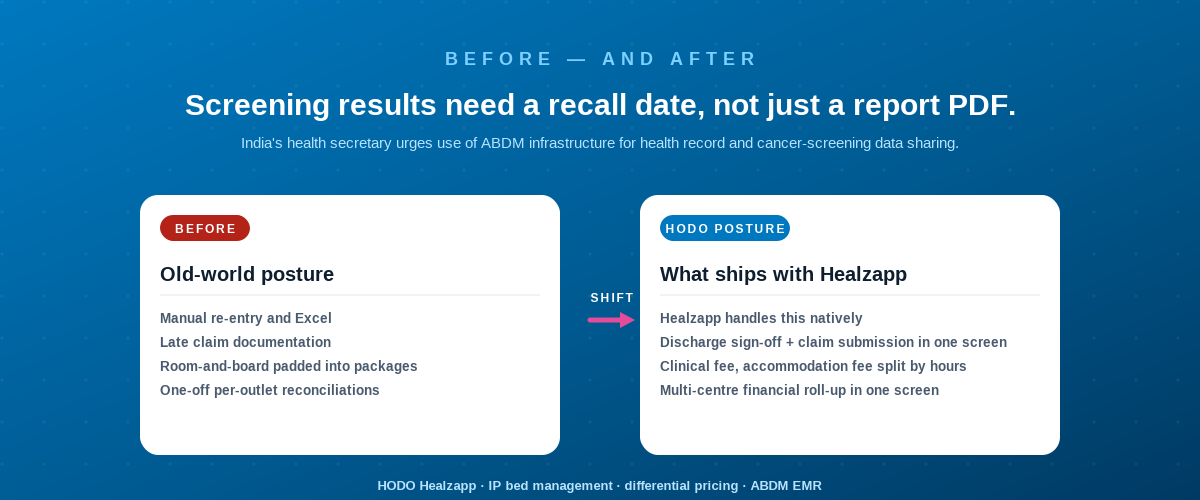
Screening results need a recall date, not just a report PDF.
The multi-outlet and referral version of the problem
For lab chains and hospitals with collection centres, screening volume rarely originates at the main facility. It comes from camps, partner clinics, corporate tie-ups and franchisee centres. Each of those is a separate point of data capture with separate staff discipline and often separate pricing.
Two failure modes recur. First, outlet-level data lands in the central system late and incomplete, so the longitudinal record is assembled days after the patient has gone home. Second, referring doctors and corporate partners phone the lab for results instead of pulling them, which generates call volume and encourages staff to WhatsApp screenshots outside the system — unlogged, unshareable and a consent problem waiting to happen. Giving partners and referring doctors their own login, with differential pricing applied per partner, removes the phone calls and keeps every release inside an audit trail. Giving patients automated report delivery closes the loop without a counsellor dialling each number.
What this means for HODO customers
The policy direction in the ET HealthWorld report is not a new mandate; it is a signal that record sharing is moving from paperwork to expectation. HODO Healzapp addresses the parts that break at facility level. ABDM-compliant EMR keeps clinical capture structured at the point of entry, so what leaves the hospital is an exchangeable record rather than a scanned attachment. EMR (AI-condensed history) gives the consulting doctor a readable longitudinal view instead of a chronological pile of visits — the difference between having screening history and being able to act on it in a six-minute OP slot. B2B Referral / Outsource Lab / Corporate-partner logins move referring doctors and corporate clients off phone calls and onto logged access, which is what makes partner-sourced screening data trustworthy. For groups adding centres, Multi-outlet scale-up with one-click new-centre setup keeps a new collection point on the same patient index from day one.