ABDM's Scan and Register service has crossed 25 crore OPD registrations, per vohnetwork.com. That is a quarter-billion patient touches where a QR code did the work of a data-entry operator. For hospital administrators the number is less a headline than a signal: patients now expect the front desk to move at ABHA speed, and the HIS behind the counter is what decides whether the promise lands.
What a Scan-and-Register event actually does at the counter
The transaction is deceptively simple. A patient opens ABHA on their phone, scans the counter's QR code, and consents to share demographics with the facility. The HIS ingests name, gender, date of birth, address, and ABHA number, checks for an existing MRN, and either opens the past chart or creates a fresh one. What used to be a three to four minute keyboard exchange - name spelt letter by letter, mobile number read back twice, Aadhaar photocopy stapled to a form - collapses to under a minute of verification.
The operational payoff is not just speed. Duplicate MRNs, the quiet enemy of every hospital's clinical data, drop sharply because the ABHA number becomes a stable external key. Handwriting errors in the address field disappear. Insurance and TPA rejections that trace back to a mismatched date of birth or a misspelt name shrink. For a 200-bed hospital seeing 700 to 900 OPD footfalls a day, that is a measurable line in the monthly denials report.
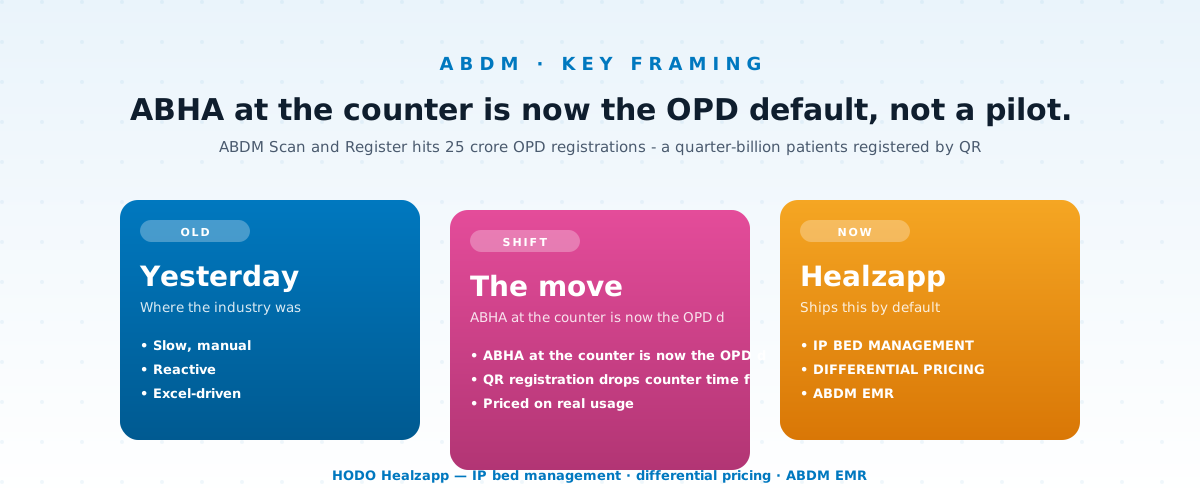
ABHA at the counter is now the OPD default, not a pilot.
The throughput math for a mid-sized hospital
Put concrete numbers on it. A 200-bed hospital running 800 OPD registrations a day, with an average manual registration time of 3.5 minutes, spends roughly 47 counter-hours per day just on registration. Move even 60 per cent of that to Scan and Register at 45 seconds per transaction, and about 25 to 30 counter-hours a day open up. That is not a productivity slide - it is two full-time equivalents that can be redirected to insurance pre-authorisation, TPA follow-up, or same-day discharge coordination, all of which sit closer to cashflow than data entry does.
Waiting-room dynamics change too. Peak-hour queue length is a function of arrival rate and service rate; halving service time at registration pushes visible queues down, patient-satisfaction scores up, and walkaways during rush hours down. In outpatient-heavy models, especially in tier-2 and tier-3 markets where one busy morning can decide the month, that curve matters.
Why the payoff only lands if the HIS is ABDM-native
A printed QR sticker at the counter is not enough. Scan and Register only delivers if the HIS behind it is genuinely ABDM-integrated: registered with the Health Facility Registry, wired to the Health Professional Registry for the treating clinician, and capable of writing FHIR-format records to the patient's Personal Health Record locker via the Health Information Exchange and Consent Manager. Bolt-on middleware that shows demographics on screen but fails to link the encounter back to the patient's ABHA record is worse than useless - it creates a false sense of compliance while leaving downstream care unchanged.
Consent artefact handling is the other quiet test. Every share, every fetch, every linkage needs an audit-grade record. When the district or state health authority audits your ABDM claims - and they will, the M3 milestone metrics are already being reported - the HIS must produce those artefacts on demand, not weeks later after a support ticket.
The downstream: linked care, second visits, and referrals
The registration itself is the smaller half of the value. When the same patient returns three weeks later - or walks into your sister outlet in another city - the HIS should recognise the ABHA number and pull the previous encounter summary, prescriptions, and investigations before the consultation begins. That saves the consultant time, prevents duplicate scans and blood tests, and makes onward referrals cleaner.
For chains running multi-outlet operations, this is the single biggest ABDM upside. A patient registered in the Kochi outlet who walks into the Coimbatore outlet six months later becomes a known patient, not a fresh MRN. Corporate and TPA panels see continuity of care. Referral loops with partner diagnostic centres close because the lab report writes back to the same ABHA record instead of sitting in a PDF folder on the referring doctor's desktop.
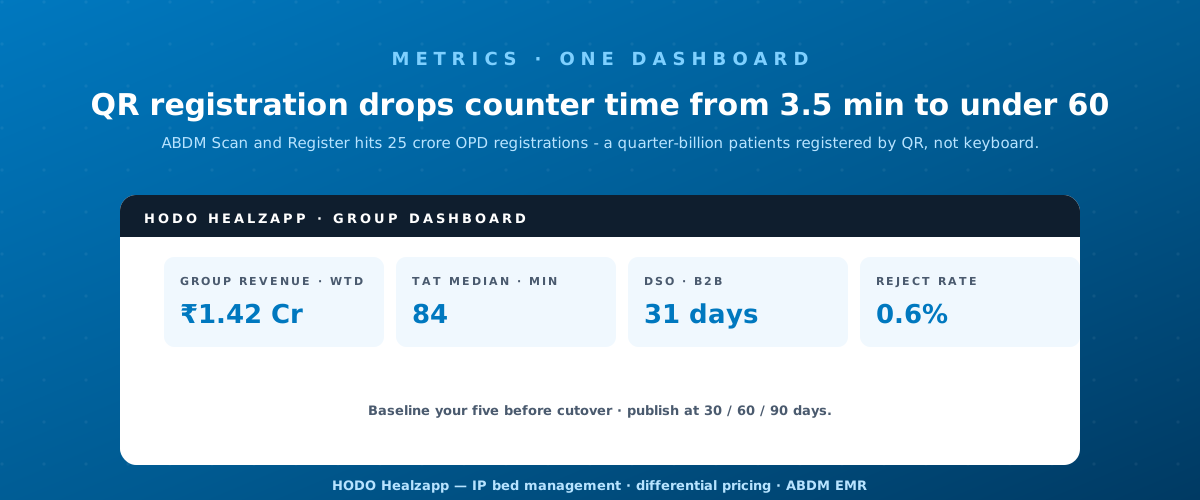
QR registration drops counter time from 3.5 min to under 60 sec.
What to check before your next HIS vendor review
The M3 certification level is now the operational floor, not a nice-to-have. Ask any HIS vendor to show live Scan and Register transactions from an existing customer, not a sandbox demo. Ask for the Health Facility Registry ID of at least three deployed sites. Ask how the system handles the patient who does not have a smartphone or has forgotten their ABHA credentials - a graceful fallback matters, because roughly a fifth of OPD walk-ins will still need manual registration for the next few years.
Also look at throughput at scale. The 25 crore national number was built on facilities that handled hundreds of concurrent scans without timing out. Small-scale ABDM demos are cheap; a Monday morning at 300 concurrent registrations across three outlets is the real test, and that is the reference call worth making before a signature.
What this means for HODO customers
HODO Healzapp was built with ABDM as a first-class citizen, not an afterthought - HODO is on the first 20 ABDM-integrated HealthTechs in India list, NRCeS listed, and on the Telemedicine Registry. Three modules do the heavy lifting for Scan and Register. Patient Management ingests the ABHA payload, deduplicates against existing MRNs, and links the encounter back to the patient's PHR locker with the correct consent artefact. Appointments pulls the scanned patient directly into the consultant's queue and, combined with TV Token Display, keeps the waiting-room flow visible without a receptionist calling out names. And when the patient returns, the ABDM-compliant EMR - with AI-condensed history - surfaces the past encounter to the consultant before the door opens, closing the loop that Scan and Register was designed to close.