The National Health Authority has selected EkaCare as a technology partner for its ambient AI-enabled voice scribe solution for doctors, as reported by The Tribune. The headline reads like a clinical documentation story, but for a 100-bed hospital or a multi-outlet lab chain it is an infrastructure story. An ambient scribe listens to a consultation and drafts the note — and the value of that draft depends entirely on what the hospital's EMR does with it next.
What the NHA announcement actually signals
Until now, ambient documentation in India has been a vendor-by-vendor experiment: a few corporate chains piloting scribes on a handful of OP desks, usually in English, usually with a consultant who already types fast. A national health authority naming a technology partner changes the frame. It signals that clinical documentation is being treated as part of the digital health stack rather than as an optional productivity add-on, and that whatever comes out of the scribe is expected to end up as a structured, shareable record linked to an ABHA number — not as a text file sitting on a desktop.
That expectation is the part most hospitals are unprepared for. ABDM compliance has largely been read as a linking exercise: generate ABHA, link care contexts, respond to consent requests. An ambient scribe puts pressure on the layer underneath — whether the hospital's EMR actually stores a diagnosis, a problem list, a medication order and a follow-up instruction as discrete, retrievable fields, or whether it stores one long narrative blob that happens to be searchable by date. A scribe writing into a blob produces a faster blob. The documentation minutes come down; the record quality does not go up. Hospitals that have postponed structuring their OP record will discover this the first week a pilot reaches them.
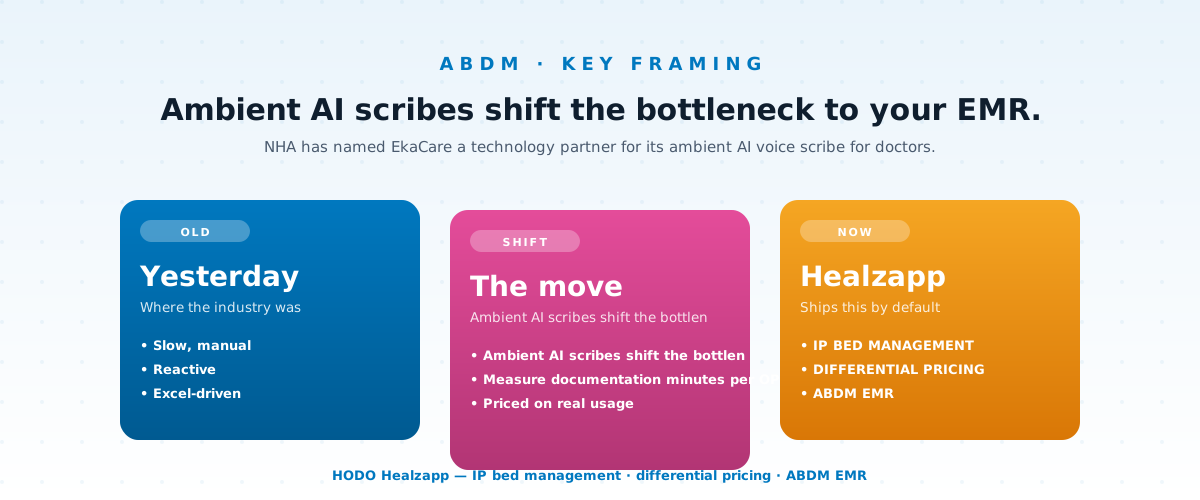
Ambient AI scribes shift the bottleneck to your EMR.
The throughput maths behind the documentation burden
Consider a typical 100-bed hospital running 300 to 600 OP consultations a day across 12 to 20 consultants. An OP consult that nominally gets eight minutes often spends two to three of those on writing, typing or dictating to a junior. If an ambient scribe recovers 90 seconds per consult, that is roughly seven to twelve consultant-hours recovered across the roster every single day. On paper, that is two extra clinic sessions.
In practice, most of it evaporates. Recovered minutes convert to throughput only if the rest of the OP line can absorb them — registration, token calling, billing counters, sample collection and investigation ordering. If a consultant finishes a note 90 seconds earlier but the next patient is still at the billing counter, the hospital has bought idle time, not capacity. This is why the baseline measurement matters more than the pilot. Before anyone demos a scribe, a hospital should know three numbers: average documentation minutes per OP consult, the percentage of OP notes closed on the same day rather than back-filled the next morning, and the share of OP records carrying a usable diagnosis entry. Without those, there is no way to tell whether a scribe improved anything or simply moved the queue's pinch point one desk to the left.
A scribe is only as good as the record it writes into
Ambient transcription solves the wrong half of the problem if the EMR cannot represent what was said. A good consultation note is not a transcript — it is a transcript reduced into a problem, an assessment, orders and a plan. Hospitals that want scribe output to be worth anything in six months need fields for each of those, plus a clean link between the order placed in the note and the test actually billed and run.
There is a second, quieter requirement: retrieval. The scribe writes today's encounter, but the consultant still needs the previous three visits, the last haemoglobin trend and the current medication list inside twenty seconds, because the patient is already seated. A hospital that automates note creation without fixing note retrieval has optimised the output side of the consult and left the input side untouched. The same applies to diagnostics-heavy setups — lab chains and hospitals with in-house labs — where machine-interfaced results need to land against the right encounter automatically. Otherwise the consultant spends the saved 90 seconds hunting for a report that arrived by WhatsApp.
The TPA and PMJAY angle nobody demos
Documentation quality in Indian hospitals is not primarily a clinical governance issue; it is a cashflow issue. Claim queries and rejections under TPA and PMJAY cluster around predictable gaps: missing justification for a procedure, an admission note that does not support the length of stay, a discharge summary issued days after the patient left. Ambient documentation has a genuine, measurable role here — a discharge summary drafted at the bedside while the consultant speaks is a summary that can go out the same day.
But only if the drafted text reaches the claims path with the required fields populated and attributable. Three things decide that. First, structure: the claim needs coded diagnoses and procedure entries, not prose. Second, attestation: an AI draft is a draft until a named clinician signs it, and the system must record who edited what and when, because a payer audit will ask. Third, timing: the gain comes from closing the summary before the patient's file leaves the floor, which means the scribe has to be available at the ward, not only at the OP desk. Hospitals evaluating a scribe should ask how it behaves in a four-bed room at 11 a.m., not in a quiet demo room.
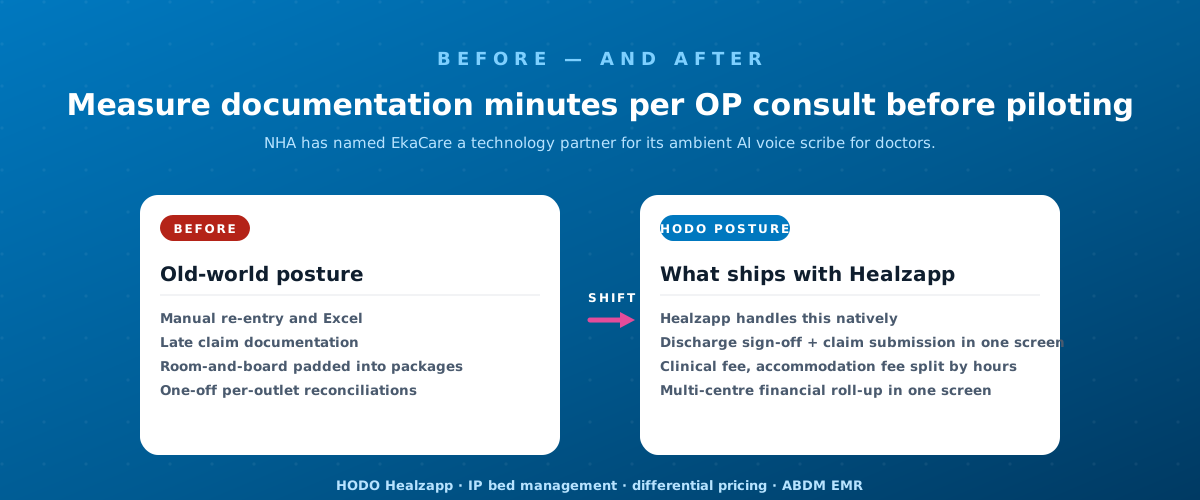
Measure documentation minutes per OP consult before piloting.
What to settle before the pilot reaches your hospital
A short, unglamorous checklist beats enthusiasm here. Check ABHA linking rates against actual OP footfall — a hospital linking 20 per cent of visits is not ready to argue about scribe accuracy. Audit whether the EMR stores structured fields or free text. Decide the sign-off policy in writing: who attests, how corrections are logged, what happens when the draft is wrong. Test in the real acoustic environment, with real code-switching between English and the local language, because Indian OPD speech is rarely monolingual and almost never quiet.
Then decide who owns correction time. If the scribe is 90 per cent accurate and a nurse spends four minutes fixing each note, the hospital has shifted work from consultants to nursing — defensible, but it must be a decision rather than a surprise. For multi-outlet groups, settle the configuration question early: a scribe rolled out across six centres with six different note templates generates six different data problems.
What this means for HODO customers
The national pilot will make ambient documentation normal faster than most hospitals expect, and the differentiator will be the record underneath it. Healzapp's ABDM-compliant EMR already stores encounters in structured, linkable form, which is what any scribe output needs in order to survive past the consultation. EMR (AI-condensed history) addresses the retrieval half of the problem — prior visits, medications and trends summarised before the consult starts, so the time recovered on writing is not lost on searching. For hospitals running in-house diagnostics, Machine Interfacing keeps analyser results attached to the correct encounter, so orders placed in a note and results returned to it stay in one thread rather than arriving separately over WhatsApp.