Nicobar Times reports that the ABHA mobile application will be discontinued from 31 October, with citizens advised to move to Aarogya Setu 2.0 for creating and managing their Ayushman Bharat Health Account. For patients this is an app migration. For a 100-bed hospital or a lab chain with eight collection centres, it is a registration-counter problem that lands on a Saturday morning with a queue already forming.
What actually changed, and what did not
The ABHA number has not changed. The 14-digit identifier a patient already holds remains valid, as does the ABHA address. What is going away is one of the consumer-facing front doors to that identifier, the standalone ABHA app, with Aarogya Setu 2.0 positioned as the replacement for creation, linking and record viewing.
That distinction matters because most hospital desks have quietly built their SOP around the app rather than the number. Staff have been trained to say "open your ABHA app and show me the QR". Patients have been told to download it. Some registration counters verify identity by looking at the app screen rather than capturing the number into the HIS. When the app disappears from the patient's phone or stops refreshing, that SOP fails silently, not with an error message, but with a 90-second argument at the counter, repeated forty times a day.
The operational lesson is older than ABDM itself: identity should be captured as data in the system of record, not as a screenshot on a patient's device. Any desk workflow that depends on a specific consumer app being installed, logged in and online has a single point of failure outside the hospital's control.
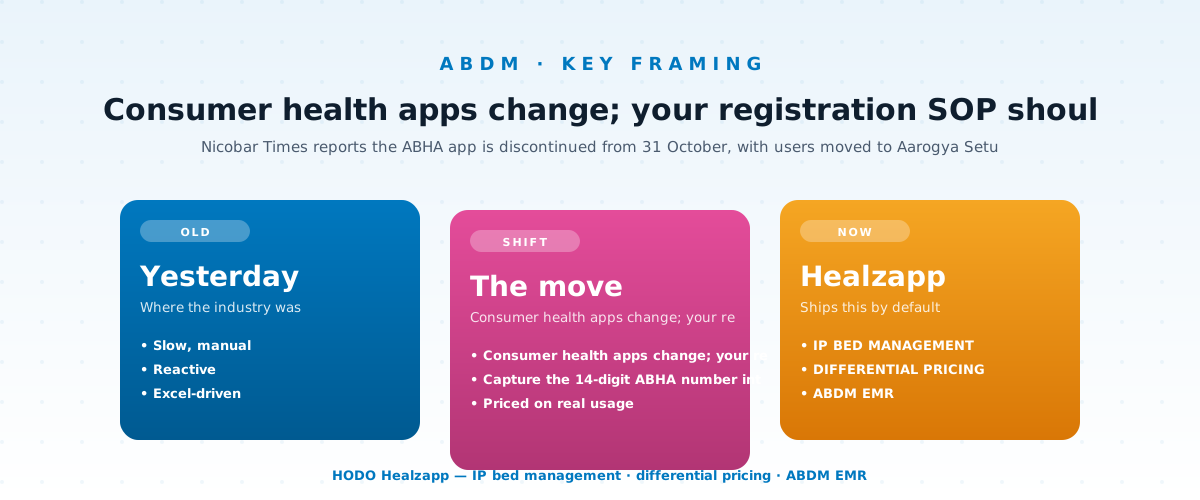
Consumer health apps change; your registration SOP should not.
Where the breakage will show up first
Three failure points are predictable in the first fortnight of November.
The first is scan-and-share check-in. Hospitals running ABDM scan-and-share at the OP counter rely on the patient presenting a QR code from a consumer app. If a patient's app is gone and they have not yet installed the replacement, the counter either falls back to manual demographic entry or stalls. Desks that have not rehearsed the fallback will stall.
The second is new ABHA creation. Counters that were sending walk-in patients off to "download the app and come back" have been outsourcing creation to the patient. That was always a weak design, it inflates repeat visits to the desk and depresses linkage rates. With the app changing, it collapses.
The third is record linking for IP admissions and lab reports. If the ABHA number was never written into the patient record, there is nothing to link against later. The hospital holds a clinical record that cannot be pushed to the patient's longitudinal view, and a compliance claim it cannot substantiate.
None of these require a technology change. They require the registration SOP to be rewritten so that the ABHA number is captured and stored at the point of registration, in the HIS, by hospital staff, with the consumer app treated as optional convenience rather than as the mechanism.
The desk script to rewrite this week
A workable counter script has four steps and should take under a minute on an existing patient.
Ask for the ABHA number or ABHA address directly, not for the app. Most patients who created an ABHA have the number on a printout, an SMS, or in a photo. If they have it, capture it into the patient record and move on, no app needed.
If the patient does not have it, offer creation at the counter. Aadhaar-based or mobile-based creation handled by the registration executive takes less time than explaining an app download, and the number lands straight in the record.
If the patient declines, record the decline and proceed with normal registration. ABHA is voluntary. A desk that treats it as mandatory creates friction and bad data in equal measure.
Finally, print or message the ABHA number back to the patient alongside their registration details so the next visit, at any outlet, starts from data rather than from a phone. Hospitals using WhatsApp or SMS for appointment and report communication already have the channel for this; the number simply needs to ride along on messages the patient is already receiving.
Audit the result weekly. The metric worth tracking is not "ABHA app installs" but the percentage of new registrations in which an ABHA number was captured, broken down by counter and by outlet. That number tells a hospital where retraining is needed and gives NABH and ABDM reporting something defensible.
Multi-outlet lab chains carry more of this risk
For a diagnostic chain, the exposure is wider because the touchpoints are shorter. A patient at a collection centre spends three minutes at the desk, not thirty. Phlebotomists at home collections have no desk at all. Franchisee-run centres follow whatever SOP they were last trained on, which may be a year old.
Chains that have pushed ABHA capture down to the franchisee counter without central enforcement will now discover a wide variance: some centres at 60% capture, others at near zero, with no one accountable. The fix is structural. ABHA capture belongs in the central registration master, configured once and applied to every outlet, with the same mandatory-versus-optional behaviour everywhere. One-click new-centre setup is only useful if the new centre inherits the registration policy, not just the rate card.
Report delivery is the second exposure. A lab that was relying on a consumer app for patients to retrieve reports has just lost a delivery channel it never controlled. Chains delivering reports over WhatsApp, SMS and email keep working through the transition without a single support call, which is the practical argument for owning the delivery channel rather than renting it.
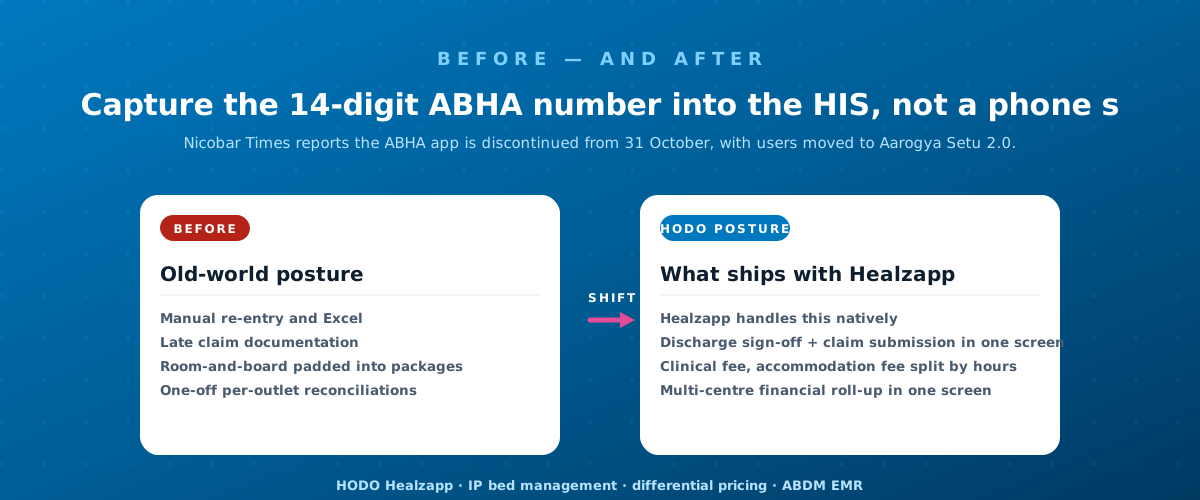
Capture the 14-digit ABHA number into the HIS, not a phone screen.
Treat the consumer app layer as volatile
The broader read for Indian operators is that ABDM's government-facing apps will keep changing. Interfaces consolidate, apps merge into larger platforms, and advisories arrive with two weeks of notice. The standards layer, the ABHA number, the consent framework, the health information provider and user roles, has been far more stable than the apps sitting on top of it.
Operators should therefore invest in the parts that do not churn: clean capture of the identifier at registration, correct linkage of clinical records inside the HIS, consent handled through the HIS rather than verbally at a counter, and a patient-facing channel the hospital owns. Hospitals that did this when ABDM integration was first certified are reading the 31 October advisory as news about their patients' phones, not as a project. Hospitals that built the SOP around an app are about to run a sprint.
What this means for HODO customers
The changes needed here sit in registration and records, not in any consumer app. ABDM-compliant EMR in Healzapp holds the ABHA number against the patient record and keeps linkage and consent inside the hospital's system, so a change in the citizen app does not touch clinical linkage. Patient Management enforces the same registration behaviour across every counter and outlet, useful for chains where franchisee desks drift from central SOP. WhatsApp/SMS report delivery and the Patient Health App give patients a route to their reports and records that the hospital controls, rather than one that depends on which government app is current this quarter. For multi-outlet groups, Multi-outlet scale-up with one-click new-centre setup propagates the corrected registration policy to new centres instead of leaving each one to improvise.