Mid-Day reports that the Brihanmumbai Municipal Corporation will run a 100-day drive from October 2 to create digital health IDs for residents, pushing ABHA registration through civic health posts, dispensaries and municipal hospitals. For private hospitals and diagnostic chains in and around Mumbai, this is not a policy story, it is a front-desk story. Within a few weeks, a measurable share of walk-ins will arrive already holding an ABHA number and expecting the provider to do something with it.
An ID drive is a registration event, not an IT project
Civic drives are good at one thing: issuing identifiers at volume. Mumbai's municipal network can generate lakhs of ABHA numbers in 100 days because creation is a two-minute Aadhaar-and-mobile transaction. What it cannot do is attach clinical history to those numbers. That happens only where care is delivered, a registration counter, a collection desk, a billing window.
So the practical effect of the BMC drive on a 100-bed hospital in Andheri or a four-outlet lab chain in Thane is a change in the input mix at the counter. Today most patients present a mobile number, sometimes an old MRN card, occasionally a TPA card. From October onwards a growing share will also offer a 14-digit ABHA number or an ABHA address. If the registration screen has no field for it, the front desk will do what front desks always do under queue pressure: skip it, and create a fresh record.
That is the failure mode worth planning for. Nobody will fine you for it this quarter. It is an operational problem, a patient already in your system now exists twice, and the second copy carries the identifier that will eventually be used to pull history.
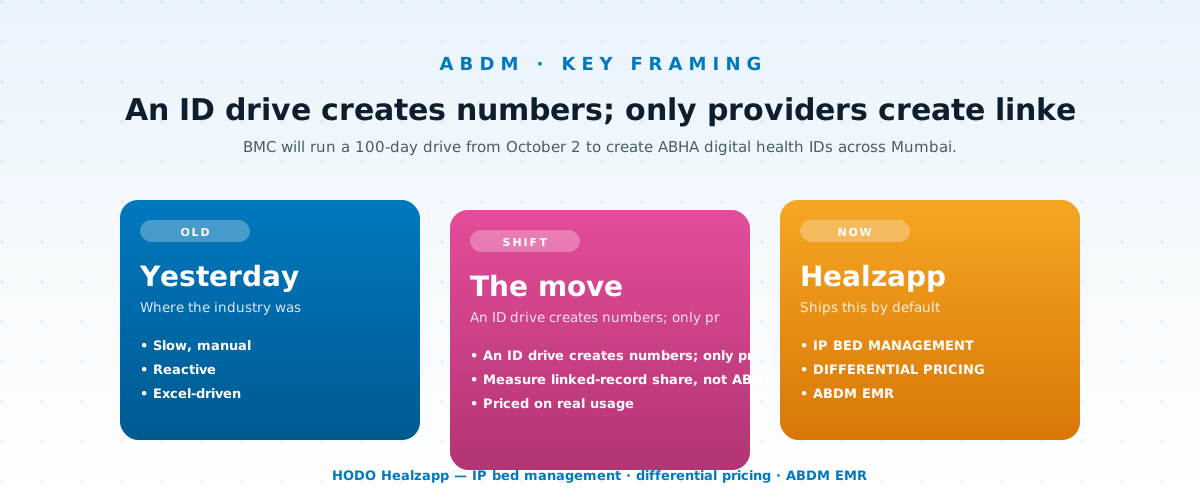
An ID drive creates numbers; only providers create linked records.
The gap between an ABHA number and a linked record
Hospitals already integrated with ABDM know the distinction, but ID drives blur it. An ABHA number is an identity. A linked record is an identity tied to a specific episode of care in your system, with a consent artefact behind it. The first is created by the citizen or a civic worker; the second only by the provider.
During the drive, the number that will be quoted in press coverage is IDs created. The number that matters inside your hospital is the share of OP and IP registrations in which an ABHA was captured and linked to the existing patient record rather than a new one. Those are very different metrics, and a hospital can score high on the first while scoring near zero on the second.
Getting the second number up is mostly a workflow design question. The counter needs a search-first flow: take the mobile number, search the master index, show the receptionist any existing record with name and last visit date, and only then offer "create new". ABHA capture belongs after identity resolution, not before it. Hospitals that bolt an ABHA field onto the top of a registration form without fixing search end up with cleaner identifiers sitting on dirtier records.
The same logic applies to lab chains, where the problem is worse: a home collection booked over the phone, a walk-in at a franchisee outlet and a corporate camp entry can all produce three records for one person. An ABHA attached to only one of them consolidates nothing.
What a surge costs at the counter
Treat the next 100 days as a capacity question. If registration takes 90 seconds per OP patient and ABHA capture plus verification adds 30 to 40 seconds, a hospital doing 400 OP registrations a day has added three to four hours of counter time across shifts. That comes out of either queue length or staff overtime.
There are three ways to absorb it. First, move capture upstream, let patients enter the ABHA number themselves while booking, through an appointment link or a patient app, so the counter only verifies. Second, make verification single-step; if the receptionist has to switch to a browser tab, log into a separate portal and copy a number back, the 30 seconds becomes two minutes and the field quietly stops getting filled. Third, decouple the queue from the paperwork: a token display that keeps the waiting area informed buys the counter the extra seconds without the visible crowding that makes staff cut corners.
Also plan for the questions. Patients who got an ABHA at a civic health post will ask what it does and whether their reports will appear in it. Staff who cannot answer in one sentence will treat the field as a nuisance, so a scripted two-line answer taped to the counter is a cheap intervention.
The drive will expose mobile number hygiene
ABHA creation is tied to a mobile number, which means the drive will surface a problem most Indian hospitals and labs already have: the phone number on file is wrong, shared or belongs to a relative. When a patient's ABHA is linked to one number and your record carries another, every downstream automation breaks, report delivery, appointment reminders, discharge follow-up calls, recovery of pending TPA documents.
This is the part of the drive with immediate commercial value. Verifying and correcting mobile numbers at the counter for 100 days gives a hospital or lab a database that can actually be messaged. For a lab chain, that directly affects cost per test: every report delivered on WhatsApp instead of a printed copy collected in person removes a counter interaction and a courier leg. For a hospital, it affects the OP revisit rate, because reminder messages reach the patient rather than a disconnected number.
The discipline is simple and worth enforcing: no registration closes without a mobile number verified in the patient's presence, and no second record is created for a mobile number that already exists in the index. Audit a sample of 50 registrations a week against those two rules and the trend will tell you whether the policy is real or decorative.
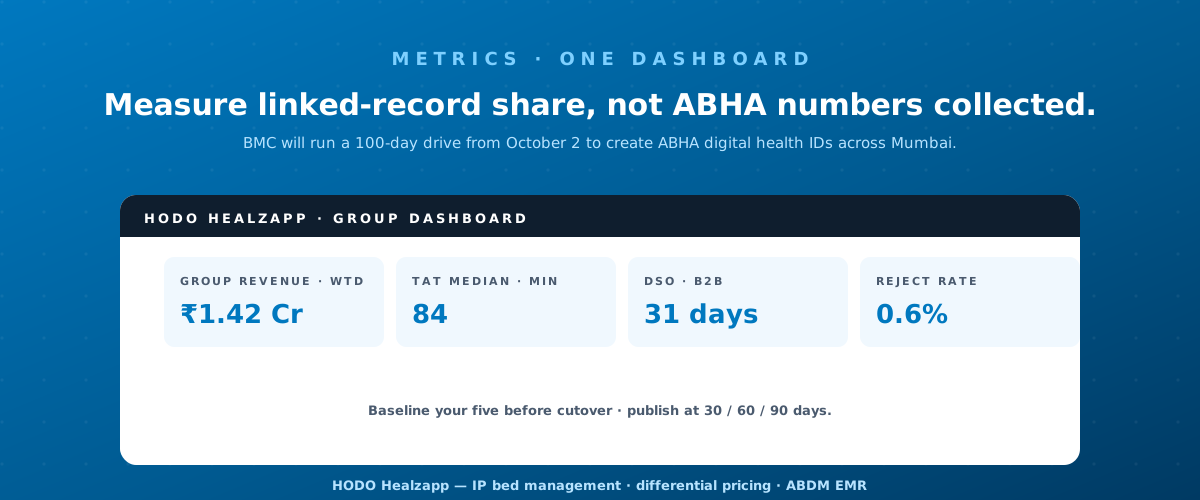
Measure linked-record share, not ABHA numbers collected.
Four numbers to run for the next 100 days
Pick a small dashboard and review it weekly rather than building a project plan. ABHA capture rate, as a percentage of total OP and IP registrations, tells you whether the counter is doing the work. Linked-to-existing-record ratio, ABHA captures attached to a pre-existing patient file, divided by total captures, tells you whether identity resolution is working. Duplicate creation rate, measured as new records created for a mobile number already present in the master index, is the cleanest early warning of counter shortcuts. Average registration time, sampled twice a week at peak hour, tells you what the capture discipline is costing in throughput.
Multi-outlet operators should break all four by centre. Capture rates vary more between two branches of the same chain than between two chains, because they track supervisor attention rather than software. The branch at 70 per cent and the one at 8 per cent are usually running identical systems.
What this means for HODO customers
The BMC drive makes identity hygiene an operational priority in Mumbai first, and most Indian metros will follow with their own versions. Patient Management handles the search-first registration flow and the master patient index that stops a second record from being created for a patient who already exists. ABDM-compliant EMR ties the ABHA number to that single record, so linkage reflects real care episodes rather than counter entries. WhatsApp/SMS report delivery and the Patient Health App convert the verified mobile numbers collected during the drive into fewer counter visits and lower report delivery cost. For chains, Multi-outlet scale-up with one-click new-centre setup keeps the same registration rules in force when a new collection centre opens mid-drive.