The Hans India reports that the Ayushman Bharat Digital Mission has crossed 100 crore health records linked to ABHA accounts, a scale ABDM took roughly four years to build. For ~100-bed Indian hospitals and lab chains, the milestone is less a headline than a workload preview: patients will start walking in expecting their history to be pulled, and back-office teams have to be ready for that fetch to be routine, not novel.
The scale shift most hospital IT teams are under-planning for
A 100 crore record base means the median new OP patient at an Indian hospital or lab chain now has at least one document sitting in a Health Information Provider somewhere, a prescription, a lab report, a discharge summary. Until 2024, ABHA fetches were an occasional novelty at the registration desk. From this milestone onward, the assumption flips: registration staff should treat 'no prior record' as the exception, not the default.
That flip has operational consequences the marketing decks skip. Every ABHA-linked fetch adds 30–90 seconds to registration if the workflow is not pre-wired, consent flow, HIP selection, document filter, doctor handoff. Multiply that by 400–600 OP registrations a day at a busy 100-bed hospital and the front desk loses one full-time equivalent to consent clicks unless the HIS handles it in-line. NABH auditors are also starting to ask for the consent artefact by MRN, not just a screenshot, so the workflow needs to persist the ABDM consent ID against the visit, not against the day.
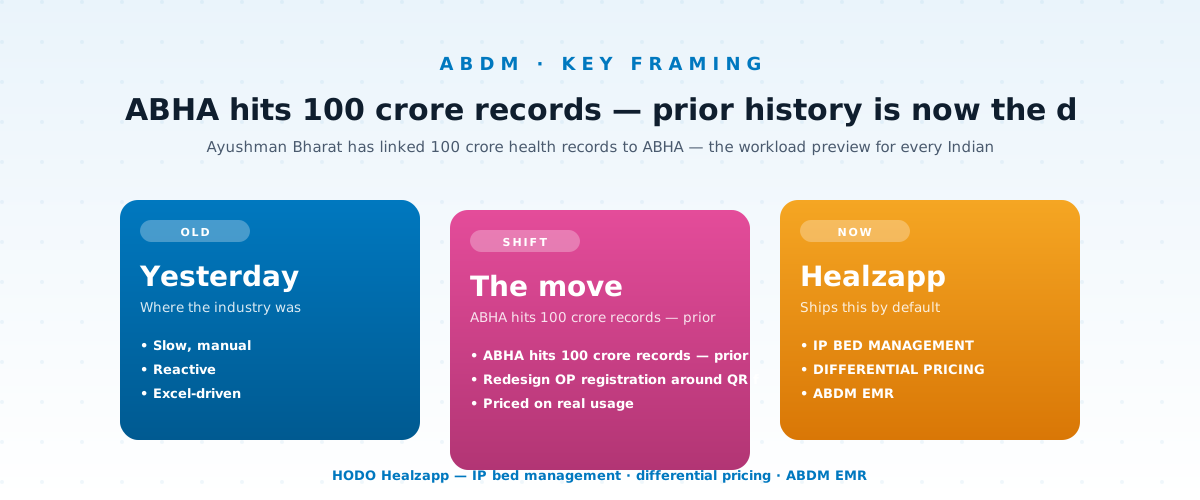
ABHA hits 100 crore records, prior history is now the default.
What the fetch actually costs at the OP desk
The typical 100-bed hospital in Kerala, Tamil Nadu or Maharashtra runs two to four OP counters, one billing desk, and a shared lab collection point. Adding ABHA fetch to that flow without redesign creates three friction points. First, receptionists ask for the 14-digit ABHA number verbally, mistype it, and re-scan, a QR-first flow removes that. Second, the fetched documents arrive as PDFs the consulting doctor has to read cold, adding two to three minutes per patient, an AI-condensed summary at the top of the chart cuts that. Third, the billing desk cannot see whether the fetched prior lab report obviates a repeat test, so duplicate orders slip through and the patient pays twice.
Hospitals that treat ABHA as a compliance checkbox will hit these frictions inside the first month. Hospitals that treat it as an OP-throughput lever redesign the counter, QR scan, consent capture, AI-condensed prior-history panel, and a repeat-test flag, before the volume arrives.
Diagnostic and lab chains carry the linkage burden twice
Standalone diagnostic labs and lab chains sit on both sides of the ABDM plumbing. As Health Information Users, they fetch prior reports to avoid unnecessary repeats and to give the reporting pathologist context. As Health Information Providers, they push every completed report back into the patient's ABHA so it is available at the next hospital visit. Both directions have to work, and both have to be logged for NABL surveillance.
For a lab chain with 15–40 collection centres, the operational question is not 'can we integrate?', the sandbox work is done. The question is whether the LIMS auto-pushes the finalised report to ABHA the moment it is signed, without a phlebotomist clicking anything, and whether the pushed record carries the correct SNOMED/LOINC codes so downstream fetches surface it. Chains still doing this as a nightly batch will see report-availability complaints from patients who leave the centre expecting the record to show up in their PHR app that evening.
Multi-outlet groups: one patient, five outlets, one identity
A hospital group running one flagship and four satellite clinics, or a lab chain with a hub lab and 20 collection points, has a specific pain the 100-crore milestone amplifies. The same patient walks into three different outlets and gets three different MRNs, then links all three visits to a single ABHA. If the group's HIS or LIMS does not de-duplicate on ABHA at the group level, the patient's chart shows up fractured at every outlet and the group forfeits the very continuity ABDM was built to deliver.
The fix is architectural, not cosmetic. New outlet onboarding has to inherit the master patient index, the ABHA-to-MRN map, and the consent artefact store from day one, not weeks later when the outlet finally submits its first ABDM claim. Groups that spin up new centres on the same HIS instance with pre-wired ABDM plumbing move faster than groups stitching integrations per site, and their finance teams see cleaner cross-outlet revenue attribution as a bonus.
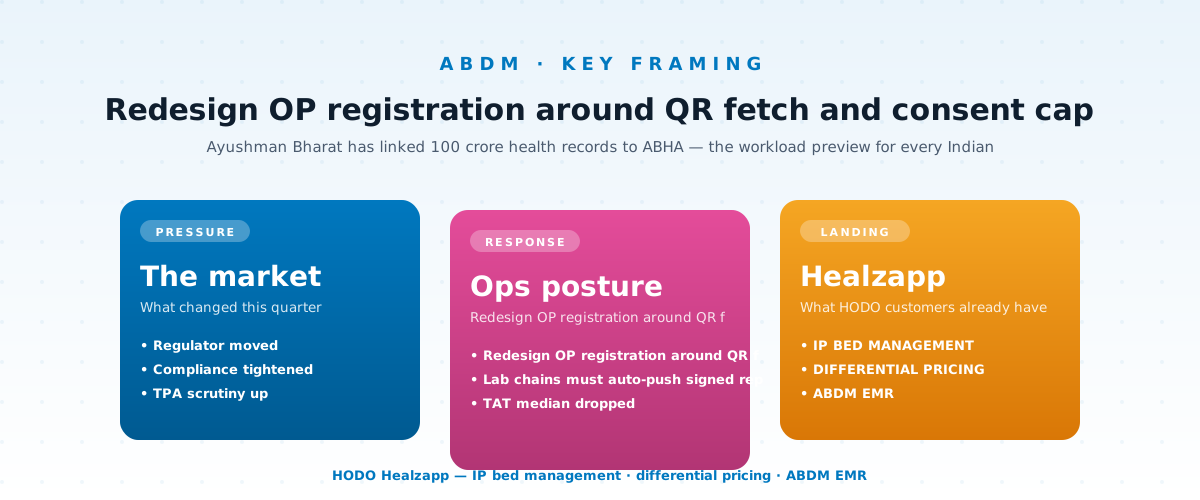
Redesign OP registration around QR fetch and consent capture.
Report delivery is now the last visible touchpoint
The other side effect of ABHA scale is that patients increasingly expect the report to reach them before they reach home. WhatsApp delivery is now the default channel, SMS is a fallback, email a formality. Any lag between report finalisation and delivery becomes a support ticket, because the patient is checking their PHR app in the car park. The report has to leave the LIMS or HIS the same minute it is signed, and the delivery has to be logged so the front desk can answer 'did you get it?' without opening the messaging vendor's console. This is where a hospital's NPS quietly rises or falls, and it is fully within the HIS's control.
What this means for HODO customers
The 100 crore milestone is not an ABDM celebration, it is a load-test notice for every Indian hospital and lab chain that has been running ABHA as a side workflow. Three Healzapp capabilities carry most of the weight here. ABDM-compliant EMR keeps the fetch, consent capture, and push in-line at the counter so registration time does not blow up when volumes rise. EMR (AI-condensed history) collapses the fetched PDF stack into a summary the consulting doctor can read in under a minute, which is what protects OP throughput at 400+ registrations a day. WhatsApp/SMS report delivery closes the loop the moment a report is signed, so the patient's PHR app and the hospital's front desk stay in sync. For groups scaling to a fifth or sixth centre, Multi-outlet scale-up with one-click new-centre setup means the new outlet inherits the ABDM plumbing on day one instead of week six.