Union Health Secretary Smt. Punya Salila Srivastava launched NCG VISHWAS at the National Cancer Grid Annual Meeting 2026 and used the occasion to press a point that is administrative rather than clinical: cancer screening records must be linked to the Ayushman Bharat Health Account (ABHA) if continuity of care is to mean anything, per the PIB release carried on Google News. For a 100-bed hospital or a lab chain that runs screening camps, that is a records-plumbing instruction, not a policy abstraction. The gap between a screening positive and a confirmed diagnosis is where most Indian cancer pathways leak, and that gap is almost always a data-handoff failure rather than a clinical one.
What the NCG VISHWAS launch signals for record-keeping
The National Cancer Grid connects cancer centres across India for protocol harmonisation, training and quality benchmarking. A platform launched at its annual meeting carries weight well beyond the tertiary centres in the room, because the referral chain feeding those centres runs through district hospitals, secondary 100-bed hospitals and diagnostic chains that perform the first test. The Health Secretary's emphasis on linking screening records with ABHA is the operationally consequential part of the announcement. It shifts the unit of accountability from "a camp was conducted" to "a screened individual has a retrievable record that the next facility can actually open."
Anyone who has run an oral, breast or cervical screening camp will recognise the current state. Registers get filled, a few hundred people are screened, suspicious cases are advised to visit a hospital, and the follow-up rate is whatever the field team's phone calls manage to achieve. Nothing retrievable exists at the receiving end. When the same patient presents eight months later at a different hospital with a symptomatic lesion, the camp finding is invisible, and the clock restarts. ABHA linkage is the mechanism that lets a screening record survive the patient's movement between facilities, outlets and districts. It only works if the record was created against a verified ABHA at the point of screening, which is a front-office discipline problem long before it is a software one.
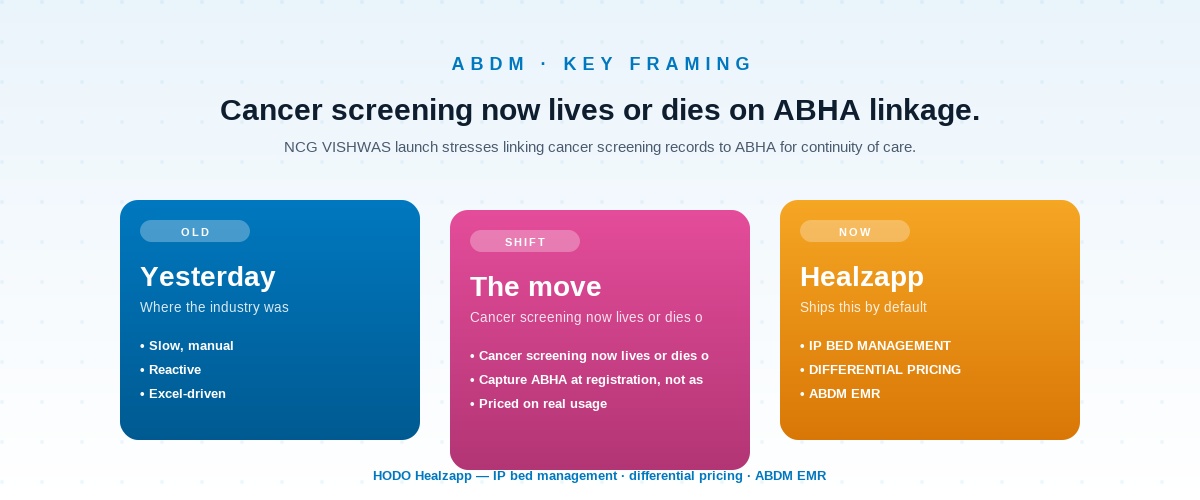
Cancer screening now lives or dies on ABHA linkage.
Screening is a records problem before it is a clinical problem
Screening programmes are usually measured by volume, because volume is the only number that is easy to collect. The numbers that determine whether a programme is worth its cost are conversion numbers: what proportion of screen-positives received a confirmatory diagnostic test, how long that took, and how many were never seen again. None of those can be computed unless three events sit on one identity: the screening encounter, the diagnostic confirmation, and the treatment initiation.
That argues for a small set of indicators that hospital and lab operators can instrument immediately. Share of screened records carrying a verified ABHA. Share of screen-positives with a diagnostic test raised within thirty days. Median days from screening to histopathology report. Loss to follow-up broken down by camp, by outlet and by the field team that ran it. These are ordinary HIS and LIMS queries once identity is consistent, and impossible when the camp data lives in a spreadsheet that never meets the hospital's patient master.
There is a cost argument here too. Screening camps are frequently funded as outreach or CSR activity, and their cost per screened person is tracked in isolation. The more useful figure is cost per confirmed diagnosis, which forces attention onto the follow-up mechanism rather than the tent and the banner. Hospitals that can produce that figure tend to redesign their camps within one cycle.
ABHA capture belongs at registration, not at discharge
The practical bottleneck is the registration counter. ABHA creation or verification adds seconds to a transaction that the front office is already trying to compress during morning OP peak, and in camp settings it competes with network coverage. The predictable consequence is that linkage gets deferred, and deferred linkage becomes retrospective data cleaning, which is the most expensive form of the same work.
Three habits separate hospitals that manage this from those that do not. First, ABHA capture is treated as part of registration itself rather than a separate compliance step, so demographic details are entered once and reused. Second, duplicate control is enforced at the counter: a patient arriving with a camp record, a walk-in OP visit and a PMJAY admission should resolve to one MRN, not three, because merge operations after the fact are slow and they corrupt longitudinal views. Third, camp registration runs on the same patient master as the hospital, with synchronisation once connectivity returns, instead of on a parallel register that someone types in later.
Front-office load is a real constraint, not an excuse, and it is worth measuring. Counter time per registration before and after ABHA capture is a number any hospital can collect over a single week. In most deployments the delta is small enough to absorb with better form design and a token display that keeps the queue predictable, and large enough that nobody should assume it away.
Where lab and imaging data breaks the chain
Cancer pathways are diagnostics-heavy, and diagnostics is where continuity usually fails for structural reasons. A cytology or histopathology report is a document, not a data field, and it frequently travels as an unstructured PDF or, worse, as a photograph on a messaging app. Scan reports behave the same way. Meanwhile the analyser values that do exist in structured form are often re-typed from a printout, which introduces transcription error into exactly the records that will be queried later.
Barcoded samples and direct machine interfacing remove the re-typing step and give the lab a defensible turnaround-time trail per sample rather than per shift. That matters for cancer work because the diagnostic interval is the metric the referral centre cares about, and because TAT disputes with referring doctors are otherwise unresolvable arguments about memory. For hospitals and chains that outsource histopathology or immunohistochemistry to a partner laboratory, the chain-of-custody question gets sharper: the sample leaves the building, the report comes back days later, and without tracked outsourcing the hospital cannot say where a pending case is sitting.
Report delivery is the last link. A screen-positive patient who never collects the report is clinically identical to a patient who was never screened. Automated delivery over WhatsApp or SMS, with delivery status visible to the operator, converts follow-up from a call-centre task into an exception list.
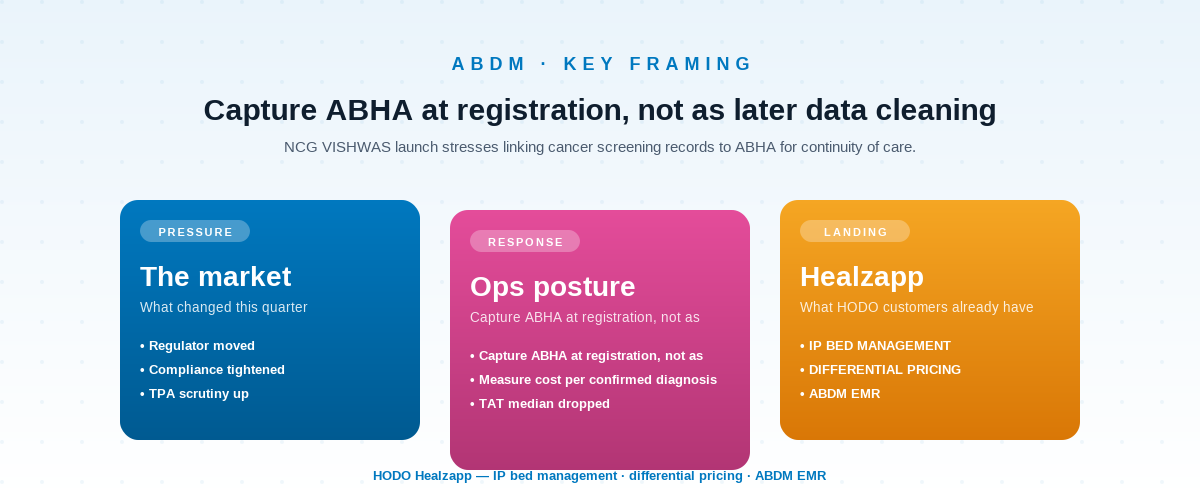
Capture ABHA at registration, not as later data cleaning.
The referral loop out of a secondary hospital
Most 100-bed hospitals will not treat the cancers they detect. They will refer, and the referral is where ownership typically evaporates. A letter is handed to the patient, and the hospital learns the outcome only if the patient returns. Under an ABHA-linked model the record is retrievable at the receiving centre, but retrievability is not the same as closure: somebody still has to confirm that the patient reached the tertiary centre and that a diagnosis was recorded.
The operational answer is to treat outbound referrals as open items with an owner and a review date, the same way a pending bill or an unverified PMJAY claim is treated. Referring doctors and corporate partners who send screening volume need a login to see status rather than a phone number to chase. That visibility also tightens documentation quality, which has a direct cashflow effect: PMJAY and TPA claims for oncology pathways turn on diagnostic evidence being attached correctly and early, and incomplete documentation is a predictable source of query cycles and delayed receipts.
What this means for HODO customers
The instruction coming out of the NCG meeting is narrower than it sounds. It does not ask hospitals to run better cancer programmes in the abstract; it asks them to make screening records portable by linking them to a verified identity, and then to prove that the next step actually happened. That is a question about registration discipline, diagnostics data quality and referral follow-through.
Healzapp carries this through three places. ABDM-compliant EMR keeps ABHA linkage inside the registration and clinical record rather than bolted on afterwards, so screening, OP and IP encounters sit on one identity. Machine Interfacing moves analyser results into the record without re-typing and gives per-sample turnaround visibility across outlets. B2B Referral / Outsource Lab / Corporate-partner logins give referring doctors, corporate screening partners and partner laboratories their own view of status, which is what turns a referral from a handed-over letter into a tracked item. For chains running the diagnostic side at scale, Labzapp covers the same ground with barcoded samples and TAT reporting across centres.