EnterpriseAM reports that UAE firms rushing into agentic AI are running into a data wall — pilots that demo well, then stall the moment an agent needs the organisation's own context to decide anything. For healthcare operators in the Gulf, that framing is generous: the missing asset is rarely raw data. It is institutional memory that no system in the stack currently holds.
The data wall is really a memory wall
The EnterpriseAM account describes a sequence familiar to anyone who has sat through an AI vendor demo in Dubai or Doha this year. An agent is given a task, performs convincingly on a clean sample, and then stalls the moment it needs the organisation's own history to act. The diagnosis offered is usually data quality — fragmented systems, inconsistent formats, no single source of truth. That is accurate but incomplete. Most healthcare operations in the region are not short of data; a mid-sized polyclinic group generates plenty of it every day across appointments, billing, insurance approvals and lab orders. What is missing is the layer above the data: the record of decisions, exceptions, standing rules and operational judgement that explains why the numbers look the way they do. An agent that can read a billing table but does not know that a particular insurer's pre-approval route changed in March will produce confident, wrong output. A data warehouse does not fix that, because the information was never written down anywhere. It lived in a manager's head, a WhatsApp thread and an email chain. The wall firms are hitting is the point at which autonomy requires memory the organisation never bothered to own.
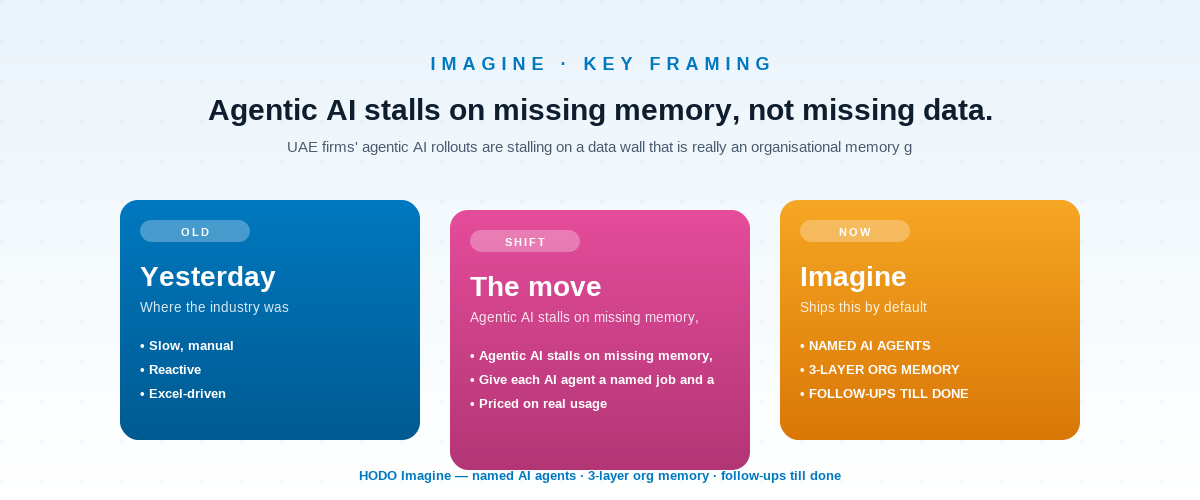
Agentic AI stalls on missing memory, not missing data.
What the wall looks like inside a Gulf polyclinic or lab group
Consider a three-branch polyclinic in Dubai or Kuwait City with twenty-odd doctors, an in-house lab and a growing home-collection arm. The questions that consume management time are not clinical. Why did one branch's insurance rejection rate double? Which doctor's slot pattern is dragging average wait time past forty minutes? Why has the new package stopped converting? Each of these has been asked before, answered before, and the answer has been lost. The person who investigated the rejection spike has since left for a competitor, and the reasoning went with them. The same pattern shows up in lab chains, where a partner's pricing exception or a repeat-sample rule is understood by one senior technologist and nobody else. Licensing adds another layer — DHA and MOHAP-style renewal, credentialing and documentation cycles create recurring work where last year's file notes would save a week, if anyone could find them. When an agentic tool is dropped into this environment, it inherits the amnesia. It can summarise a spreadsheet, draft a message or pull a report, but it cannot carry a decision forward, because nothing in the stack carries decisions forward. The pilot looks like an AI failure. It is an organisational memory failure wearing an AI costume.
Named agents with jobs, not a shared chat window
The standard response is to buy a better model or a longer context window. The more useful response is structural: give AI work the same shape given to human work. An agent with a name, a defined job, a reporting line and accountability behaves differently inside an organisation than a chat window shared by forty staff. Ownership is what makes output auditable. If one agent is responsible for insurance rejection analysis across branches, its outputs accumulate into a body of work that can be reviewed, corrected and cited. This is the design principle behind imagine's named AI agents: each has a job, a memory and a place in the reporting structure, so that work done in January is still available in June, to whoever holds that seat. It also changes what gets delegated. Generic assistants get used for drafting; owned agents get used for follow-through — chasing an insurer response, closing a credentialing checklist, tracking whether last month's scheduling change actually held. Operators evaluating agentic tools in the Gulf should test for this directly. Ask what the tool remembers after the session ends, who owns that memory, and whether a new manager inherits it on day one.
Memory in three layers, not one long transcript
Memory is not one thing, and treating it as a single undifferentiated log is why most deployments degrade within a quarter. Operational awareness works on different horizons. What happened today — which approvals are pending, which samples are in transit, which doctor called in sick — needs to be immediate and disposable. What is happening this week — the rejection trend, the TAT slippage, the half-finished licensing file — needs to persist long enough to act on, then fold into something durable. And what the organisation knows permanently — the insurer's actual pre-approval route, the partner lab's exception, the reason one branch's pricing differs — must survive staff turnover without being reconstructed from scratch. imagine's 3-layer memory separates these deliberately: today, this week, forever. The practical effect is that daily noise does not bury durable knowledge, and durable knowledge does not have to be rebuilt each time somebody asks. When a senior coordinator resigns, how much of what they knew is retrievable? In most clinic groups and lab chains the honest answer is close to nothing, and the cost shows up as three months of reduced throughput while a replacement rebuilds context. Memory that compounds is the asset; the agent is only the interface to it.
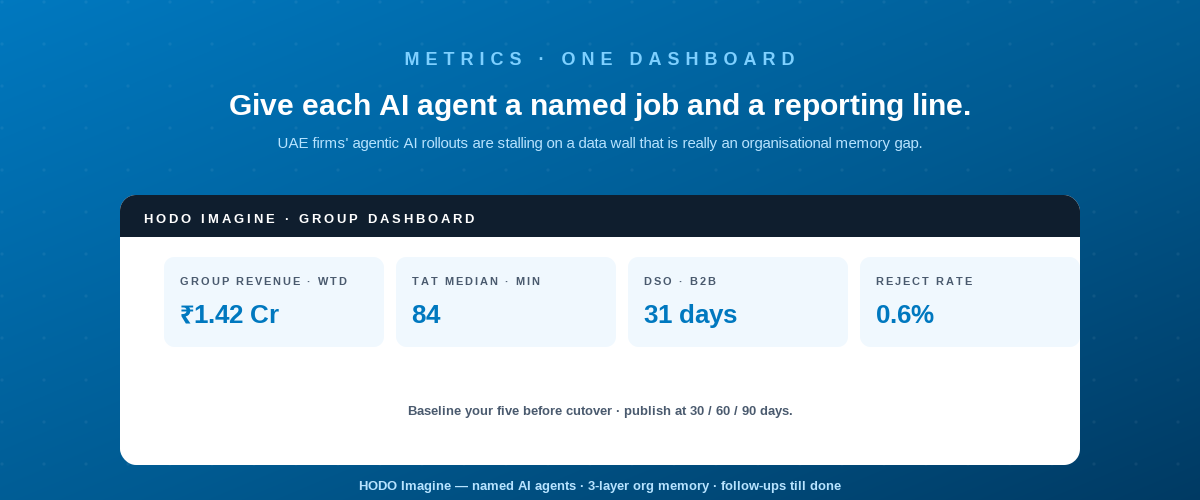
Give each AI agent a named job and a reporting line.
Voice and follow-through are governance, not polish
Two further failure modes separate a working deployment from an abandoned one. The first is voice. An operation that sends patient reminders, insurance correspondence, referral-doctor updates and partner-lab notices in four different registers reads as disorganised, and in a licensed environment inconsistency invites scrutiny. Brand voice consistency is not a marketing concern here; it is a control that makes outgoing communication predictable and reviewable. The second is closure. Most AI output dies as a draft. Agentic value appears only when tasks are followed up until they close — the insurer actually responds, the credentialing document is actually filed, the scheduling change is actually audited two weeks later. imagine's follow-ups until tasks close address exactly this gap, and it is the gap that distinguishes an organisational intelligence layer from a faster writing tool. None of this replaces the Microsoft 365, Copilot or ChatGPT licences a Gulf clinic group probably already holds. Those tools generate; the layer above them remembers, assigns and chases. Operators who skip the second half keep paying for generation and then wonder why the pilot never became an operating change.
What this means for digital transformation
The data wall described by EnterpriseAM is not a reason to delay AI adoption in Gulf healthcare — it is a signal that the sequencing is wrong. Context has to be owned before autonomy is worth anything. For a polyclinic group, a lab chain or a homecare operator, that means deciding which decisions are worth keeping, who owns them, and where they live when the person who made them leaves.
Three parts of imagine map directly onto that wall. Named AI agents with jobs, memory and reporting lines give AI work an owner and an audit trail instead of forty private chat histories. 3-layer memory — today, this week, forever — keeps daily operational noise separate from knowledge the organisation should never lose. Follow-ups until tasks close turn analysis into completed work, which is the only version that shows up in throughput or cost per patient. Knowledge stays owned by the organisation, so it survives churn instead of walking out with a resignation letter.
See how imagine turns AI into organisational intelligence — explore imagine.