Surgy Health has launched SurgyOne, described as an agentic AI-first HIS/EHR built for mid-market hospitals in India and the GCC, as reported by Business Standard. What is being sold is autonomy rather than module count, software that drafts, chases and closes work instead of waiting for a clerk to click through it. For a 100-bed hospital still running a decade-old HIS, the launch matters mainly because it re-opens a question most promoter-run hospitals have been deferring: what should an HIS replacement actually be judged on in 2026?
"Agentic" has become a category claim, not a feature
Until recently, HIS tenders in India were won on coverage, does the system do IP, OP, pharmacy, stores, lab, radiology, billing and MIS. Every serious vendor eventually ticked all the boxes, so differentiation collapsed into price per user and implementation timeline. The agentic framing changes the axis of comparison. A vendor is no longer claiming that the software records what happened; it is claiming the software will do part of the work, condense a case sheet, flag a missing pre-authorisation, assemble a discharge summary, follow up on an unbilled investigation.
That shift is relevant to Indian mid-market hospitals, because the binding constraint in a 100-bed facility is almost never a missing module. It is staff hours. One billing executive typically handles OP cash, IP interim bills, TPA documentation and PMJAY uploads. One medical records clerk handles coding, ABDM linking and discharge summary chasing. When a vendor sells autonomy, it is implicitly selling those hours back.
The difficulty is that autonomy is the easiest thing in healthcare software to demonstrate and the hardest to verify. A scripted demo of an AI drafting a discharge summary looks convincing on a clean dataset. The same model on a hospital's actual mixed-language case sheets, scanned consent forms and handwritten nursing notes behaves differently. The claim should be treated as a hypothesis to be tested, not a specification to be accepted.
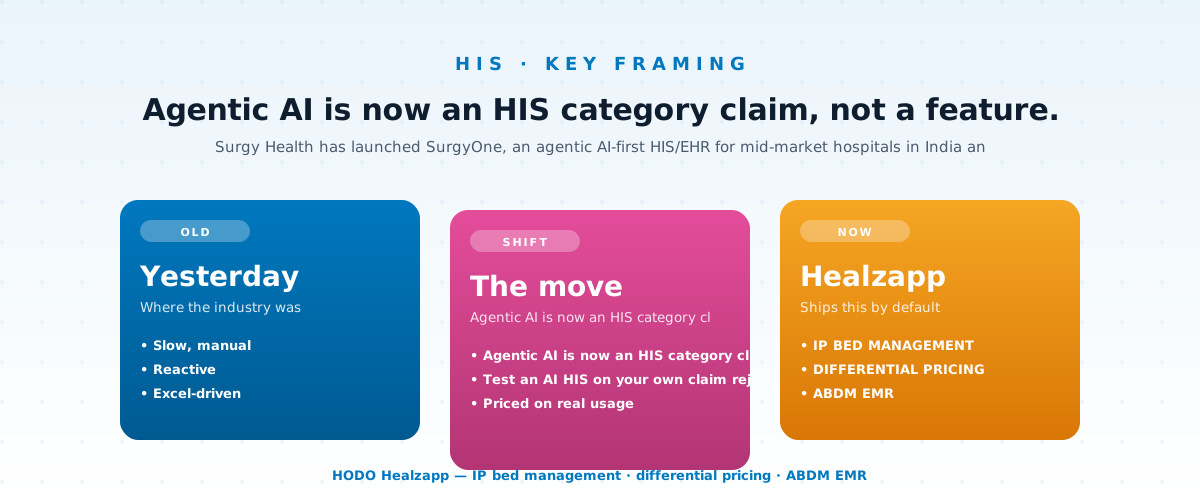
Agentic AI is now an HIS category claim, not a feature.
What to test in an agentic HIS demo
Insist on a pilot run on the hospital's own records rather than the vendor's sandbox. Three tests separate marketing from capability.
First, the messy-input test. Hand over fifty real case sheets, including the badly scanned ones, the ones with vernacular shorthand, the ones where the consultant's note runs to three lines, and ask the system to produce condensed histories. Read the output as a consultant would, looking for omitted comorbidities and invented detail.
Second, the exception test. Agentic workflows are judged on what they do when they cannot proceed. Ask what happens when a TPA portal is down, when an ABHA linkage fails, when an analyser returns a result for a test that was never ordered. A system that silently drops the task is worse than a manual process, because nobody is watching the queue.
Third, the audit test. Every autonomous action needs a visible trail: which agent did what, on whose authority, and which human approved it. NABH assessors and insurer auditors will ask. If the vendor cannot show a reviewable log of AI-initiated actions, the hospital is carrying a documentation risk it cannot quantify.
None of these tests require technical expertise. They require the hospital's own billing head, medical records officer and nursing superintendent to be in the room, instead of only the IT contact and the promoter.
Claims and cashflow are where autonomy earns its keep
For most 100-bed hospitals, the largest operational leak is receivables, not throughput. TPA and PMJAY payments move through pre-authorisation, query, resubmission and part-settlement, and in practice no single person owns that chain end to end. Claims get deducted for a missing investigation report or an unsigned consent, and the deduction surfaces weeks later during reconciliation, by which time the window to contest it has closed.
This is the clearest place to stress-test an agentic claim, because the outcome is measurable in rupees. Useful questions: what is the current average days-to-settlement by payer, and what does the vendor commit it will become? How many claims are deducted per hundred submitted, and for which recurring documentation reasons? Can the system flag an incomplete claim file before submission rather than after rejection?
A hospital that cannot answer the first version of those questions about its own operations is not ready to evaluate AI at all. The baseline has to exist before autonomy can be credited with improving it. The sensible starting point is a payer-wise ageing view and a deduction-reason analysis built from existing billing data, before anything autonomous is switched on. The same logic holds for lab chains hearing AI-first LIMS pitches: cost per test and TAT by centre are the baselines, and anything an agent does should move one of them.
Migration risk outranks AI risk
The failure mode in Indian HIS replacement is rarely that the new system lacked intelligence. It is that go-live went badly, OP queues collapsed for a fortnight, pharmacy stock did not tally, old reports became unreachable, and the hospital quietly reverted to parallel registers.
Any HIS evaluation this year should therefore weight migration mechanics at least as heavily as the AI roadmap. What happens to ten years of historical records: full migration, read-only archive, or abandonment? How many analysers and imaging modalities need interfacing again, and has the vendor done those exact models before? Who retrains the night-shift nursing staff, and over how many weeks? Is pharmacy and inventory cut over on the same date as billing, or staged?
Staged cutover is almost always safer in a mid-market hospital, because the staff absorbing the change are the same people running the floor. A vendor confident enough to propose a staged go-live, registration and billing first, then nursing and IP, then pharmacy and stores, is usually one that has done this more than twice. Reference checks should be equally specific: ask for a hospital of similar size and specialty mix that went live in the last eighteen months, and ask that hospital's billing head, not its promoter, how the first month went.
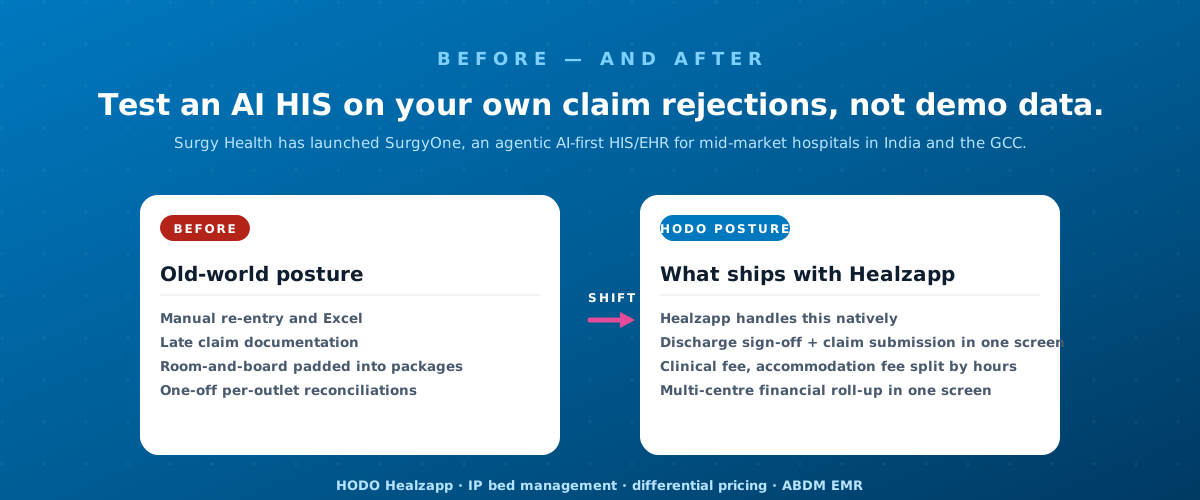
Test an AI HIS on your own claim rejections, not demo data.
What mid-market buyers should put in the tender
Four line items are worth adding to any HIS tender issued this year.
A data-exit clause. The hospital's records must be exportable in a documented, open format at any time, without a commercial negotiation. This single clause does more for long-term leverage than any feature.
Named-outcome commitments. Instead of accepting "AI-driven efficiency", write in the numbers: days-to-settlement by payer, claim deduction rate, registration-to-consult time in OP, discharge summary turnaround. Tie a portion of the implementation fee to them.
Interfacing scope in writing. Each analyser, modality, barcode printer and payment terminal listed by make and model, with responsibility and timeline against each.
Expansion terms priced upfront. Most mid-market groups add a second centre or a collection point within three years, and the cost of adding one should be known before signing rather than discovered later.
What this means for HODO customers
An HIS that does part of the work is a reasonable direction for mid-market Indian hospitals, provided the autonomy is scoped, logged and measured against a baseline the hospital already tracks. HODO Healzapp approaches it from the operational side rather than the headline side: EMR (AI-condensed history) compresses prior visits into something a consultant can read in an OP slot without losing the audit trail, Machine Interfacing removes the transcription step between analysers and the record, and Multi-outlet scale-up with one-click new-centre setup keeps the cost of a second centre predictable instead of treating each addition as a fresh implementation. Alongside ABDM-compliant EMR, that combination addresses the documentation and cashflow leaks before adding anything autonomous on top.