Surgy Health has launched SurgyOne, positioned as an agentic AI-first HIS/EHR for mid-market hospitals across India and the GCC, according to a launch report carried by ANI News. The framing matters more than the feature list: a vendor is now selling the autonomy of the software rather than the breadth of its modules. For a three-doctor polyclinic in Deira or a six-branch group in Abu Dhabi, that shifts the questions worth asking in the next procurement meeting.
What "agentic" changes in a procurement conversation
Most clinic systems sold in the region are still forms-and-fields software. A receptionist types, a doctor types, a cashier types, and the database faithfully records what was typed. An agentic system claims something different, that it will take steps on its own, such as drafting a clinical note from a consultation, chasing an incomplete claim file, or refilling a slot after a late cancellation. SurgyOne's launch puts that autonomy at the centre of the pitch instead of the edge.
The practical consequence for a polyclinic owner is that the evaluation checklist has to change. Module coverage is table stakes by now; almost every vendor selling into Dubai, Doha or Manama can demonstrate appointments, consultation notes, pharmacy and a cash counter. What separates systems today is whether the automation is auditable, whether a clinician can correct an AI-generated entry in one step, and whether the system degrades safely when the branch link drops for twenty minutes. Those are operational questions, not AI questions.
It also changes who should sit in the demo. If software is going to draft notes and nudge pending claims, the clinic manager, the insurance coordinator and at least one treating consultant need to watch the same screen. A decision made only by the owner and an IT contractor will miss the two places where agentic behaviour either saves real time or quietly creates rework for someone else.
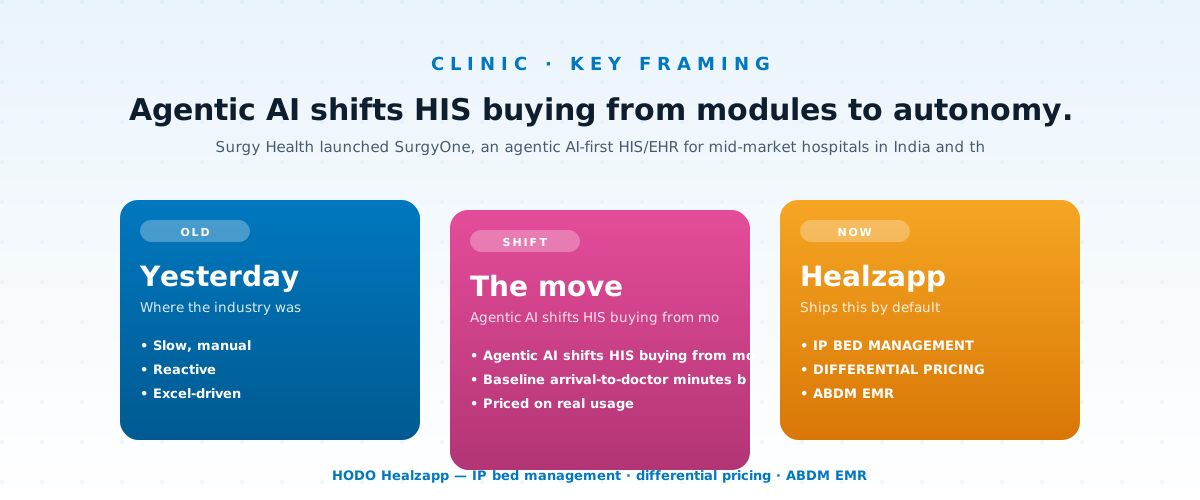
Agentic AI shifts HIS buying from modules to autonomy.
Why the GCC mid-market is the obvious launch target
The region's polyclinic layer is fragmented and consolidating at the same time. Single-location clinics are being bought into three- and eight-branch groups, and those groups inherit whatever software each site was running, often a licence bought a decade ago for one reception desk, now stretched across several emirates or across a Bahrain-Saudi footprint. The pain is not clinical. It is that the group cannot see today's revenue by branch before the end of the month.
Mandatory insurance in Dubai and Abu Dhabi, and the steady expansion of coverage schemes in Oman, Qatar and Saudi Arabia, mean that a growing share of a polyclinic's income arrives through a payer rather than over the counter. That makes the HIS a cashflow instrument, not a record-keeping tool. At the same time, licensing regimes run by DHA, MOHAP and DOH expect documentation discipline per practitioner, and staff turnover in reception and nursing roles is high enough that any system requiring three weeks of training is a liability.
Put those together and the mid-market GCC clinic is an attractive buyer for automation claims: high transaction volume per square metre, thin administrative headcount, expensive clinician minutes, and a payer process that punishes sloppy paperwork. Any vendor, SurgyOne, an incumbent, or HODO, is really selling relief from the same four pressures.
The front-desk test for an AI-first clinic system
Agentic claims are easy to demonstrate and hard to verify, so the only sensible response is to measure the clinic before the pilot starts. Three baselines are usually enough. First, minutes from patient arrival to doctor's room on a normal weekday evening, broken into registration, insurance eligibility check and waiting. Second, documentation minutes per consultation for two or three consultants, measured honestly, including the notes finished after the last patient leaves. Third, days from consultation to a clean claim leaving the clinic.
Once those numbers exist, every AI promise becomes testable. If a system drafts the consultation note, the question is whether documentation minutes fall and whether the consultant still signs something accurate, not whether the demo note read well. If the system claims to manage waiting, the measure is arrival-to-doctor minutes and the number of patients who walk out. Clinics that skip the baseline end up arguing about impressions six months into a contract.
A second test is less obvious but more revealing: ask what happens to the agent's decisions when they are wrong. Who sees the correction, where is it logged, and does the record show both the generated and the corrected version? A clinic that cannot answer this during evaluation will not be able to answer it during a licensing inspection either.
Insurance and billing decide GCC HIS projects
Most failed clinic software projects in the Gulf do not fail on clinical screens. They fail at the cash counter, where a receptionist has to apply the right payer rate, the right co-pay, the right package price and the right currency in front of a queue. A system that handles this cleanly removes an entire category of daily disputes. A system that does not will be worked around with spreadsheets within a month, and the group will lose consolidated visibility again.
The specifics are unglamorous and non-negotiable. Different tariffs per insurer and per corporate contract. Co-pay and deductible logic that the front desk does not have to calculate mentally. Multi-currency handling for groups operating across more than one country. Corporate and referral partners who want their own view of the patients they send. Clear separation between what the patient owes now and what the payer owes later, so that collection follow-up is a list rather than a memory.
None of this is AI work, which is precisely the point. Agentic features sit on top of billing correctness; they cannot substitute for it. The right order of evaluation is billing and payer handling first, automation second, and any vendor that wants to invert that order is worth a second look.
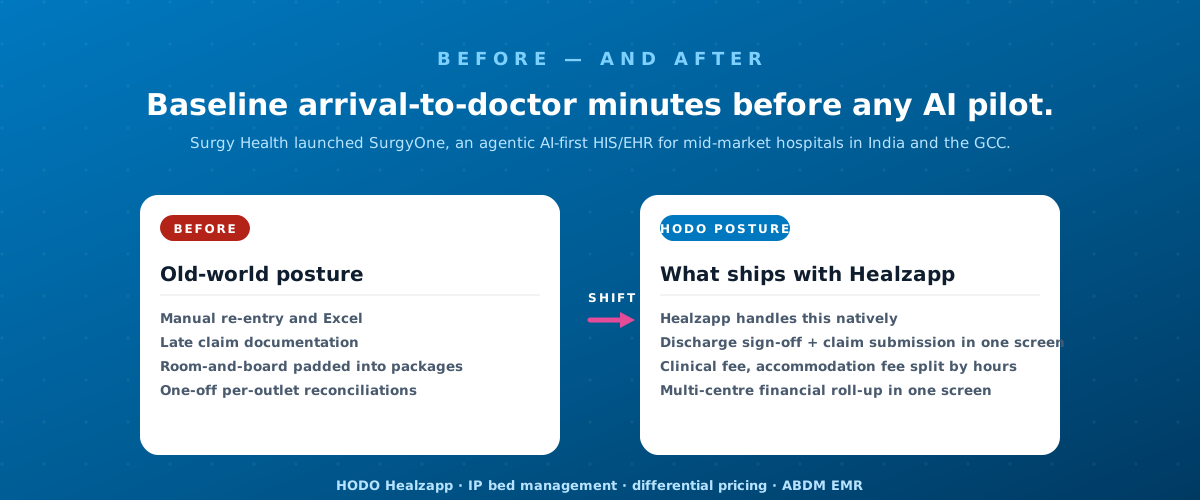
Baseline arrival-to-doctor minutes before any AI pilot.
Running the evaluation without betting the clinic
A sensible pilot is one branch, sixty days, three metrics and a named internal owner who is not the owner-doctor. Keep the old system running in parallel for billing reconciliation only, and agree in writing what happens to the data if the pilot stops: export format, timeline, cost. Data portability is the single clause most clinic groups forget, and it is the clause that determines whether the next switch takes two weeks or two quarters.
For multi-branch groups, add one more requirement. Ask to see a new branch created end to end during the evaluation, with its own licence numbers, tariffs and doctor roster, without a vendor services ticket. Groups that plan to open two sites a year cannot afford a four-week configuration project each time. The ability to stand up a centre quickly is worth more over three years than any single automation feature in the demo.
What this means for HODO customers
Healzapp already runs the operational spine that these agentic pitches are built to sit on, for both Indian clinic chains and UAE and wider GCC polyclinics. EMR (AI-condensed history) gives a consultant a usable summary of a returning patient's record without scrolling through years of visits, which is the documentation-time problem most AI-first claims are aimed at. Billing (incl. multi-currency / GCC patterns) with Differential pricing covers the payer, corporate and package tariffs that decide whether the front desk trusts the system. For groups adding sites, Multi-outlet scale-up with one-click new-centre setup turns a new branch into a configuration task rather than a project, and B2B Referral / Outsource Lab / Corporate-partner logins keeps referring partners inside the same record instead of on WhatsApp.