Surgy Health has launched SurgyOne, described as an agentic AI-first HIS/EHR built for mid-market hospitals in India and the GCC, in a launch report carried by Big News Network. The pitch is notable less for the modules it lists and more for what it puts at the centre: software that acts, rather than software that records. For a 100-bed hospital in Kochi, Nashik or Vijayawada, that reframes the questions worth asking in the next HIS evaluation.
The pitch has moved from module count to autonomy
For the last decade, HIS procurement in India has been a checklist exercise. Registration, OP, IP, billing, pharmacy, stores, lab interface, MIS, every vendor ticks every box, the committee compares price per user, and the decision is settled on implementation reputation and local support. Agentic positioning breaks that pattern deliberately. The claim is no longer "our system has these modules" but "our system will complete these tasks".
That is a meaningful shift, because the bottleneck in a mid-sized Indian hospital is rarely a missing module. It is the gap between what the module can capture and what the staff actually have time to enter. A discharge summary module exists in every HIS sold in India; the summary still takes three hours to finish because a junior doctor has to sit and type it. A denial-tracking screen exists; nobody reconciles it until the TPA ages the file past 30 days.
So the right response to an agentic launch is not scepticism about AI, and not enthusiasm about AI. It is a demand for evidence on specific tasks: which step currently takes staff time, how much of it the system removes, and what happens when it gets that step wrong.
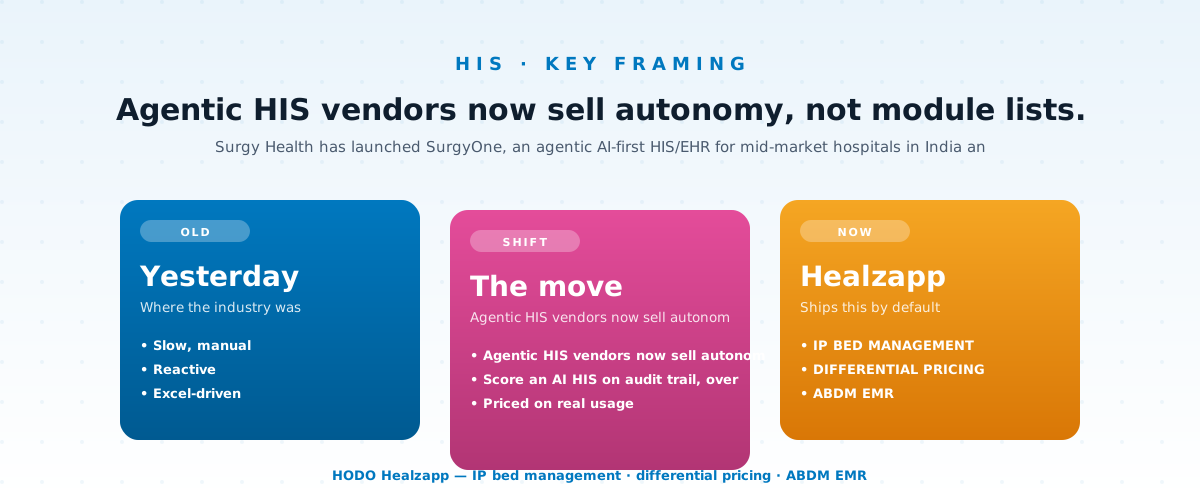
Agentic HIS vendors now sell autonomy, not module lists.
In a 100-bed hospital, the leak is the claim file
Bed occupancy and OP throughput get the attention in management reviews, but cashflow in this bracket is usually decided by the claim file. A hospital running 70 per cent occupancy with a payer mix weighted towards TPA and PMJAY can be operationally busy and still short of working capital, because the money sits 45 to 90 days out and a predictable slice comes back queried or short-paid.
The failure points are mundane and repetitive, which is exactly why automation is interesting here. Pre-authorisation submitted without the investigation report attached. Implant invoice missing from the surgical claim. Diagnosis coded on the discharge summary differently from the coding on the claim form. A query letter that lands in a shared inbox and is opened four days later. None of these require clinical judgement to fix; they require someone to notice, chase and close the loop before a deadline.
That is the honest case for agentic behaviour in a hospital system, not clinical reasoning, but relentless follow-up on administrative tasks that humans deprioritise under load. Any hospital evaluating SurgyOne or a comparable system should insist the demo run on this ground: show the denial queue, show what the system did unprompted, and show the audit record of each action. If the vendor demonstrates agentic AI only on note drafting, the demo is avoiding the part of the workflow that actually moves cash.
Agents inherit whatever data quality sits beneath them
An automation layer is downstream of structured data, and this is where many Indian deployments quietly fail. If haematology and biochemistry results arrive as scanned PDFs uploaded by a technician, no agent can reason about a trending creatinine. If pharmacy issues are posted in a batch at the end of the shift, no agent can flag an unbilled consumable before discharge. If the OP consultation note is one free-text paragraph, structured extraction becomes a second-guessing exercise.
Hospitals in this segment already know the symptom: an MIS that nobody trusts, because the numbers depend on when and whether someone keyed them in. Adding AI on top of that does not resolve the trust problem; it generates confident outputs from incomplete inputs, which is worse than an empty dashboard because it invites decisions.
The sequencing therefore matters. Direct analyser-to-system result capture, barcoded sample identification, point-of-use pharmacy and consumable posting, and coded diagnoses at discharge are not glamorous investments, but they determine whether any agentic layer has material to work with. A hospital that fixes capture discipline first will get value from a modest automation layer. A hospital that buys the automation layer first will spend the next year explaining why the AI keeps missing things.
The replacement question the demo usually skips
Most 100-bed hospitals considering an AI-first system are not greenfield. They are running a HIS that works badly but works, holding five or ten years of billing history, TPA tariff masters, doctor share calculations and package definitions that were never documented anywhere else. Replacement risk is the real cost, and it is rarely priced into the comparison sheet.
Practical diligence here looks like: who migrates the tariff and package masters, and who validates them against last quarter's actual bills. How outstanding claims already filed under the old system are tracked to closure during the cutover. Whether ABDM linkage and ABHA-based record sharing are already certified, or scheduled for a later release. What the pharmacy and stores opening stock reconciliation looks like on go-live day. Whether finance posting to Tally continues without a parallel manual entry for three months.
There is also a staffing reality. A hospital with four billing executives and one IT person cannot absorb a system that requires continuous prompt tuning or a data science resource to maintain. Automation that needs supervision by a skill the hospital does not employ is not automation. The sensible test is whether the existing front-office team can run the system in week three without the vendor sitting on site.
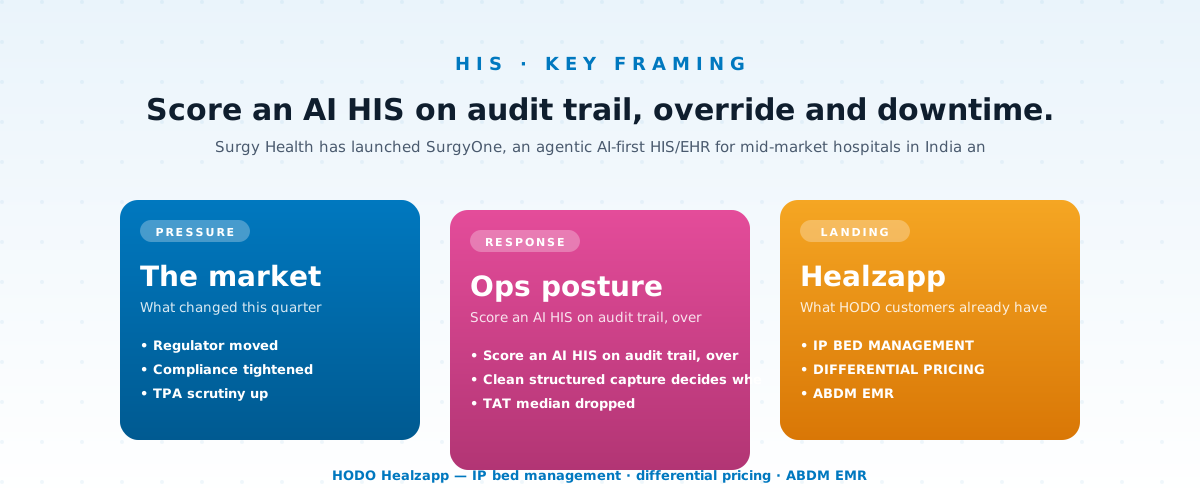
Score an AI HIS on audit trail, override and downtime.
What belongs on the evaluation sheet now
Four additions are worth making to the standard scoring template. First, auditability: every automated action logged with timestamp, trigger and the user who can reverse it, because NABH assessors and insurers will both ask. Second, override cost: how many clicks to correct an AI-generated entry, and whether the correction trains or merely patches. Third, degraded operation: what the registration counter and the OT do during a four-hour internet outage, which is a weekly reality in many districts. Fourth, scope boundary: a written list of what the system will never do without human confirmation.
None of this is an argument against agentic systems. The direction is correct, and hospitals that keep paying people to retype data between screens will carry a structural cost disadvantage within a few years. But the gains come from the dull layer underneath, clean capture, connected devices, closed loops on claims, and not from the adjective on the product page.
What this means for HODO customers
The operational ground SurgyOne is targeting is familiar territory. Machine Interfacing in Healzapp exists precisely so lab and device output lands as structured values rather than uploaded scans, which is the precondition for any analytics or automation layer to be worth trusting. EMR (AI-condensed history) addresses the consultation-time problem directly, compressing prior visits into something a consultant can read in the thirty seconds actually available. For groups adding capacity, Multi-outlet scale-up with one-click new-centre setup keeps masters, tariffs and reporting consistent across units instead of creating a new data island per location. The common thread is that automation is only as useful as the capture discipline and the audit trail beneath it.