
The Association of Healthcare Providers India (AHPI) has directed member hospitals to stop cashless treatment for Bajaj Allianz General Insurance from next month, with a similar notice issued to CARE Health Insurance, according to The Economic Times. For a mid-sized Indian hospital where insurance-linked admissions can touch 55-70% of IP revenue, the fallout is less a clinical question and more a working-capital and front-desk operations problem — and it lands with under thirty days of notice.
AHPI's grievance is not new: hospitals have complained for months about tariff freezes, arbitrary deductions on final bills, delayed pre-authorisation, and one-sided policy revisions from Bajaj Allianz and, more recently, CARE. The industry body says talks broke down, and it is now telling members to move both insurers to reimbursement mode from the announced date. That flips the entire patient-facing flow. Instead of a cashless approval landing on the billing desk before discharge, the patient pays the full bill upfront and chases the insurer afterwards.
For the hospital, three things change simultaneously. First, the mix of paying versus cashless patients shifts overnight for two large books. Second, front-office staff have to explain the change to patients who booked the admission believing cashless would apply. Third, the finance team loses visibility of a receivable that was earlier locked in with a TPA approval letseither. None of this is theoretical — hospitals that lived through the earlier Star Health and Niva Bupa flare-ups will remember how quickly walk-in volumes wobble when a large TPA gets pulled.
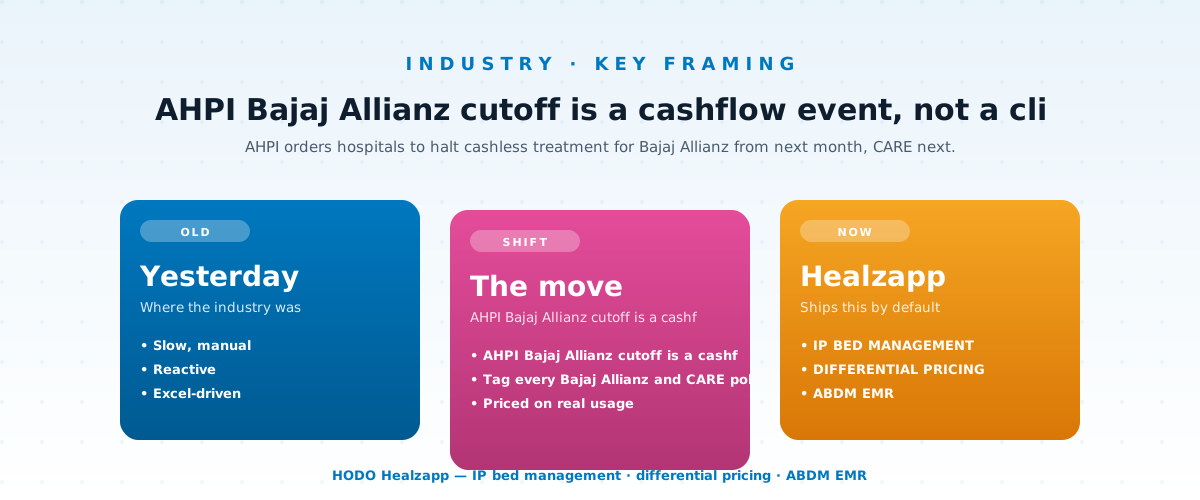
The obvious hit is the receivable. What is less obvious is the second-order effect: patients who cannot arrange lump-sum payment either postpone elective procedures or shift to a competitor hospital that has stayseed cashless with the same insurer. Both outcomes bleed IP occupancy, and for hospitals running on 60-65% occupancy with fixed nursing and pharmacy costs, a two-week dip is enough to distort the month's P&L. Diagnostic and pathology volumes tied to admitted patients slide alongside.
Add to this the collection reality. Reimbursement claims — even clean ones with proper discharge summaries and itemised bills — take 45-90 days for retail policyholders. That is 45-90 days of hospital-financed treatment for what used to be a 15-day TPA settlement. For a 200-bed hospital doing ₹18-22 crore monthly revenue, moving even 25% of the book from cashless to reimbursement can pull ₹3-4 crore of working capital out of operations. Owners and CFOs need a live dashboard of insurer-wise IP and OP exposure, not a monthly Tally export, to make pricing and pre-authorisation calls in real time.
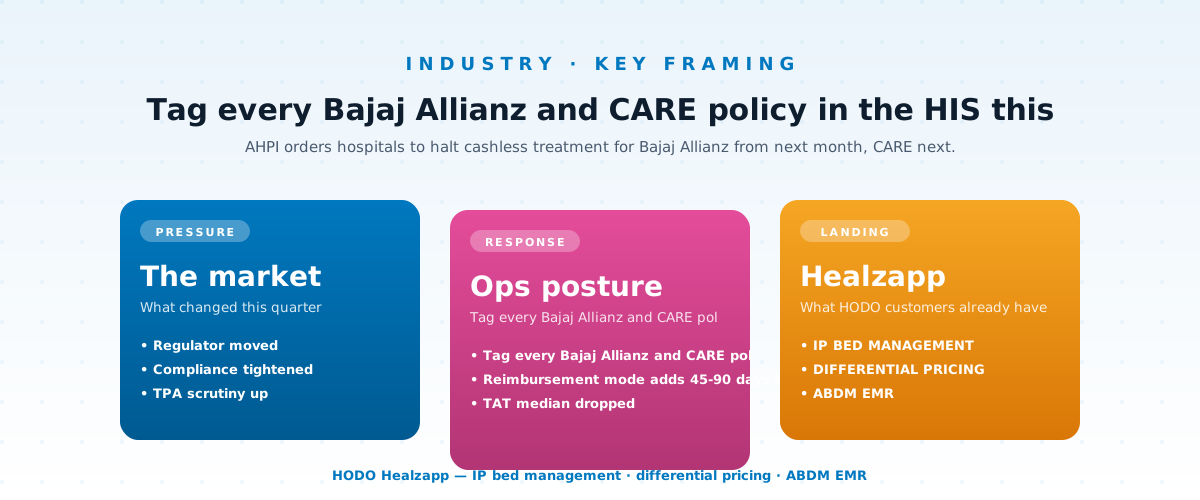
The registration counter is the first place where this news arrives, usually as a confused patient at 9 am. Every hospital using an HIS should be doing four things by the end of this week. One: tag every active Bajaj Allianz and CARE policy in the patient master so the billing screen throws an alert at admission. Two: publish an internal SOP that tells the front-desk exactly what to say — cashless is unavailable, reimbursement is possible, here is the estimated deposit. Three: update the pre-authorisation queue to stop auto-firing to these two insurers from the switch date. Four: reprint the standard patient consent and estimate letters so the reimbursement route is documented at admission.
Billing teams also need a per-insurer tariff view. Many hospitals negotiated different rate cards for Bajaj Allianz versus corporate cash patients — those differentials still matter because they set the ceiling for what the insurer will eventually reimburse. If the HIS cannot flip pricing per payer at the click of a button, the billing team will do it manually and get it wrong under pressure.
Most Indian hospitals discovered during the Star Health episode that their TPA data lives in three places — the HIS, an Excel tracker maintained by the insurance desk, and the TPA's own portal. Reconciliation is a monthly nightmare in normal times. During a cutoff, it becomes a daily one, because auditors, the CFO, and the promoter all want the same answer: how much money is stuck with which insurer, aged by how many days, and against which patient encounters.
The fix is architectural, not procedural. Insurance and TPA fields need to sit inside the patient encounter record itself, not a parallel spreadsheet. Pre-auth request, approval amount, final bill, deduction, and settlement should link back to a single encounter ID so ageing reports run themselves. Hospitals that already have this glued together are the ones that will get through the Bajaj Allianz transition without a working-capital scare. The rest will find out in September when their receivables ageing crosses ninety days.
Three moves are worth making before the cutoff kicks in. One, run a stress test of the July and August OT and IP schedule against the Bajaj Allianz and CARE patient base — anything elective can be counselled about the reimbursement route now, not on admission day. Two, revisit corporate empanelments: many corporates carry group Bajaj Allianz cover, and HR desks at those companies need to hear directly from the hospital before their employees turn up confused. Three, tighten the discharge-summary and itemised-bill quality bar. Reimbursement claims live or die on documentation, and hospitals that were sloppy under cashless will find their claim rejection rate double.
None of this needs a new IT project. It needs the HIS and the billing engine to expose the data that is already inside them, and it needs the standard operating procedures to be written down before Friday.
Hospitals running on HODO Healzapp already have most of the plumbing this situation demands. Billing supports payer-tagged encounters, so an admission carrying a Bajaj Allianz or CARE policy can be flagged from registration through discharge, with an automatic switch to reimbursement workflow from the cutoff date. Differential pricing lets the finance team hold separate rate cards per insurer and per corporate partner, so the tariff change does not require a mass re-quote of estimates. Tally integration keeps the receivables ageing view live for the CFO, which matters when working capital has to be reforecast weekly instead of monthly.
Multi-outlet chains get an added benefit: the same policy change can be pushed to every centre without each unit rebuilding its own SOP. That matters for pathology and scan-centre chains too, where OP-linked insurance claims sit under the same TPA pressure.
See how Healzapp handles this — book a 30-min demo.
See how Healzapp, Labzapp and EReazy fit your speciality in a free 30-minute demo.
Book a Free Demo