EnterpriseAM reports that UAE companies rushing to deploy AI agents are running into a data wall, and that clearing it means another round of infrastructure spend nobody wrote into the original budget. For founders building lab-at-home, doctor-at-home and homecare platforms across the Gulf, that is not an enterprise IT story at arm's length. It is a verdict on an architecture decision most health startups make in their first six months and only pay for in year three.
The second infrastructure round nobody budgeted for
The pattern described in the EnterpriseAM piece is consistent: an organisation buys or builds an agent, the demo performs, and then the agent meets the actual operating environment and stops being useful. The data it needs exists, but it sits in formats no agent can act on — PDF reports, WhatsApp threads, spreadsheet trackers, a billing system that records totals but not the sequence of events that produced them. Closing that gap turns into a project with a budget line of its own: pipelines, a warehouse, event schemas, identity resolution across systems.
For a funded enterprise in Dubai or Riyadh, that second round is an annoyance. For a health platform running on seed capital, it is the difference between shipping an AI differentiator in a quarter and spending two quarters rebuilding plumbing while competitors ship. The relevant lesson is not that agents are overhyped. It is that agent readiness is a property of the operational system of record, and founders choose that system long before anyone on the team says the word agent. A booking and collection stack that already records who did what, when, to which sample, at which address, needs very little retrofit. One that records outcomes only in free text needs the whole second round.
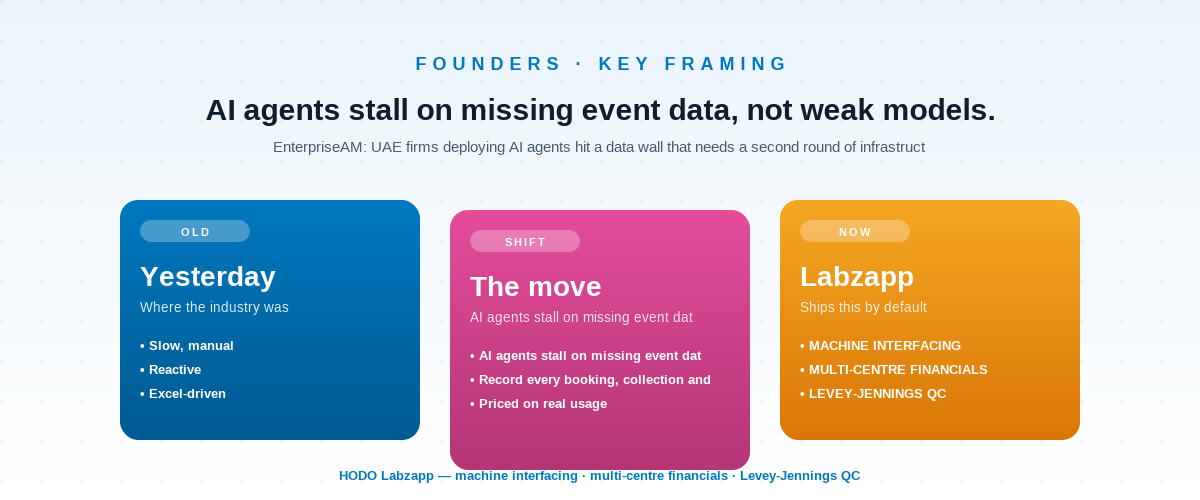
AI agents stall on missing event data, not weak models.
Why home-health platforms hit the wall earlier
Home-visit operations generate more discrete events per unit of revenue than almost any other healthcare model. A single home collection in Abu Dhabi involves a booking, a slot assignment, a route, a phlebotomist arrival, a consent capture, a sample draw, a container label, a transport leg, a lab receipt, an analyser run, a verification, and a report delivered to a patient who is no longer in front of anyone. A doctor-at-home visit adds prescription, follow-up scheduling and payment reconciliation. Each of those steps is an operational decision point where an agent could plausibly help — rescheduling a missed slot, flagging a sample that has been in transit too long, chasing an unverified result, following up on a report nobody opened.
None of that is possible if the only durable record is a completed visit and an invoice. Platforms that compress twelve events into two rows lose exactly the data that makes agents useful, and they lose it permanently — history cannot be reconstructed after the fact. This is why home-health founders tend to discover the data wall earlier and more painfully than clinic software founders. The operational complexity is higher, the margin per visit is thinner, and the questions worth asking an agent are all questions about sequence and timing rather than about totals.
Structured events beat scraped documents
The instinct when facing the wall is to point a model at whatever documents exist and hope retrieval compensates. In practice, scraping a PDF report to recover facts that were structured upstream and then flattened is the most expensive way to get those facts. Every retrieval layer built over unstructured output is a tax paid forever on a problem that cost nothing to avoid at the point of capture.
The alternative is unglamorous and well understood in LIMS design. Samples carry barcodes, so every handoff is a scan with a timestamp rather than a note. Analysers write results directly into the record through machine interfacing, so there is no transcription step and no ambiguity about which run produced which value. Turnaround is computed from recorded timestamps rather than estimated from memory. Report delivery is a logged event with a channel and a status, not a message somebody sent.
Founders evaluating stacks should read those features as data architecture rather than as convenience. Barcoded samples and machine interfacing are not just error reduction; they are the mechanism by which an operation accumulates a machine-readable history of itself. A platform with three years of that history can deploy an agent in weeks. A platform with three years of WhatsApp threads is facing the infrastructure round EnterpriseAM describes, at a stage where capital is more expensive than it was at seed.
Costing the retrofit before it lands
The honest way to make this decision is to price both paths. The build-it-right path costs discipline: insisting on structured capture when a spreadsheet would ship faster, paying for a system of record that enforces workflow rather than a thin layer over forms. The retrofit path costs engineering months, a data platform the team now has to operate, and the gap between a competitor's AI feature and the absence of one.
Regulatory context in the GCC sharpens the arithmetic. DHA, MOHAP and Qatari licensing regimes expect traceability of who handled a sample or saw a patient, and health data residency expectations push founders toward infrastructure decisions that are hard to reverse. Building for auditability and building for agent readiness converge on the same requirement: an immutable, timestamped, attributable record of operational events. Founders who treat the compliance requirement as the architecture requirement get the AI capability as a by-product rather than as a second project.
The same logic applies to partner and franchise expansion. Operators who grow by signing collection partners need per-partner cost, volume and turnaround visibility to price contracts at all — and that reporting substrate is exactly what an agent needs to flag a partner drifting out of tolerance.
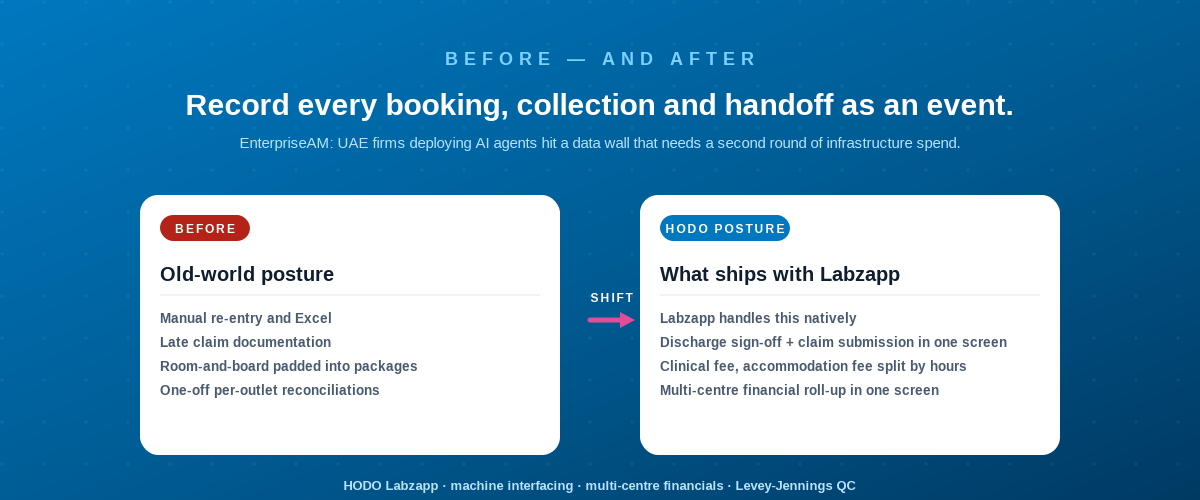
Record every booking, collection and handoff as an event.
What this means for builders
The data wall is a product decision wearing an infrastructure costume. Founders building lab-at-home, doctor-at-home or homecare platforms in the Gulf should choose an operational spine that records events, not summaries, and should treat that choice as the precondition for any later AI differentiation. HODO Labzapp is useful here as reference architecture: phlebotomy/home-collection workflows capture the visit as a sequence of attributable steps, TAT reporting turns those timestamps into a measurable operating metric per centre and per partner, and automated SMS/WhatsApp/Email report delivery closes the loop as a logged event rather than a manual send. Franchisee management and partner-lab integration with anonymised sample tracking extend the same discipline across a network. The AI layer gets cheaper in direct proportion to how much of the operation was structured on the way in.