A KPMG-CII report covered by Livemint finds that 93% of Indian business leaders plan to adopt AI agents inside their workplaces, shifting the conversation from chat assistants to software that holds a job. For hospital groups, lab chains and healthcare founders, the number matters less than the gap it exposes: intent is now close to universal, while the organisational scaffolding that makes an agent useful on day 200 is rare. That scaffolding — memory, ownership, reporting lines, follow-through — is what separates a digital USP from another browser tab.
What the KPMG-CII number actually measures
Intent surveys measure boardroom direction, not installed capability. The report, as summarised by Livemint, describes Indian leaders planning agentic AI across business functions rather than confining it to a single pilot cell. Read that against how AI actually enters an Indian healthcare organisation today. A consultant pastes a discharge summary into a chatbot to tidy the language. The marketing executive drafts an offer in a second tool. Finance runs a reconciliation prompt in a third. Every one of those uses is real. None of it is organisational.
When the marketing executive resigns, her prompts leave with her. When the chat session closes, the reasoning behind a pricing decision — why the home-collection charge was set at one level for a particular locality and not another — disappears with it. So the 93% figure is better read as a statement about structure than about licences. Adoption of AI tools in Indian healthcare is already near-total in practice, because nobody needs procurement approval to open a browser tab. Adoption of AI agents — software with a defined job, a reporting line and a record of what it did — has barely started. The organisations that convert this intent into advantage will be the ones that settle three questions early: who owns the output, where the knowledge is stored, and what happens to both when the person leaves.
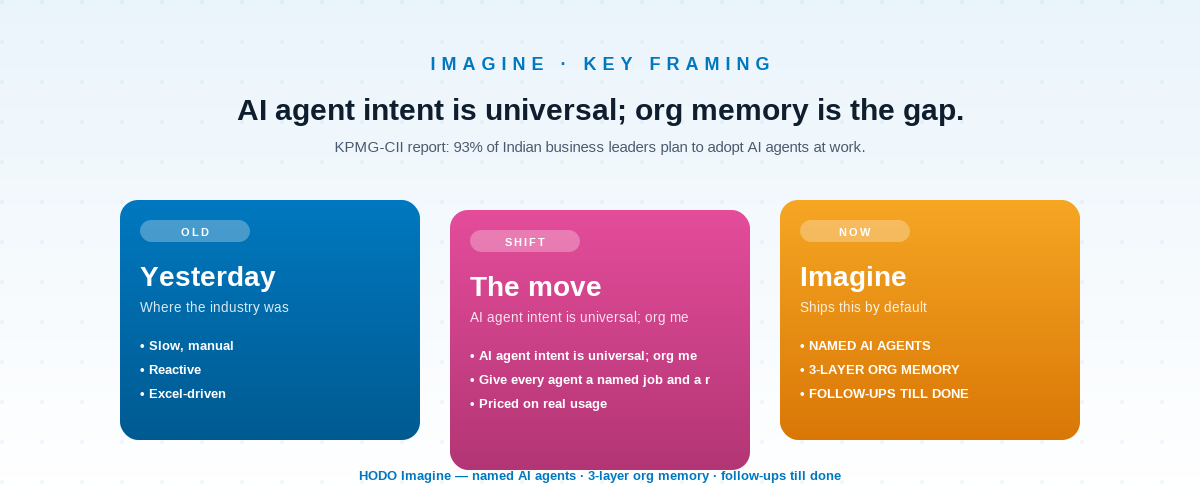
AI agent intent is universal; org memory is the gap.
Why healthcare AI pilots stall by the third month
A 100-bed hospital in Kochi or a six-centre pathology chain in Coimbatore runs on knowledge that was never written down. Which TPA rejects which procedure code, and what documentation unblocks it. Which referring doctor expects a call every Friday. Why one reagent vendor was dropped two years ago. Which outlet consistently under-reports its evening cash collection. This sits in four or five heads, and the organisation's throughput is quietly limited by their availability.
AI pilots in these organisations usually fail for an unglamorous reason: the pilot is run by a motivated person, not by the organisation. For six weeks the output is good, because that person carries the context in their own working memory and re-supplies it in every prompt. Then the quarter closes, an accreditation audit lands, the person gets busy, and the pilot ends without anyone declaring it over. Nothing was institutionalised. There is no record of what the AI concluded in week two, no trail showing which recommendations were acted on, and no mechanism by which an unfinished task came back and asked to be closed. The lesson behind the KPMG-CII direction of travel is that an agent which cannot remember and cannot follow up is a demo, not a deployment.
Named agents with jobs, not one shared chat window
The practical shift is to stop treating AI as a single oracle and start treating it as staff. imagine is built around named AI agents with jobs, memory and reporting lines. The operator defines the job in plain language — one agent owns referral-partner correspondence, another owns the weekly MIS summary for the promoters, another owns inbound enquiry follow-up — and each agent keeps its own accumulating context for that job.
Three things change the moment a job is named. First, scope becomes reviewable: a manager can judge whether the referral agent is doing its work because the work was written down, which is impossible inside an undifferentiated chat window. Second, escalation becomes possible, because a reporting line exists and unresolved work has somewhere to go. Third, context stops being re-typed — the agent handling referral correspondence already knows the commercial terms, the tone used with that partner, and what was promised last month.
For founders building a lab-at-home or doctor-at-home product, this maps onto the back office that usually breaks first at scale. Routing and booking get software early; enquiry follow-up, partner communication, vendor chasing and internal reporting stay manual far too long.
Memory that compounds is the asset, not the model
Model choice is now close to a commodity decision; any serious provider will be competitive within a release cycle. What does not commoditise is the organisation's own accumulated context. imagine structures this as 3-layer memory — today, this week, forever — so operational chatter stays short-lived while decisions, standards and institutional judgement are promoted into something durable.
The test for any Indian healthcare operator evaluating agentic AI after this report is blunt: if the senior-most operations person left next month, how much of the organisation's working knowledge would walk out with them? In most hospitals and lab chains the honest answer is uncomfortable. Knowledge owned by the organisation rather than by an individual's chat history changes that answer. New staff inherit context instead of rebuilding it, and promoters get an audit trail of what was decided and why — which matters as much for accreditation discipline as for management control.
This is also where compounding happens. A knowledge base that grows by one documented decision a day is unremarkable in month one and hard for a competitor to replicate in year three. That asymmetry, not the model licence, is the digital USP worth building.
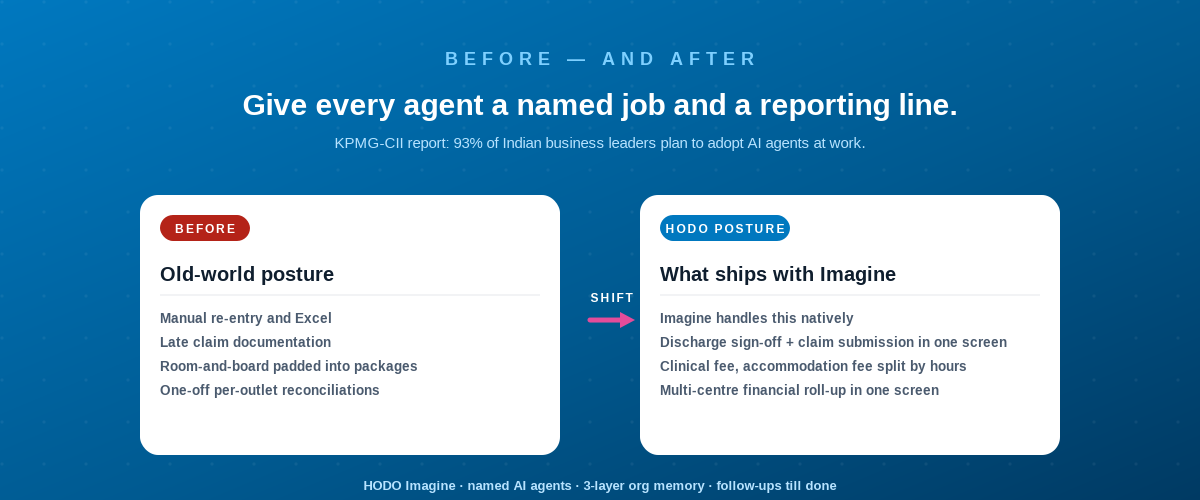
Give every agent a named job and a reporting line.
Where this sits alongside Microsoft 365 and ChatGPT
A fair question from any promoter reading the report: the organisation already pays for Microsoft 365, and several people already use ChatGPT. imagine replaces neither. It connects them with memory. Documents stay where they are, general-purpose models stay available for general-purpose work, and what gets added is the layer those products deliberately leave out — persistent organisation-owned context, named ownership of recurring jobs, consistent brand voice across everything published, and follow-ups that continue until a task actually closes.
That last point deserves emphasis, because most operational leakage in hospitals and labs is not a decision failure but a closure failure. The claim was queried and never resubmitted. The corporate client asked for a revised rate card and nobody sent it. The equipment AMC lapsed because the renewal reminder sat in one inbox. Dashboards report; agents follow up.
What this means for digital transformation
The KPMG-CII finding tells promoters that the decision has effectively been made across Indian industry, and that differentiation now lies in implementation quality. For a hospital group, a lab chain or a healthcare founder, the sequence worth following is narrow: name two or three recurring jobs that currently depend on one person's memory, assign each to an agent with a clear reporting line, and insist that every decision taken along the way is recorded somewhere the organisation owns.
In imagine, that sequence runs on named AI agents with jobs, memory and reporting lines, on 3-layer memory (today / this week / forever) that lifts durable knowledge out of daily noise, and on follow-ups until tasks close so open items are chased rather than archived. Twelve months from now, the organisations that acted on this report will not be distinguishable by which model they licensed. They will be distinguishable by how much of their own judgement is written down, owned and reusable.
See how imagine turns AI into organisational intelligence — explore imagine.