Zoho has launched Zia Chat, an AI interface layered across its software, and has simultaneously stepped into vertical SaaS with seven industry-specific applications, as reported by ETCFO (cfo.economictimes.indiatimes.com). For a healthcare founder or operator, a polyclinic group in Dubai, a lab chain expanding across Riyadh and Doha, a lab-at-home startup in Kochi, the launch matters less as a product release and more as a signal about which parts of the software layer are about to stop being differentiators. The conversational interface is becoming table stakes. What sits behind it is where the remaining advantage lives.
What the launch actually signals
Two things follow from a horizontal suite vendor shipping both a chat interface and seven vertical applications in the same breath. First, the distance between a general-purpose platform and a credible domain-specific application is now measured in quarters rather than years. A vendor with existing distribution, billing relationships and support infrastructure can move into an adjacent vertical far faster than it could when domain software had to be written from scratch. Any founder who assumed a two-year head start on features should re-run that assumption.
Second, and more consequential, the AI interface itself is commoditising. A chat box that answers questions over the organisation's own data was a pitch-deck asset eighteen months ago. It is fast becoming a checkbox that every suite ships by default. A homecare operator in Sharjah who has been planning an AI feature for the next release cycle needs to be honest about what is actually being built: if the plan is a chat window over existing records, that plan has a shelf life measured against the next platform update, not against the competition.
This is not an argument against adopting AI. It is an argument about where to put the effort. The interface is the door. What the organisation knows, and whether that knowledge is stored anywhere other than in senior staff's heads and WhatsApp history, is the building behind it.
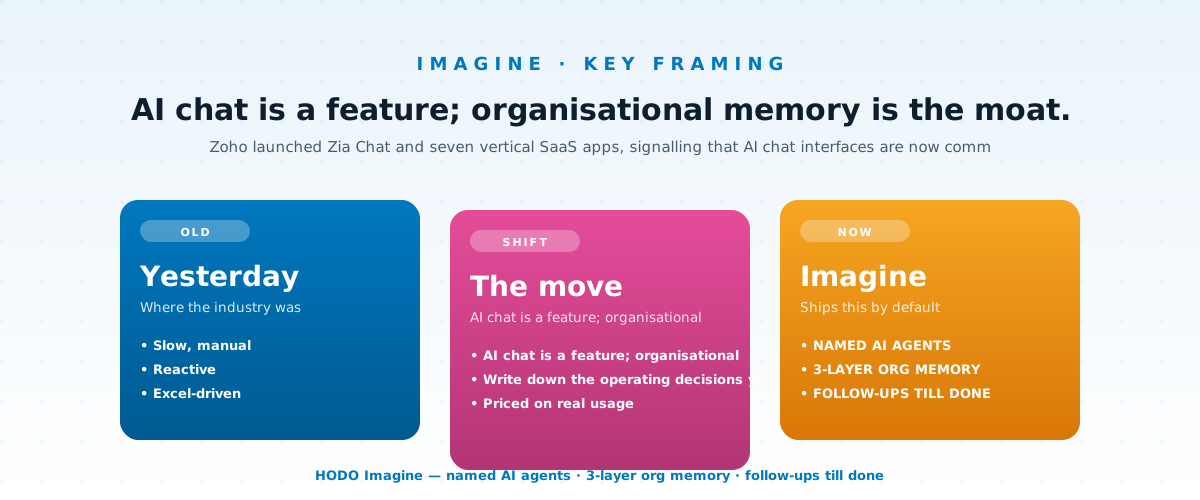
AI chat is a feature; organisational memory is the moat.
A chat window answers questions; it does not remember decisions
The practical limitation of most AI assistants in an operating business is not reasoning quality. It is amnesia. Each conversation starts from zero. The assistant does not know that the partner lab handling histopathology has been running four days beyond agreed turnaround since June, that a corporate client was promised differential pricing in a meeting last March, or that the insurer rejecting claims on a specific code was escalated twice and never closed. Staff know these things. The software does not, and when staff leave, neither does anyone else.
This is why organisational intelligence is a different category from a smart chat interface. imagine is built around named AI agents that have defined jobs, reporting lines and memory, not a single anonymous assistant that answers whatever is asked. An agent that owns insurance follow-ups accumulates a record of what has been submitted, rejected, resubmitted and recovered. An agent that owns partner-lab coordination accumulates the turnaround history. The knowledge compounds instead of evaporating at the end of each session.
The three-layer memory structure, today, this week, forever, reflects how operating businesses actually think. Today's memory handles the shift: which collections are pending, which reports have not gone out. This week's memory handles the operating rhythm: what was promised, what slipped, who is chasing it. The forever layer holds what the organisation has learned and should never have to relearn, pricing decisions, escalation paths, why a particular vendor was dropped. A stateless chat box can do none of this, regardless of which model sits underneath it.
The GCC operator's version of this problem
Consider a three-branch polyclinic group in Abu Dhabi with a small diagnostic arm. Insurance pre-approvals sit with two coordinators. Licensing renewals and staff credentialing sit with an administrator who has been there nine years. Corporate contracts sit with the managing partner. Nothing about this is unusual, and nothing about it is documented. When the administrator takes four weeks of leave, the group discovers exactly how much of its operating knowledge was never written down.
The same pattern appears in a lab chain onboarding franchise partners across two emirates. The first three partners were onboarded by the founder personally, who knows which explanations land, which documents the partner will forget to submit, and which pricing questions come up in week two. Partners four through twelve get a version of that process reconstructed from memory by whoever is available. Quality drifts. Not because the team is careless, but because the institutional knowledge lives in one person's recall.
Organisational intelligence addresses this directly. When agents carry memory and have named owners, onboarding a new partner or a new branch draws on what the last twelve onboardings taught the organisation. Brand voice consistency matters here too: patient communication, partner emails and report cover notes going out across multiple branches and languages should read as one organisation, not as eleven individuals with varying English and varying degrees of care about tone.
Follow-through is the operational gap AI can actually close
Ask most clinic or lab operators where revenue leaks, and the answer is rarely a missing feature. It is things that were started and not closed: a pre-approval not chased, a rejected claim not resubmitted inside the window, a corporate renewal not raised until after expiry, a home-collection sample reported but never confirmed as delivered to the patient. Every one of these has an owner on paper. Very few have a mechanism that keeps asking until the task is actually closed.
This is where follow-ups until tasks close changes the operating picture more than any interface improvement. An agent that holds the item, knows who owns it, and keeps raising it until it is resolved removes the failure mode that spreadsheets and reminder apps have never fixed, namely, that reminders can be dismissed and lists can be ignored. Combined with memory, it also produces something buyers and auditors increasingly ask for: a record of what was decided, by whom, and what happened next.
It is worth being clear about what this is not. Organisational intelligence does not replace Microsoft 365, Copilot or ChatGPT. Those tools remain where work gets drafted and documents get written. The gap they leave is continuity across sessions, people and tools, and that is the layer worth owning while everyone else is shipping chat boxes.
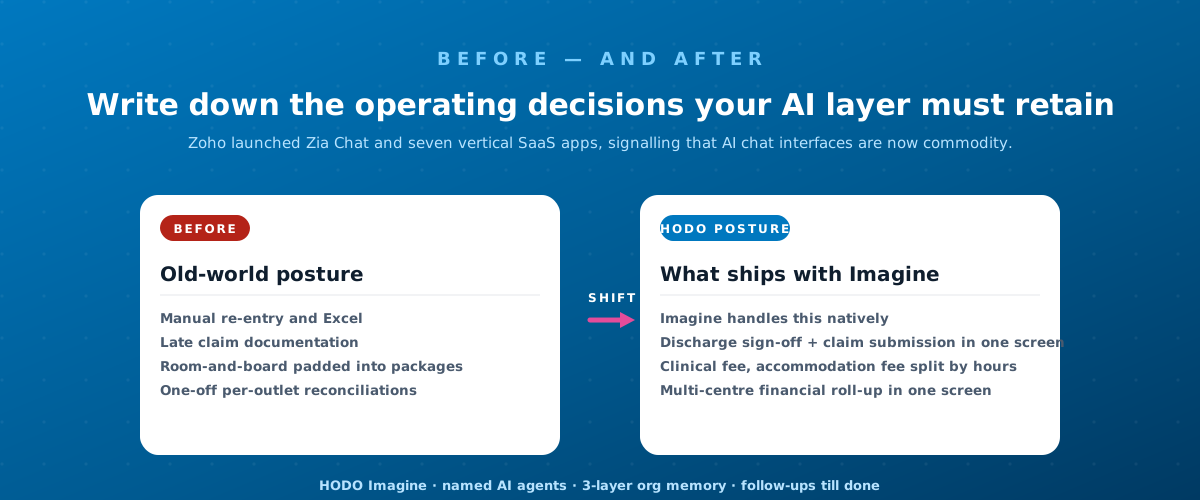
Write down the operating decisions your AI layer must retain.
What this means for digital transformation
The vertical SaaS wave means feature parity will arrive faster than most healthcare founders have planned for. A conversational interface will not distinguish one clinic group, lab chain or homecare platform from another by next year. What will distinguish them is whether the organisation's operating knowledge is owned by the organisation or rented from whoever happens to still be employed.
That is the case for treating AI as an organisational intelligence layer rather than a feature. Named AI agents with jobs, memory and reporting lines give accountability a structure instead of a spreadsheet. 3-layer memory, today, this week, forever, keeps what the business learns after the people who learned it move on. Brand voice consistency keeps multi-branch communication coherent, and follow-ups until tasks close converts intent into completed work. Taken together, that is a Digital USP that survives a competitor's next release note.
See how imagine turns AI into organisational intelligence, explore imagine.