The National Health Authority has issued a public call for AI solutions to speed up Ayushman Bharat PMJAY claim adjudication, according to a Times of India report this week. The signal to empanelled hospitals is clear: the paperwork bottleneck at NHA's end is about to shrink, and the pressure will land squarely on hospital-side data quality. For 100-bed hospitals already juggling TPA cycles and NABH audits, this is a good moment to look inward at what their HIS is actually sending upstream.
What NHA is actually asking for
The brief reported by Times of India describes AI tooling meant to triage claims, flag anomalies, and shorten the adjudication cycle at NHA's Transaction Management System. In practice, that means claim packets, pre-authorisation requests, discharge summaries, investigation reports, procedure notes, drug charts, will be read by a model before they reach a human adjudicator. If the packet is thin, inconsistent, or missing key fields, it will be rejected or queried faster than it is today, not slower. Hospitals that rely on manually assembled PDFs and last-minute typing at the billing counter will feel this first. The upside for hospitals with clean, system-generated documents is real: faster settlement, better cashflow, fewer TPA disputes. But the payoff only reaches operators whose HIS output is machine-readable in the first place. AI adjudication does not forgive sloppy source data, it exposes it, at scale, and within seconds.
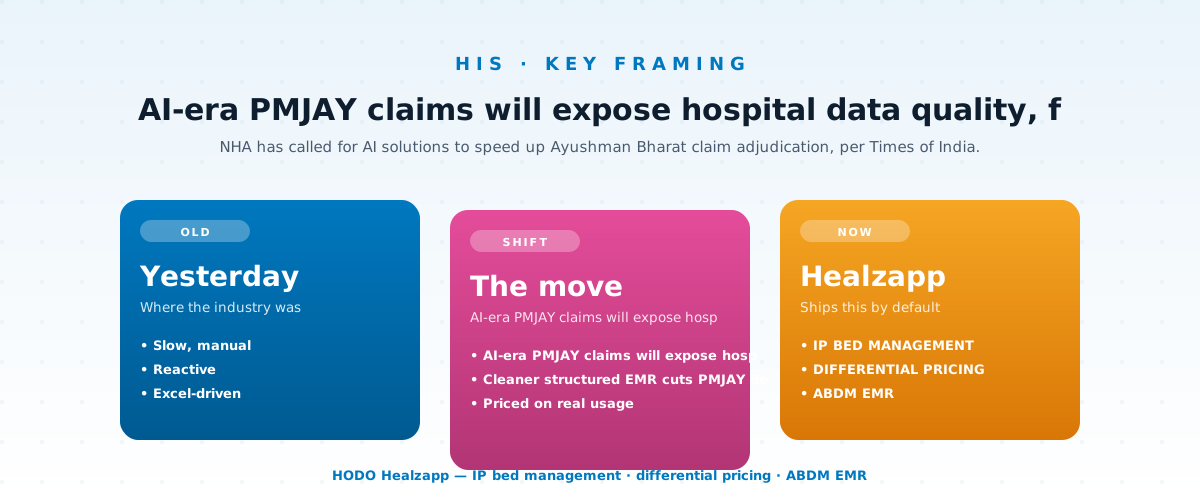
AI-era PMJAY claims will expose hospital data quality, fast.
Why claim delays hit 100-bed hospital cashflow hardest
A 100-bed hospital running a 40-50% PMJAY and state-scheme mix typically has 60-90 days of unbilled or unsettled claims sitting on its balance sheet at any given time. Each week saved at NHA's end is genuine working capital freed up, money that today gets spent on interim overdrafts, delayed vendor payments, or postponed asset purchases. Larger corporate chains can absorb 45-day settlement cycles; a district-town 100-bed hospital cannot. The other cost is human: a claims cell of two to four people who spend most of their week chasing rejections, re-uploading documents, and re-writing discharge summaries to match scheme templates. If AI adjudication tightens the loop and flags issues on submission rather than at day 30, that team's workload shifts from firefighting to prevention, provided the HIS surfaces the flag inside the hospital and not just at NHA. The operational win is not simply that AI approves faster. It is that the loop closes faster, and denials are catchable before submission goes out.
The document quality problem inside hospitals
Walk into most 100-bed hospitals today and the PMJAY document trail is a mix of typed Word files, scanned handwritten notes, screenshotted lab reports, and a discharge summary drafted by a junior resident on the day of discharge. That format survives human adjudication because a claims officer at the TPA end can read intent from context. It will not survive model-based screening. Structured discharge summaries, ICD-10 tagged diagnoses, procedure codes matched to package rates, investigation results tied to the ordering encounter, and drug charts pulled from the pharmacy module rather than typed post-hoc, these become the difference between one-shot approval and a query cycle. This is a HIS problem, not a clinician problem. Hospitals whose EMR forces structured entry at the point of care, and whose billing pulls line items from the actual clinical record rather than a parallel spreadsheet, are ready for the shift. Hospitals whose so-called EMR is essentially a document upload folder are not.
What hospitals should fix on their side before AI helps
Three practical fixes matter more than any new tool. First, treat the discharge summary as a system output, not a document. It should be assembled from the admission note, daily progress notes, procedure record, and medication administration record, signed off, not typed from scratch on the day of discharge. Second, close the loop between IP bed occupancy, procedure charges, and pharmacy consumption. PMJAY packages assume a defined length of stay and drug footprint; if the actual bed-day count and pharmacy issue log do not match the claim, that is a red flag any model will catch. Third, get pre-authorisation into the same system as the EMR. Pre-auth done on a scheme portal in one browser tab while the doctor writes notes in a different system guarantees mismatch. Beyond these three, hospitals should audit the last 100 rejected PMJAY claims and cluster the rejection reasons, most 100-bed hospitals will find three or four repeat causes accounting for 70% of denials. Fix those upstream in the HIS and the AI-adjudication era becomes a tailwind rather than a threat.
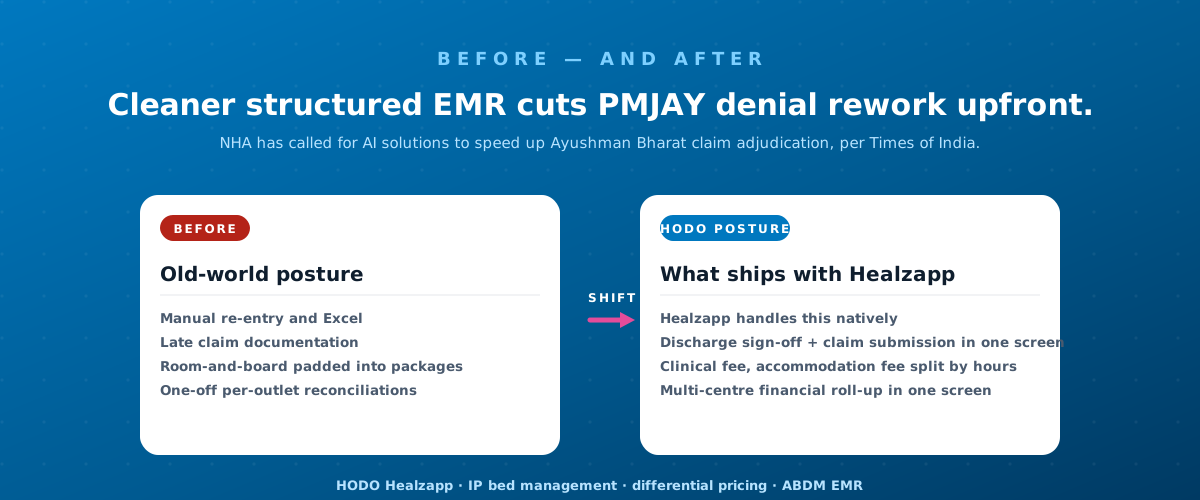
An HIS ready for AI-adjudicated claims looks different from one built for the manual-TPA era. It captures diagnosis and procedure at the point of care with coded fields, not free text. It links every billed line item back to a clinical event, a bed-day, a procedure note, a lab order, a drug issue slip. It generates the discharge summary and the claim packet from the same underlying record, so the two cannot disagree. It exposes an internal dashboard that shows, per admission, whether the claim packet is submission-ready or missing components, before the case reaches the billing counter. For multi-outlet operators, the same discipline has to hold across every centre; a single centre with weak documentation drags the whole chain's approval rate down. The NHA's move is, in effect, a nudge toward this operating model. Hospitals that treat it as a compliance headache will keep bleeding working capital. Hospitals that treat it as an excuse to tighten their own internal claims-readiness process will pull ahead on cashflow within two quarters.
What this means for HODO customers
For 100-bed hospitals on Healzapp, the NHA signal maps directly onto modules already in the stack. Billing ties every claim line back to the source encounter, so pharmacy issues, bed days, and procedure charges reconcile automatically against PMJAY package rates. EMR (AI-condensed history) keeps diagnosis and procedure entry structured at the point of care and assembles discharge summaries from the actual clinical record rather than a typed template. IP bed management gives the claims cell a live view of length-of-stay against package norms, so mismatches are caught before submission, not after rejection. Together they cut the manual re-work loop that eats claims-cell time today, and position the hospital to benefit when NHA's AI adjudication starts approving clean packets faster. Multi-outlet hospital groups get the same discipline across every centre through one-click new-centre setup, so a new empanelled unit inherits the parent group's claims-readiness baseline from day one, rather than rebuilding it centre by centre.