Adgully reports that Superclaims has pulled claims adjudication down from roughly 90 minutes to under five, using AI to read, match and decide on claims that previously sat in a human review queue. The number worth studying is not the five minutes. It is the 85 minutes that disappeared, because nearly all of that time was spent on work most healthcare organisations still do by hand, from both sides of the claim.
What the missing 85 minutes were actually made of
Break an adjudication down and very little of it is judgement. A reviewer opens a policy document and checks the sum insured, sub-limits and waiting periods. They match procedure descriptions against a tariff. They look for exclusions that may apply. They verify whether the discharge summary, investigation reports and implant invoices are all present. They search their own inbox for a similar case decided last quarter, because consistency matters more than speed in a dispute. Then they draft a query letter in language the counterparty will accept.
Each of those steps is a lookup against something the organisation already knows. The reason it took 90 minutes is that the knowledge was scattered, part in a policy PDF, part in a tariff spreadsheet, part in one senior executive's memory of how a particular hospital submits paperwork, part in an email thread nobody can find. An AI layer that compresses this to five minutes is not being clever about medicine. It is being disciplined about retrieval, consistency and handoff. That distinction is the whole lesson for operators and founders on the provider side, because the same 90-minute decisions exist in hospital billing desks, lab accounts teams and home-collection operations, and they have not been compressed at all.
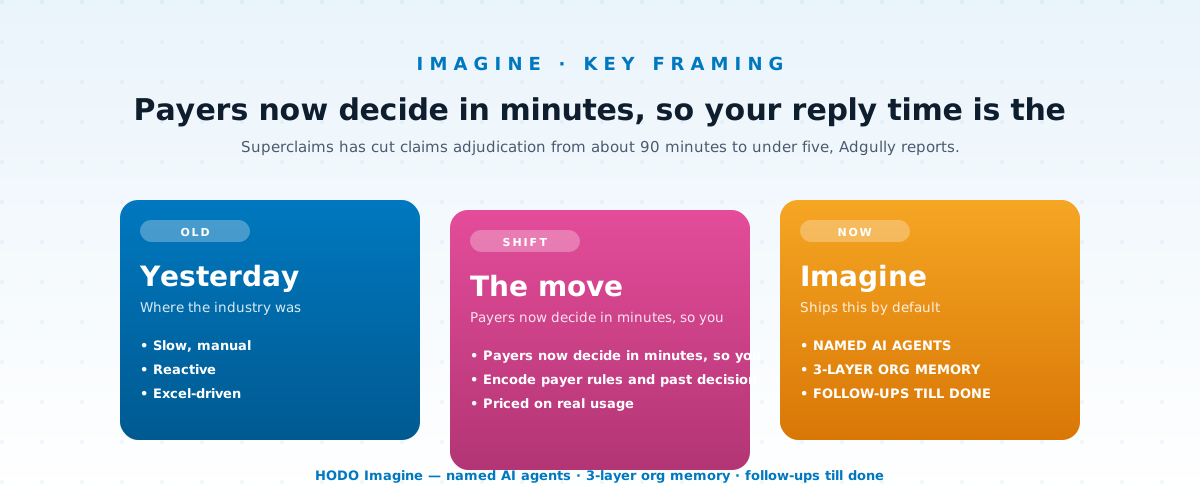
Payers now decide in minutes, so your reply time is the bottleneck.
The asymmetry that lands on the billing desk
When the payer side adjudicates in minutes, the slow party in the cycle changes. Today a pre-authorisation query arrives and a hospital takes a day or two to pull the right documents, chase the treating consultant for a clarification and send a reply. A lab chain takes longer still, because corporate and TPA correspondence usually sits with one person who also handles everything else. If adjudication itself drops to five minutes, the end-to-end turnaround is no longer being set by the insurer. It is being set by the provider's internal response time.
That has a cash consequence rather than a philosophical one. Faster adjudication means faster denials as well as faster approvals, and denial windows for appeal do not get longer. A query that would have been answered comfortably within the old cycle now defines the delay. Operators who measure days in receivables but not hours in query response will see the gap only when ageing buckets stop improving despite the counterparty getting quicker. Founders building anything payer-facing, a claims product, a billing layer, a homecare platform that bills corporates, now get benchmarked against a five-minute number they did not set.
Why a general-purpose chatbot does not close this gap
The instinct is to put a general assistant in front of the billing team and ask it to draft replies. It helps at the margin and then stalls, for a structural reason: a chat window starts cold every time. It does not know that this particular TPA rejected three claims last month for the same missing nursing note, that a specific clause has been read narrowly in past correspondence, or that the appeal drafted in August was accepted and should be the template. The staff member supplies that context by hand, which is exactly the work that was supposed to be removed.
What made the adjudication engine fast was not conversation. It was encoded rules, a history of prior decisions, and clear routing of the cases that genuinely need a human. Reproducing that inside a provider organisation is an organisational intelligence problem, knowledge that is stored, reused and owned by the institution rather than re-explained in every prompt. This is where imagine is positioned: it does not replace Microsoft 365, Copilot or ChatGPT, it connects them with memory, so the context that makes an answer correct stops living in individual heads and inboxes.
What a decision layer looks like in an ordinary organisation
Practically, this means giving AI work a shape that matches the org chart instead of a shared chat history. In imagine, agents are named, hold a defined job and sit in a reporting line, one owns payer and TPA correspondence, another owns receivables follow-up, another owns corporate and partner queries. Each accumulates the specific knowledge of its beat. The payer correspondence agent learns which documents each TPA asks for first; the receivables agent learns which corporate clients pay on reminder and which need an escalation call.
Memory is what turns that from a filing exercise into capability. A three-layer structure, today, this week, forever, maps to how claims work actually behaves. Today holds the open queries and their deadlines. This week holds the pattern that matters operationally, such as a rise in rejections against one procedure code. Forever holds the durable institutional knowledge: clause interpretations, accepted appeal templates, each payer's documentation habits, and the tariff history behind a contested rate. Brand voice consistency matters more here than it sounds, because payer correspondence and partner communication are read as evidence of how the organisation operates. Letters that read the same regardless of who is on duty are treated differently from letters that do not.
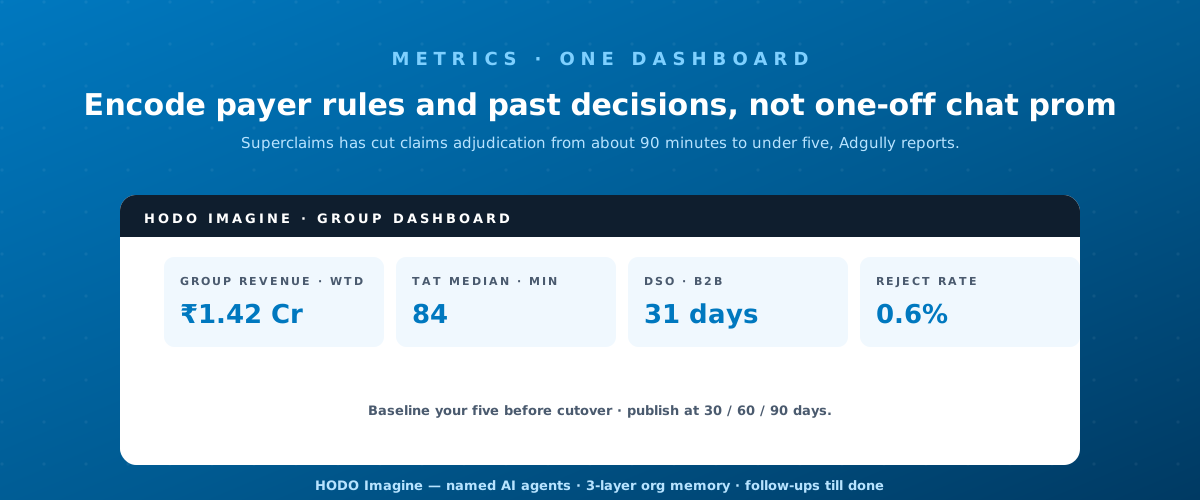
Encode payer rules and past decisions, not one-off chat prompts.
Audit trail is the precondition, not the add-on
Decisions made at machine speed need a record, and healthcare organisations have reason to care about this beyond compliance. If a claim was resubmitted with a specific clarification, the organisation should be able to show what was sent, when, on whose approval and against which evidence. If a rate was conceded to a corporate partner, the reasoning should survive the executive who conceded it. Billing and accounts roles turn over frequently, and a departure usually takes several years of payer-specific knowledge with it.
An organisational memory layer treats that knowledge as an asset of the institution. The audit trail is a by-product of working through named agents with memory rather than a separate project, every follow-up, draft and decision carries its own provenance. For founders, this is the difference between an AI feature and a digital USP that holds up in a procurement conversation: not that the product uses AI, but that it can explain, after the fact, why it decided what it decided.
What this means for digital transformation
The Superclaims number is a benchmark the provider side will be measured against, not a payer-only story. The response is not a faster typist on the billing desk but a layer that remembers. Named AI agents with jobs, memory and reporting lines give payer correspondence, receivables and partner queries an owner that does not start from zero each morning. 3-layer memory keeps today's open queries, this week's rejection patterns and the permanent payer playbook in one place that outlives staff churn. Follow-ups until tasks close matter most where cash is involved, because a query answered on the fourth reminder is still money recovered. Knowledge owned by the organisation, with an audit trail attached, is what converts an AI deployment into an operating advantage.
See how imagine turns AI into organisational intelligence, explore imagine.