Abu Dhabi is being read as a test case for whether AI spending turns into working systems, with gulfnews.com reporting that the emirate is putting AI to work as the global race shifts from hype to deployment. For healthcare founders and clinic group operators across the UAE and the wider GCC, the useful part of that story is not the capital figures or the partnership announcements. It is the standard of proof that now comes attached to the word deployment.
Deployment is a narrower word than most operators assume
The shift the Gulf News piece describes is from AI as a positioning statement to AI as something in daily operational use. That distinction matters because it is the one buyers and investors are starting to apply to smaller healthcare businesses too. A six-doctor polyclinic group in Dubai, a three-branch lab in Sharjah, a lab-at-home operator in Doha, each of them can honestly say they use AI. Very few can say it is deployed.
A working definition is useful here. Something is deployed when a named person's daily job depends on it, when its output goes somewhere specific rather than into a chat window, and when it keeps running after the person who set it up leaves. By that test, a pilot is not a deployment. A staff WhatsApp group where coordinators paste model output into patient messages is not a deployment either, however much value individual staff get from it. It is private tooling with no organisational footprint.
The practical consequence is that most healthcare operators in the region are further behind than their own internal narrative suggests, and closer than they fear. The gap is rarely technical. It is that nobody has decided which tasks the AI owns, who receives its output, and where its working knowledge is stored.
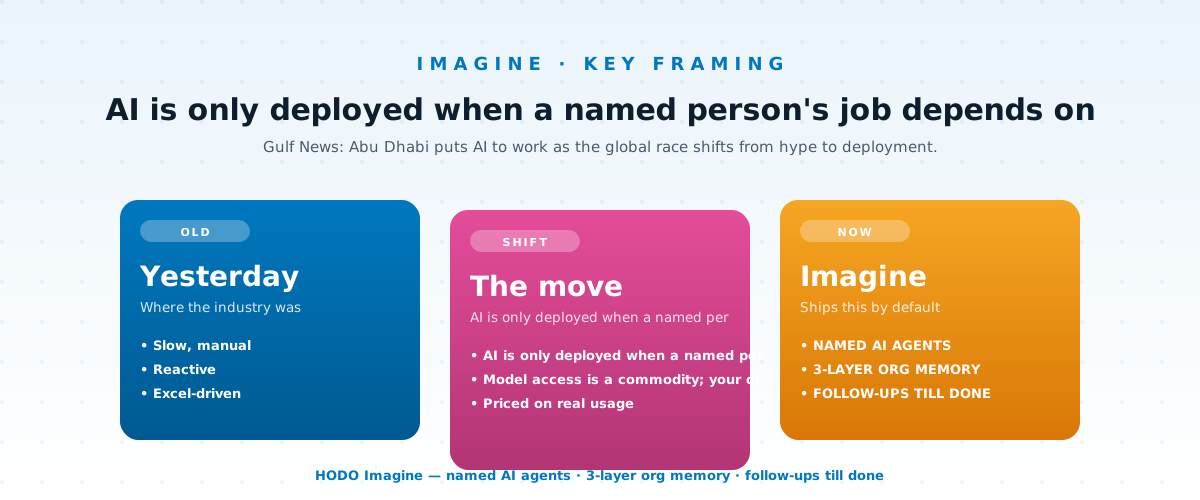
AI is only deployed when a named person's job depends on it.
Model access stopped being a differentiator this year
Any clinic group, lab chain or homecare operator in the GCC can now buy the same frontier models at the same published per-token price as the competitor on the next street. The procurement advantage that existed two years ago has evaporated. This is why "we use AI" has no remaining value as a Digital USP: it describes a commodity input that every rival has bought as well.
What does not commoditise is the organisation's own context. Which insurer settles in eighteen days and which takes sixty. Why the health check package was repriced last quarter and which referral partners were told. Which phlebotomist covers the Al Barsha route on weekends and what the escalation path is when a sample arrives out of temperature range. Which consultant's licence renewal sits with which coordinator. None of that is in a model's training data, and none of it survives being typed fresh into a prompt each time it is needed.
This is the gap imagine is built to sit in. It is positioned as an organisational intelligence layer rather than another chat product, and it does not attempt to replace Microsoft 365, Copilot or ChatGPT. It connects them with memory, so the context an operator has accumulated becomes something the AI works from instead of something staff re-explain in every session.
Named agents beat a shared chat window
The structural difference between AI usage and AI deployment is ownership. In the usage pattern, forty staff hold forty private conversation histories, each solving its problem once and then discarding the reasoning. Nothing accumulates. There is no way to audit what the AI advised or to check whether the advice was followed.
In the deployment pattern, agents are named, each with a defined job and a reporting line. An agent that owns insurer correspondence has a brief, a history of past claim disputes and a human who receives its output. An agent that owns monthly centre reporting knows what last month's numbers were and what questions were asked about them. The reporting line is the part operators tend to skip, and it is the part that makes the difference: output that lands with an accountable person gets acted on, while output in a shared channel gets skimmed.
For founders building homecare, lab-at-home or marketplace platforms, this is also an org design decision taken early and cheaply. Deciding that the AI coordinating visit rescheduling is a named teammate with a supervisor, rather than a feature buried in an admin panel, changes how the team treats its output and how quickly errors surface.
The memory problem is sharper in the Gulf
Institutional memory leaks everywhere, but GCC healthcare operations lose it faster. Contract cycles of two to three years, licence-linked employment, and a clinical and administrative workforce that moves between emirates and between countries mean a clinic group can replace a third of its coordinators inside eighteen months. Every departure takes undocumented operational knowledge with it, and the replacement rebuilds it by trial and error over a quarter.
imagine's answer is a three-layer memory, today, this week, forever, where each layer has a different operational purpose. Today holds live context: who is covering which route, which claim is stuck, what the shift handover said. This week holds the working thread, so a Thursday conversation does not start from zero after the weekend. Forever holds what the organisation has decided and learnt: pricing logic, payer behaviour, escalation rules, the reasons behind past decisions.
The point is ownership. Knowledge held in that structure belongs to the organisation rather than to the individual who happened to accumulate it, so it survives churn. An operator who can hand a new centre manager a working context on day one has an advantage that is genuinely hard for a competitor to copy, because it took eighteen months of operations to build.
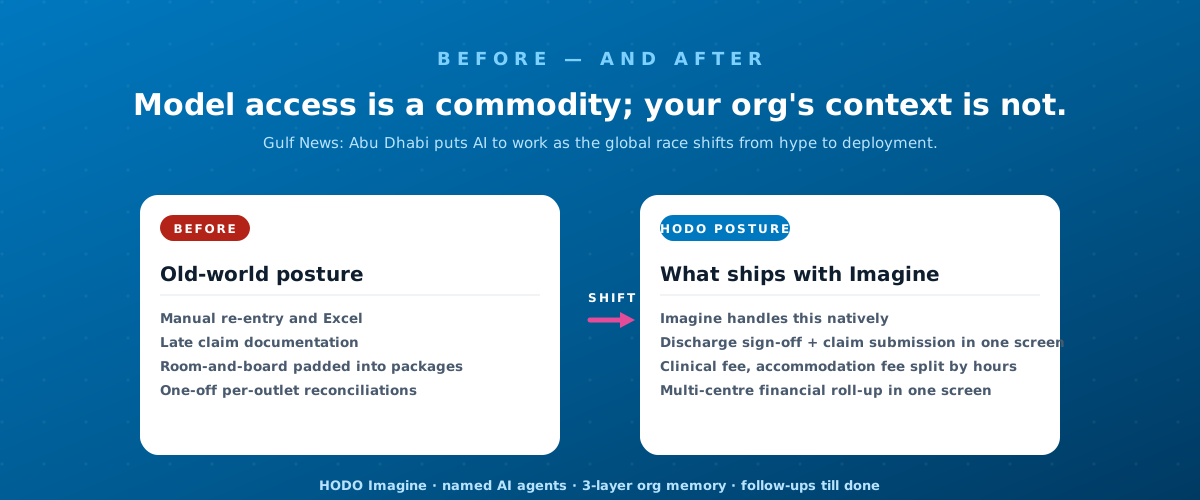
Model access is a commodity; your org's context is not.
Follow-ups until closed is the honest audit
Most AI output in healthcare businesses dies as a suggestion nobody actioned. A draft insurer appeal that was never sent. A flagged TAT breach that was noted and forgotten. A patient recall list generated twice and worked through once. On any deployment scorecard, that is a failure, even though the AI performed correctly.
Follow-ups until tasks close is the specific behaviour that separates an assistant from a teammate, and it is also the cheapest audit an operator can run. Pick ten tasks the AI touched last month and check how many reached a terminal state. If the answer is three, the problem is not model quality. Brand voice consistency belongs in the same column: in a multi-branch group handling patient communication in two or three languages, consistency is an operational property, not a design preference, and it is only achievable when the standard lives somewhere the whole organisation draws from.
What this means for digital transformation
Abu Dhabi's repositioning is a useful marker for healthcare operators and founders in the region, because it moves the conversation from access to evidence. The defensible Digital USP is not AI adoption. It is an organisation whose accumulated knowledge compounds and whose AI work reliably closes.
Three things in imagine carry that load. Named AI agents with jobs, memory and reporting lines give every automated task an owner and an audit trail. 3-layer memory, today, this week, forever, keeps operational context with the organisation rather than with whoever is currently employed. Follow-ups until done, paired with brand voice consistency, turn AI output into completed work in a recognisable voice across branches and channels.
See how imagine turns AI into organisational intelligence, explore imagine.