World Health Expo (WHX) reports that AI is set to supercharge the GCC's healthcare industry, pointing to national digital health strategies, sovereign investment and a payer environment that is already largely digital. The headline is directed at ministries and hospital groups. The practical question for a four-doctor polyclinic in Deira, Al Sadd or Salmiya is narrower: which part of the day should a machine take over first, and what has to be true of the clinic's records before any of it works.
Where GCC AI money is actually going
Most of the announced activity in the region sits in three buckets. First, imaging and diagnostics support, radiology triage, retinal screening, pathology reads. Second, population health and payer analytics run by regulators and insurers rather than providers. Third, administrative automation: coding, claims scrubbing, documentation, contact-centre handling and scheduling. The first bucket gets the conference keynotes. The third is where a single-site or three-site polyclinic actually recovers money.
That ordering matters because the cost structures are different. A polyclinic does not own the scanner that a triage algorithm would sit on; it refers out. It does not hold the claims book; the insurer does. What it does own is the consultation hour, the reception desk, the pharmacy counter and the claim submission queue. Those are the assets that either run at capacity or leak. A clinic running 60 per cent chair utilisation across a nine-hour day is not short of AI, it is short of visibility into which slot patterns fail and why.
So the first automation question is not "which model" but "which repeated decision does a staff member make forty times a day with incomplete information". Usually it is three: whether a walk-in can be fitted in, whether a service is covered under the patient's plan before it is delivered, and whether a prior visit contains something the doctor needs to see in the next two minutes.
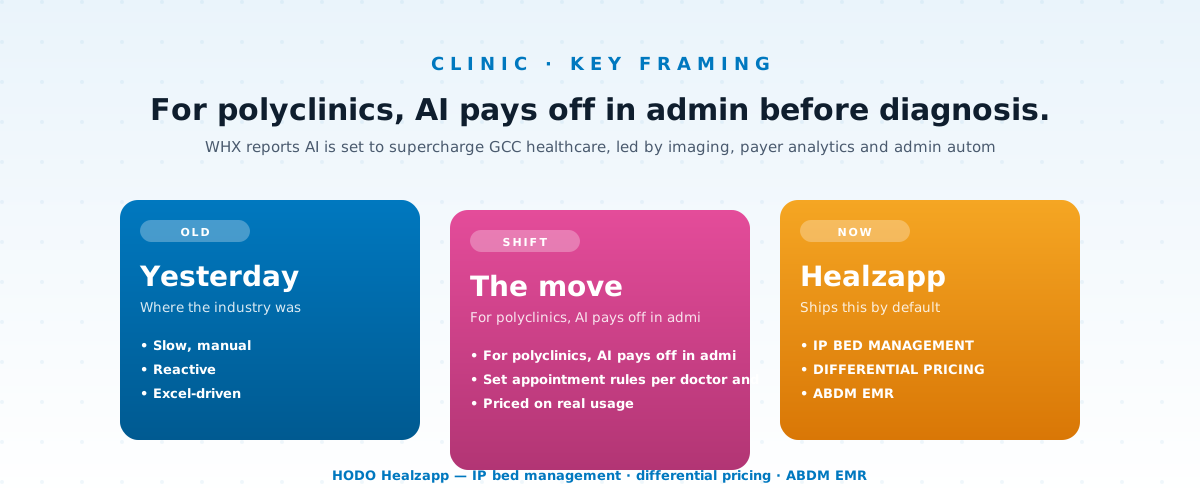
For polyclinics, AI pays off in admin before diagnosis.
The polyclinic bottleneck is the front desk, not the diagnosis
In a typical GCC polyclinic the consultant is not the constraint, the throughput ceiling is set upstream. Registration takes longer than it should because insurance details are re-keyed from a card each visit. Queue management is verbal, so patients cluster at the desk and the waiting area feels full at 70 per cent occupancy. Multi-doctor scheduling is done in a shared calendar that does not know that the dermatologist's follow-up slots are ten minutes and the GP's are fifteen, or that Friday mornings behave differently from Tuesday evenings.
Fixing that layer produces measurable change quickly. Structured appointment rules per doctor and per service type make the day's capacity explicit before it is sold. A visible queue display moves patients out of the reception scrum and cuts the number of "how long more" interruptions the front desk absorbs, each of which costs thirty seconds of registration throughput. Digital pre-visit capture means the insurance and Emirates ID or civil ID details are already in the record when the patient arrives, not typed while they stand there.
None of this requires a model. It requires the clinic's operational data to exist in one place in a structured form, which is also, conveniently, the precondition for everything in the WHX story. Clinics that skip this step and buy a standalone AI tool end up feeding it the same fragmented records that caused the original problem.
Insurance and billing: automation has to respect local rules
GCC billing is not Indian billing with a currency swap. A polyclinic in Dubai may hold contracts with a dozen insurers and third-party administrators, each with its own tariff, co-payment structure, pre-approval threshold and exclusion list. Abu Dhabi, Qatar, Kuwait and Bahrain each add their own regulatory and submission patterns. A single patient's visit can split across an insurer-paid portion, a co-pay collected at the counter and a cash-only service such as an aesthetic or wellness item.
Automation here pays for itself faster than clinical AI, because the failure mode is direct revenue loss. Services delivered without pre-approval get rejected. Co-pays not collected at the counter rarely get collected later. Tariffs applied from the wrong contract produce underbilling that no one notices until a quarterly reconciliation. The control is structural: the billing system has to hold each payer's rate card separately and apply it automatically at the point of service, rather than relying on a receptionist's memory of which insurer pays what.
Licensing and reporting obligations under DHA, MOHAP and DOH-style frameworks add a second requirement, that the clinical record produced during the visit is complete enough to stand up to audit and to support the claim attached to it.
AI is downstream of clean records
The realistic near-term use of AI inside a polyclinic is compression, not diagnosis. A returning patient with four years of visits across three doctors in the same group arrives with a record the consultant cannot read in a three-minute slot. Condensing that history into what is clinically relevant now, active medications, allergies, recent abnormal results, prior procedures, is a genuine time saving that does not require the clinic to accept algorithmic clinical decisions.
That only works if the underlying record is structured. Results that arrive as scanned PDFs cannot be summarised usefully. This is why machine interfacing at the clinic's own lab and imaging points matters more than it appears to: an analyser result that lands in the record as discrete values becomes trendable, flaggable and summarisable. The same result typed in by hand, or attached as an image, is effectively invisible to any downstream automation.
Clinics planning for the environment WHX describes should therefore sequence the work in reverse order of glamour. Structure the data capture. Interface the devices that produce numbers. Standardise how visits, orders and results relate to each other. Then apply summarisation and analytics on top. Clinics that do the reverse spend budget on a layer that has nothing reliable to read.
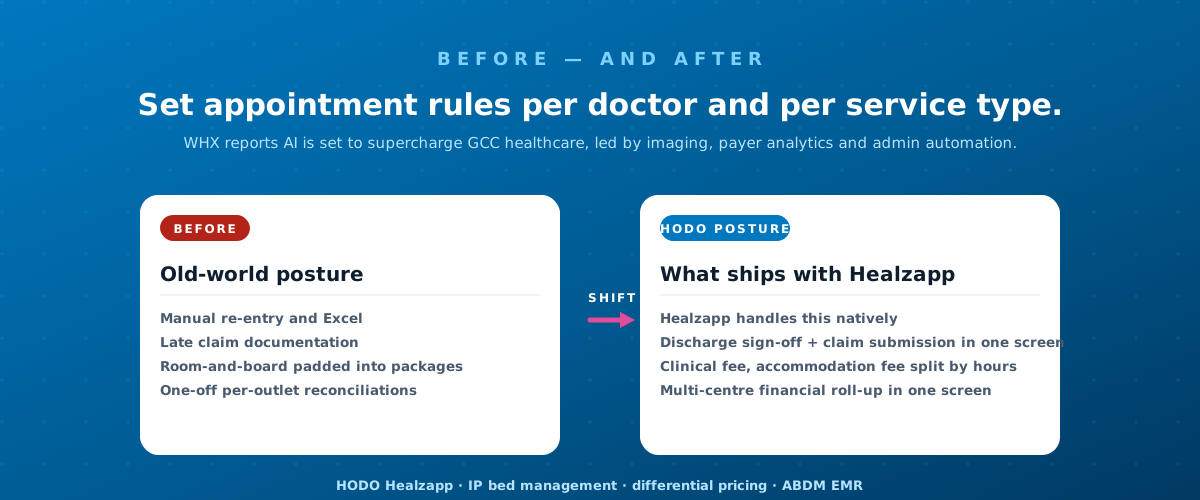
Set appointment rules per doctor and per service type.
Adding branches without adding overhead
The growth pattern across the region is the multi-branch group rather than the single site, two or three locations under one licence holder, sharing doctors, a lab contract and a brand. The operational risk in that model is configuration drift: each new branch gets set up slightly differently, so tariffs, service codes and doctor schedules diverge and group-level reporting stops being comparable.
The counter-measure is to treat a new centre as a replication of an existing template rather than a fresh build. Service masters, payer tariffs, roles and report formats should carry over by default, with only the genuinely local items, licence details, rooms, staff roster, configured per site. That is what makes the second branch cheaper to open than the first, and the fourth cheaper than the second.
What this means for HODO customers
The WHX signal is real, but the entry point for a polyclinic is operational rather than clinical. Billing (incl. multi-currency / GCC patterns) holds each insurer and TPA tariff separately so the right rate is applied at the counter instead of reconstructed at month end. EMR (AI-condensed history) compresses a long multi-doctor record into what is relevant in the current slot, which is where AI earns its place in a three-minute consultation. Machine Interfacing keeps analyser and device output as structured data rather than attachments, so the record stays readable by both clinicians and automation. And Multi-outlet scale-up with one-click new-centre setup carries an existing configuration into a new branch, so a second or third location inherits the tariffs and masters instead of drifting away from them.