Express Computer's recent feature, How AI-enabled hospital management platforms are reshaping healthcare operations in India, argues that the interesting AI story in Indian healthcare is no longer the imaging model, it is the operations layer sitting between the OP counter, the ward and the finance desk. For a 100-bed hospital or a growing diagnostic chain, that is the exact stack that decides whether occupancy, TPA cashflow and NABH readiness stay under control this quarter.
What Express Computer actually flagged
The Express Computer piece does not treat AI as a bolt-on chatbot. It reads AI as a substrate underneath the HIS, condensed patient histories at the point of consult, discharge summaries drafted from structured notes, claim documents assembled without a chase, and dashboards that surface where the day is leaking money or minutes. That framing matters because most 100-bed hospitals in Tier-2 and Tier-3 India are not shopping for a new EMR every year; they are asking whether their existing HIS can absorb an AI layer without ripping out billing, pharmacy and lab.
The subtext for buyers is direct: pick platforms that already handle IP, OP, pharmacy, OT and billing under one roof, so the AI features have real operational data to work on. A siloed AI tool bolted on top of a fragmented stack ends up as a demo, not a workflow. And the vendors who will win the next replacement cycle are the ones whose modules already share a schema.
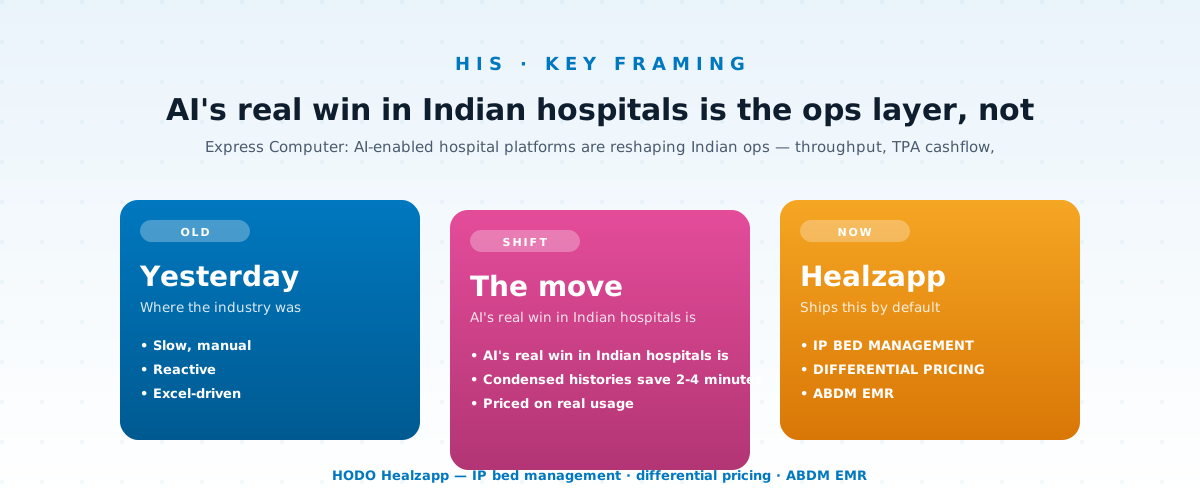
AI's real win in Indian hospitals is the ops layer, not chatbots.
Where AI actually shifts the needle in a 100-bed setup
Three places, in order of return on investment. First, the consulting room: an AI-condensed history that surfaces the last three visits, current medicines and abnormal labs in one paragraph saves each consultant roughly two to four minutes per follow-up. At 40 OP consults a day per doctor across ten consultants, that is measurable throughput, not a slogan on a slide.
Second, the billing counter: automated cross-checks between tariff, package inclusions and TPA MOU catch under-billing before the file leaves the desk. Under-billing is a bigger silent leak in Indian 100-bed hospitals than outright fraud; AI-driven package reconciliation attacks it directly and shows up in the P&L within one quarter.
Third, the ward and OT: bed-turn dashboards that combine EMR discharge readiness with housekeeping and pharmacy hand-offs cut the familiar 'discharge ordered at 11 am, bed free at 4 pm' gap. Every hour reclaimed on a 100-bed base at 70% occupancy is real admission capacity, not a KPI decoration. This is where AI in the HIS earns its keep, invisible to the patient, obvious to the CFO.
TPA, PMJAY and cashflow: the AI use case operators underrate
The single biggest ops pain in a 100-bed Indian hospital is not clinical, it is claim ageing. TPA and PMJAY cycles that stretch from 45 to 90+ days quietly kill working capital and push operators into inventory and salary compromises. AI-assisted claim assembly changes the shape of that curve: pre-authorisation packets built from EMR and OT notes, denial-pattern learning per TPA, and automated flags on missing documents before submission.
The rule of thumb from operators who have already moved on this: cut denial rate by 30-40% and halve resubmission cycles, and a ₹8-12 crore-a-year hospital frees eight to twelve days of working capital. That is the AI story CFOs actually care about, not the demo dashboard. When choosing an HIS, ask specifically how the AI layer reads TPA MOUs, how it handles PMJAY line-item mapping, and whether Tally integration posts the receivable without a re-key at month-end.
ABDM, NABH and the compliance floor
AI features are only useful if the underlying data is compliant and portable. ABDM registration is now a competitive baseline for hospital HIS in India, not a differentiator, but the operators who benefit most are the ones whose HIS was built ABDM-native rather than retrofitted. That distinction shows up in three places: consent artefacts, health record linking, and the audit trail when a patient triggers a data-fetch request.
NABH pre-assessment is the second compliance floor. AI-generated documentation is welcome only if it is traceable, versioned and attributable to a named clinician. Free-text summarisation that cannot be reconstructed later is a liability, not an asset. The right question to ask a vendor is not 'do you have AI?', it is 'when NABH auditors ask who wrote this note and when, can you show them the chain in one click?'
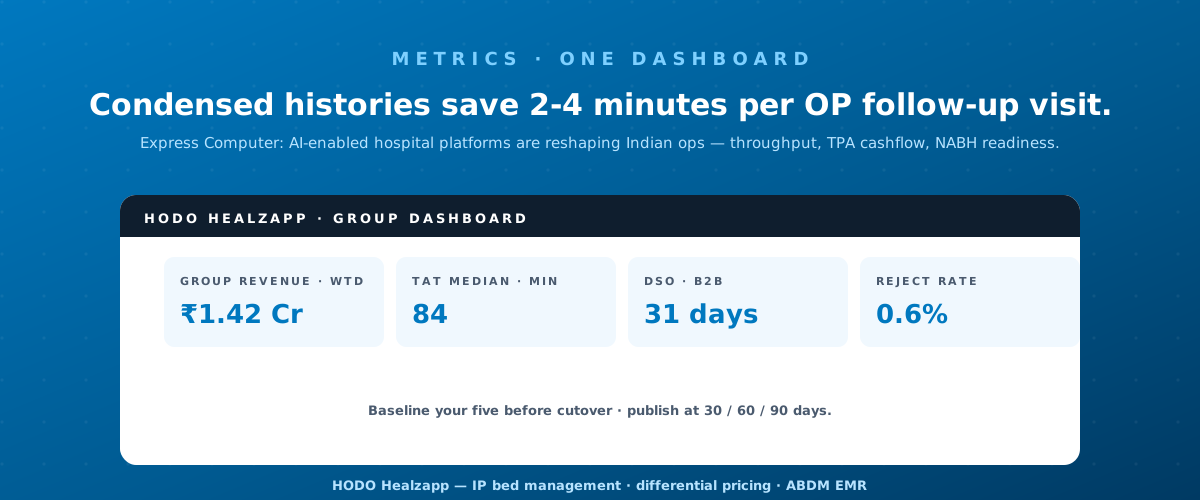
Condensed histories save 2-4 minutes per OP follow-up visit.
Multi-outlet scale, the harder problem AI alone does not solve
A 100-bed hospital that adds a satellite OP centre or a lab collection outlet doubles its complexity, not its revenue. AI helps at the edges, routing, roster optimisation, cross-outlet inventory, but the harder problem is configuration hygiene: tariff masters, doctor share rules, TDS mapping, pharmacy SKU codes, and role-based access. Chains that scale cleanly are the ones whose HIS ships a defensible new-centre setup with all masters, roles and dashboards inherited on day one.
The corollary for diagnostic chains and lab-at-home operators watching this space: the same discipline applies. Machine interfacing at the parent lab has to replicate at every satellite without a fresh integration project. Multi-currency handling and differential pricing per partner have to hold when the third franchisee logs in. AI sits downstream of that plumbing, it does not fix a fragile master data setup.
What this means for HODO customers
Healzapp is built to be that operational spine for Indian 100-bed hospitals and clinic chains that want AI where it actually pays back. Three features are worth naming in this context. EMR (AI-condensed history) gives consultants a usable paragraph at the top of every follow-up rather than another tab to hunt through. Multi-outlet scale-up with one-click new-centre setup is the difference between adding your third centre in a weekend and adding it over a quarter. And ABDM-compliant EMR plus Tally integration keeps the compliance floor and the finance close intact while the AI layer works above them.