Medical Buyer has argued that AI in diagnostics is moving from an operational efficiency tool to a source of competitive advantage. For Indian lab owners, that distinction matters far more than the technology itself: efficiency is something every competitor can buy from the same handful of vendors, while advantage has to rest on data nobody else holds. Closing the gap between the two is an operations problem long before it is an AI problem.
Efficiency gains arrive already commoditised
Analyser vendors, imaging suppliers and reporting platforms are all shipping the same class of capability — auto-verification of normal results, image pre-reads, voice-driven reporting, flagging of implausible values. A standalone lab in Kochi or Coimbatore buys its chemistry and haematology platforms from roughly the same four suppliers as the chain two streets away. If a lab's AI story is only that it reports faster, the competitor will have the identical story next quarter at the same licence fee.
That is what commoditised efficiency looks like. It raises the floor for everyone and shifts nobody's position. It is still worth having: a lab that cuts manual verification on routine panels frees senior pathologist time for the cases that actually need reading, and that shows up in cost per test. But it is table stakes, not a moat.
Advantage requires something the lab alone owns, and in diagnostics that is almost always the operational record of the lab's own working: which tests get repeated and why, which referral doctors send which panels in which months, which collection centre quietly adds four hours to turnaround every Monday, which partner's rate card has stopped covering its consumable cost. None of that arrives with the analyser. It accumulates — or it does not — depending on how the lab captures its own work.
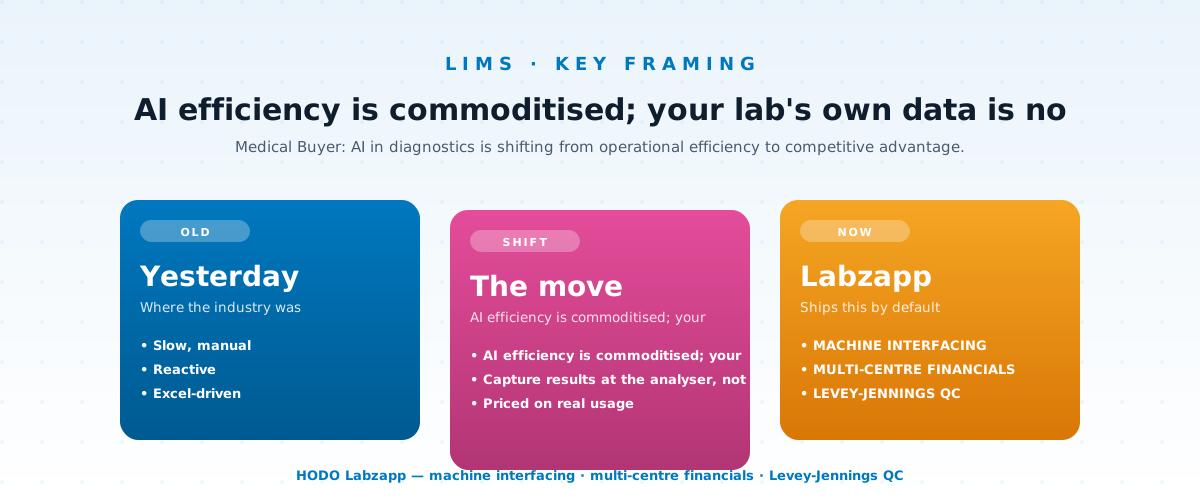
AI efficiency is commoditised; your lab's own data is not.
AI has a prerequisite, and it is capture at the source
Most Indian labs that describe themselves as data-rich are in fact report-rich. They hold lakhs of finished PDFs and very little structured history of how those reports were produced. The difference becomes obvious the moment anyone asks an analytical question. Median turnaround for thyroid profile at the Thrissur centre over the last ninety days, split by walk-in versus home collection? Repeat rate on a particular analyser since the last calibration? Share of samples rejected at receipt, by phlebotomist?
Those answers need timestamps at each handover — registration, collection, receipt, run, verification, release — and they need results flowing from the instrument rather than being typed. Barcoded samples and machine interfacing are usually filed under IT hygiene. They are better understood as the data layer: without them, there is no timeline to learn from, and every AI claim collapses into a demo on somebody else's dataset.
This also sets a practical test for any lab evaluating AI vendors this year. Before signing, check whether the lab can produce ninety days of clean, test-level operational data on request. If that extract takes a week of manual compilation, the problem to solve first is capture, not intelligence. Labs that fix capture find a second benefit immediately: the same structured trail is what NABL assessors ask for, so the accreditation workload drops at the same time.
Where advantage shows up first: the turnaround promise
For referral doctors, hospitals and corporate clients, the commercial decision rarely turns on report quality, which they assume. It turns on predictability. A lab that can commit to a turnaround band per test and then hold it wins B2B volume from labs that report faster on average but miss unpredictably.
That is where operational data earns its keep. With enough history, delay becomes forecastable rather than discovered: a batch that arrives after the afternoon run, a histopathology case that needs additional sectioning, a courier route running late in the monsoon. The useful intervention is not a dashboard — it is an exception raised to the coordinator before the referring doctor rings up, with a revised time the client can plan around.
Home collection makes the same point sharper. Visit slots, phlebotomist routes and sample receipt times decide whether an evening draw makes the night run or waits until morning, and that single decision moves reported turnaround by twelve hours. Labs running home collection without recording collection-to-receipt time are managing the promise blind. The chain-of-custody record is not paperwork; it is the input that makes the commitment credible.
Partner pricing is a data decision, not a negotiation instinct
The other place advantage compounds is the B2B rate card. Most lab chains in India run differential pricing across referral doctors, corporate clients, insurers and franchise partners, and most of them set those rates on relationship memory rather than contribution. The arithmetic needed is unglamorous: revenue per partner, test mix per partner, cost per test including consumables, controls and repeats, and the share of work routed to an outsource partner lab at a different cost base.
No algorithm fixes a rate card that nobody has costed. But once partner-level revenue and test-level cost sit in the same system, the questions become answerable and the answers are specific — this corporate contract is loss-making only on two panels, that franchisee's volume growth is entirely in low-margin profiles, this referral cluster has shifted its outstation work elsewhere over six months. These are the decisions that separate lab chains with similar equipment and similar NABL scope.
It also changes how AI pilots get judged. A pilot that saves verification minutes is measurable in cost per test. A pilot that cannot be tied to cost per test, partner margin or turnaround compliance is a purchase without a numerator.
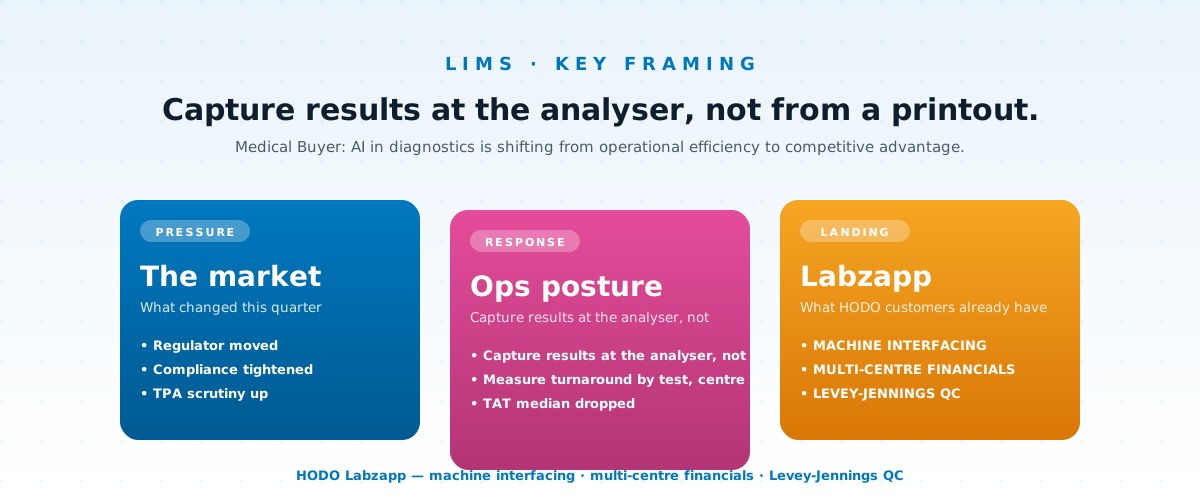
Capture results at the analyser, not from a printout.
The sequencing trap
The common failure is ordering. Labs commission an AI pilot while registration still runs on a paper slip, results are keyed in from printouts, and quality control lives in a monthly register. The pilot produces a tidy result in a controlled subset and then does not generalise, because the surrounding workflow never produced the data the model needs in routine conditions.
A workable order is plain enough. Instrument the workflow end to end so every sample has a barcode and every result has a source. Measure what the workflow now reveals — turnaround by test and centre, repeat and rejection rates, quality control performance per analyser, contribution per partner. Only then automate judgement, starting with the highest-volume, lowest-ambiguity decisions. Labs that follow that sequence tend to find that steps one and two already deliver most of the margin improvement they were hoping to buy from step three, and that step three works when they get there.
What this means for HODO customers
The Medical Buyer argument holds, with one correction for Indian conditions: the advantage sits in the operational record, and the record has to be produced by the daily workflow rather than reconstructed later. Labzapp is built around that record. Machine interfacing with barcoded samples puts results and timestamps into the system from the instrument instead of a keyboard, which is what makes any downstream analysis trustworthy. TAT reporting turns those timestamps into turnaround performance by test, centre and collection type, so the B2B promise is measured rather than assumed. Differential pricing per partner, with referral-doctor and corporate-partner portals, keeps partner-level revenue and test-level cost in one place, so rate cards are negotiated against contribution. Levey-Jennings QC keeps analyser performance in the same structured trail that NABL assessment and any future automation both depend on.