Digital Health News reports that Tandem Health has raised $100 million to build an AI-native clinic operating system for practices across Europe. The size of the round matters less than the label: within a quarter, most clinic software vendors will be describing themselves the same way. For a polyclinic group in Dubai, Abu Dhabi, Doha or Manama, the question worth asking is narrower, when an AI layer arrives, which system remains the record of what happened in the clinic today.
What "AI-native" claims, and what it does not
The category claim behind an AI-native clinic operating system is that intelligence sits at the centre of the workflow rather than bolted to the side of it. In practice, funded entrants into this space almost always start at the consultation note, ambient capture, drafted summaries, structured problem lists, because that is where clinician time visibly leaks and where the demo lands well.
That is a real saving, and it is also the narrowest part of a clinic's operating day. A polyclinic consultation generates a note, but it also generates an appointment slot consumed, a service line priced against a specific insurer tariff, a co-payment collected at a counter, a pharmacy dispense, possibly a lab order routed to an in-house analyser or an outsource partner, and a report that has to reach the patient. None of those are documentation problems. They are transaction problems, and they decide whether the clinic is profitable at the end of the month.
So the honest reading of the news is not that clinic software is being replaced. It is that a well-funded layer is forming above the transactional core, and buyers will be asked to choose between the two as though it were one decision. It is not one decision.
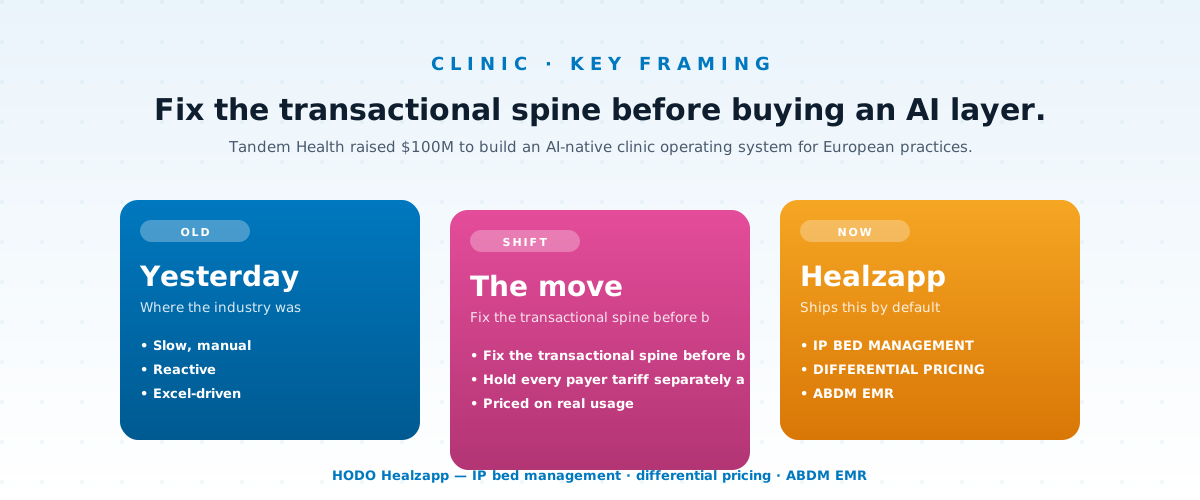
Fix the transactional spine before buying an AI layer.
Europe's clinic stack is not the Gulf's
A product built for European general practice inherits assumptions that do not survive a move to the GCC. Payer structure is the first. A Deira or Al Sadd polyclinic typically bills across a dozen or more insurers and TPAs, each with its own tariff sheet, approval thresholds and e-claim submission format, plus a genuine cash and walk-in segment paying retail rates. Pricing is not a single fee schedule; it is a matrix of payer, plan, service and sometimes nationality-linked package.
Licensing is the second. Facility and practitioner records tied to DHA, MOHAP, DOH or the relevant Qatari, Kuwaiti and Bahraini authorities have to be current, and clinical staff credentials have to map to what each doctor is permitted to bill. A system that cannot hold that mapping creates manual reconciliation work that no amount of note-drafting offsets.
The third is shape of business. GCC polyclinics commonly run a pharmacy, a small lab and several specialities under one licence, often with multi-currency receipts and cross-border patient traffic. The record of truth has to span all of it. Documentation-first products tend to treat everything beyond the consultation room as an integration problem for later.
The system-of-record question comes first
Any AI layer is only as useful as the data underneath it. This is the part buyers consistently underweight. If a clinic's history lives as scanned PDFs, free-text remarks and a separate billing spreadsheet, an AI tool has nothing structured to reason over, it will summarise the note it just wrote and little else. Value compounds only when diagnoses, orders, results, dispenses and payments are all captured as fields in one place.
That sets a practical sequence for a polyclinic group in 2026. First, consolidate the transactional spine: patient identity, appointments, billing, pharmacy, lab orders and results in a single system with one patient index across branches. Second, make sure analyser results arrive as structured values rather than printouts. Third, add the intelligence layer, condensed histories, drafted notes, recall prompts, on top of records that are already machine-readable.
Run in the other order, and the clinic pays twice: once for an AI tool that cannot see enough context to be trusted, and again for the migration that should have happened first. The funding announcements will keep pushing the reverse sequence, because documentation is the easiest thing to sell into a busy practice.
Where AI actually earns its keep in a polyclinic day
Three places, ranked by how quickly the return shows up on an operations report.
Repeat-visit context. A patient returning to a different doctor in the same group forces someone to read through months of scattered entries, or skip it. A condensed history that surfaces prior diagnoses, medications and abnormal results in a few lines removes a real minute-tax from every follow-up consultation, and it improves the consultation rather than just shortening it.
Front-desk load. Booking, rescheduling, no-show follow-up and report delivery are high-volume, low-judgement tasks. Automating report delivery over WhatsApp or SMS alone removes a visible share of inbound calls. Scheduling rules that respect each doctor's slot length by service type prevent the overbooking that produces waiting-room complaints in the first place.
Revenue hygiene. Applying the correct payer tariff at the point of billing, flagging services that need prior approval, and catching mismatches before submission is unglamorous work that AI assistance handles well, and it moves cash collection more than any clinical feature will.
Notably, none of these require a new operating system. They require the operating system to hold structured data and expose it.
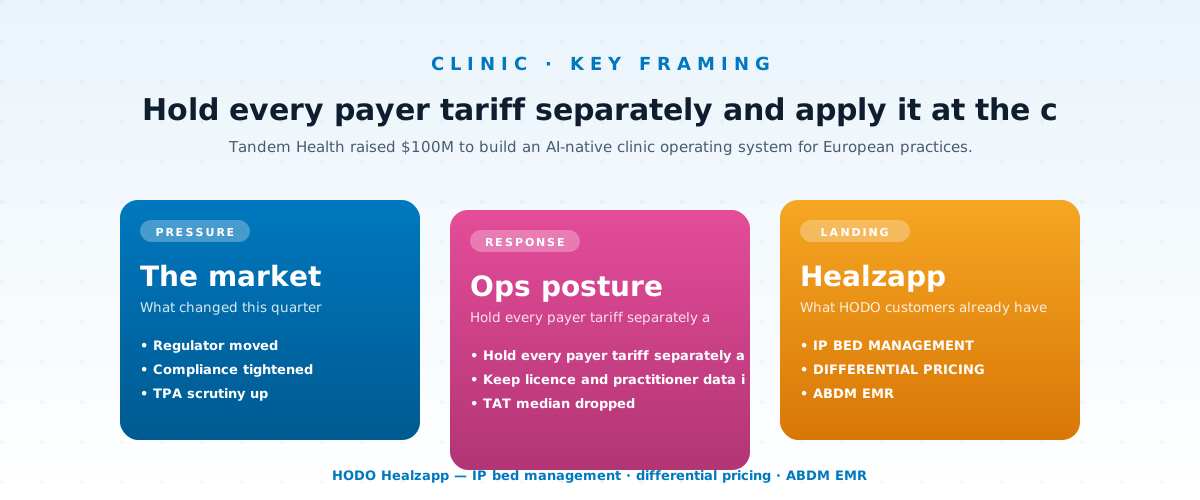
Hold every payer tariff separately and apply it at the counter.
Buying questions for a three-site polyclinic
Five questions separate a durable purchase from a demo-driven one. Does the system hold every payer tariff separately and apply the right one at the counter, or does it expect staff to remember? Can facility and practitioner licence data be maintained inside the record, with expiry visibility? When a fourth branch opens, is setup a template exercise or a fresh implementation? Do analysers and imaging devices interface directly, or does a technician retype values? And if the vendor relationship ends, does the clinic get its structured data out, not a PDF archive?
Cost per patient visit is the metric that makes these concrete. A clinic that knows its blended cost per visit, including staff minutes at the counter and rework on rejected claims, can price an AI layer honestly. A clinic that does not will buy on enthusiasm, and the enthusiasm will not survive the second billing cycle.
What this means for HODO customers
Healzapp is built as the transactional spine that an intelligence layer can sit on, rather than the reverse. Billing (incl. multi-currency / GCC patterns) holds payer-specific tariffs and differential pricing so the counter applies the correct rate without staff memory. EMR (AI-condensed history) gives the returning-patient context that makes repeat consultations faster inside the same record set, not in a parallel tool. Appointments and Machine Interfacing keep slot rules and analyser results structured, which is the precondition for anything AI-driven to be useful. For groups adding sites, Multi-outlet scale-up with one-click new-centre setup turns a branch launch into configuration rather than a second implementation project.
The Tandem round is a signal that the clinic software category is being re-drawn around AI. It is not a signal to replace a working record system with a documentation tool. Get the spine right, keep the data structured, and the intelligence layer becomes an upgrade instead of a migration.