ET HealthWorld reports that Indian hospitals are moving from scattered AI experiments to what the sector is now calling AI-native operations. The hospitals making that claim are standing on ten or fifteen years of admission, billing and lab data sitting in one system. Home-visit operators, doctor-at-home services, lab-at-home and home-collection networks, are running the same ambition on a far thinner base, because most of their operational history lives in WhatsApp groups and a phlebotomist's memory.
The AI-native conversation skips the fastest-growing delivery channel
Almost every Indian AI-in-healthcare discussion is set inside a building. Triage at the OP counter, bed turnaround, radiology reads, discharge summary drafting, all of it assumes the patient came to the provider. Meanwhile the delivery model growing fastest in Indian metros and tier-2 cities is the one that goes the other way: a doctor or a phlebotomist travelling to an address, on a schedule, with a sample or a prescription coming back.
That channel has the worse data position and the higher operational variance. A hospital OP visit generates a registration, a bill, an order set and a result, all timestamped by systems that cannot easily be bypassed. A home visit generates a phone call, a location pin shared on chat, a cash or UPI collection, and a handwritten note. Nothing about that sequence is machine-readable, which means none of it compounds. An operator running 300 visits a month for two years has no usable record of which routes ran late, which addresses needed a second attempt, which tests were added at the doorstep, or which patients were worth calling back.
Before any model is useful here, the visit itself has to become a record. That is unglamorous work, and it is the entire prerequisite.
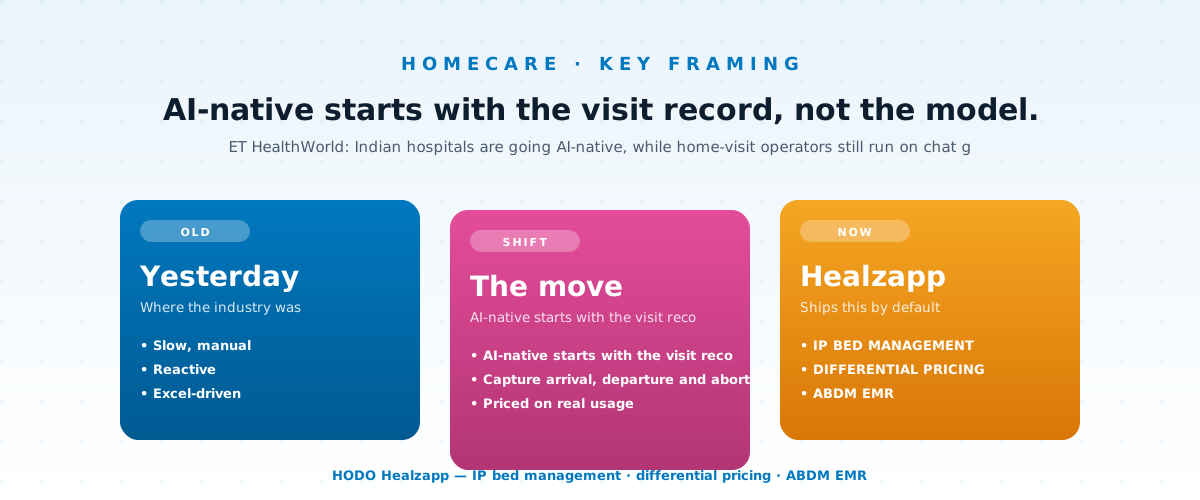
AI-native starts with the visit record, not the model.
What a visit record must contain to be worth anything
The test for a home-visit record is simple: could a system reconstruct the visit six months later without asking a human? That requires five things captured at the time, not reconstructed afterwards.
First, one patient identity that survives across visits, so a repeat patient is recognised rather than re-registered under a slightly different spelling. Second, a booked slot with a promised window and the actual arrival and departure timestamps, not just the date. Third, the assigned staff member, by name, on every visit. Fourth, what was actually done and collected at the doorstep, including tests or consultations added on the spot, which is where unbilled work usually hides. Fifth, the outcome: sample received at the lab, consultation completed, visit aborted, patient not available.
Operators resist this because it looks like paperwork added to a field worker's day. In practice the capture has to happen on the phone already in the staff member's hand, in under a minute, with the booking already loaded. If the field app asks a phlebotomist to retype a patient's name and address, it will be filled in at the end of the day from memory, and the timestamps become fiction. A record that is entered late is worse than no record, because it looks authoritative while being wrong.
Schedule adherence is the first honest number
Routing software is the standard first purchase in this vertical, and it is usually bought before anyone knows what the current adherence rate is. The number worth establishing first is the share of visits that happened inside the promised window, measured per route and per staff member, over a full month including Sundays and festival weeks.
Most operators who measure this honestly find a figure between 55 and 75 per cent, and find that the misses cluster, two routes, three staff members, one time band. That clustering is the useful finding, because it is fixable with scheduling discipline rather than a new algorithm. Optimisation applied on top of unmeasured chaos reorders the chaos.
The second number is attempts per completed visit. A home visit that needs a second trip because nobody was at the address, or the patient had eaten, or the requisition was unclear, roughly doubles the cost of that visit while earning the same revenue. For a doctor-at-home service billing ₹800 to ₹1,500 per consultation and paying the clinician a per-visit fee plus travel, two or three failed attempts a week erase the margin on an entire route. Capturing the abort reason as a structured field, not a chat message, is what turns that loss into something a schedule can be designed around.
What the clinician needs before the doorbell
The clinical quality problem in doctor-at-home work is not skill, it is context. A doctor walking into a flat has no chart, no previous vitals, no record of what the last visiting doctor changed, and often no reliable account from the patient of which medicines are actually being taken. Many operators rotate clinicians across routes, so the person at the door is rarely the person who visited last time.
This is the one place where an AI layer earns its keep immediately, and it is also where it is completely dependent on the record layer. A condensed history, last three visits, current medication list, recent results, the previous plan, is genuinely useful in the two minutes before a visit. It is also only constructible if those three visits were recorded as structured data rather than scanned notes. The same applies to the patient-facing side: a home-visit operator that cannot show the patient their own previous reports and prescriptions on a phone is competing on price alone, because there is nothing else to retain them with.
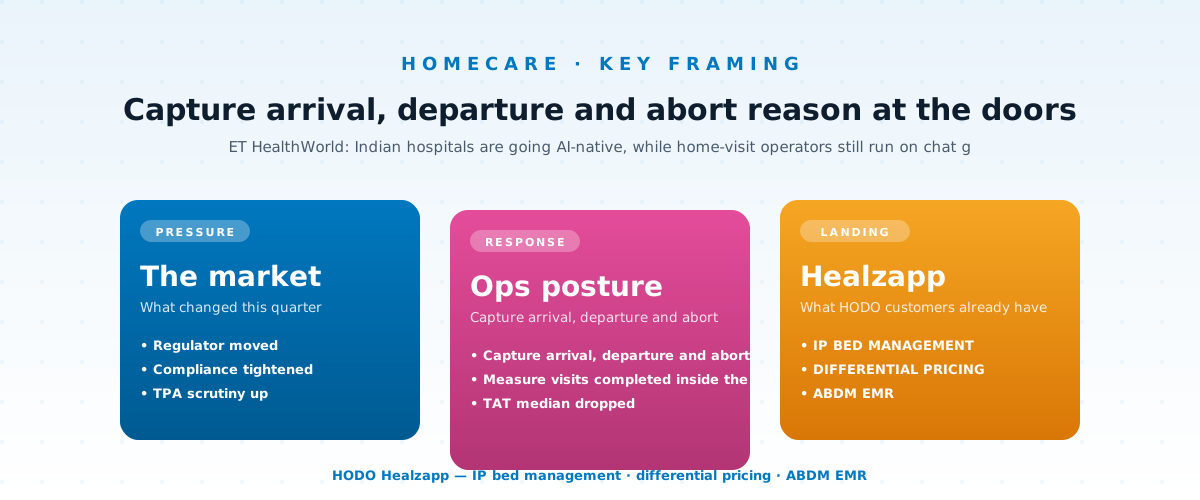
Capture arrival, departure and abort reason at the doorstep.
Report delivery and follow-up decide repeat revenue
For lab-at-home work, turnaround time has to be measured from the draw at the doorstep, not from sample accession at the lab. The gap between those two timestamps, transit, batching, a scooter waiting for a full box, is invisible to the lab and completely visible to the patient. Operators that do not record collection time cannot see their own worst delay.
Report and prescription delivery is the other half. Patients expect the report on WhatsApp, and expect it without calling to ask. Automated delivery on result authorisation removes the single largest category of inbound calls in a home-collection business, which is a direct staff-cost saving rather than a convenience feature. Follow-up is the revenue side of the same mechanism: a repeat test due in three months, a review consultation at day seven, a chronic patient due for a quarterly panel. These are known, dated, predictable events, and in most home-visit operations they are tracked by whoever remembers. A system that holds the follow-up date and prompts the call is the difference between a one-visit business and a recurring one, and repeat visits carry no acquisition cost.
What this means for HODO customers
Doctor-at-home and lab-at-home operators do not need a separate AI product. They need the visit to exist as data, and then the useful things become available in order. In Healzapp, Appointments holds the booked slot, the assigned clinician and the actual visit timestamps, which is what makes schedule adherence and attempts-per-visit measurable rather than anecdotal. EMR (AI-condensed history) gives the clinician at the door the last visits, medications and results in a readable summary, useful precisely because the underlying visits were captured as structured records. The Patient Health App and WhatsApp/SMS report delivery close the loop on the patient side, delivering reports and prescriptions without an inbound call and keeping prior records accessible to the patient between visits. For operators expanding into new cities, multi-outlet scale-up with one-click new-centre setup means route two inherits the same record structure as route one, rather than starting its own spreadsheet.