ET HealthWorld's report on Indian hospitals moving "from AI experiments to AI-native" operations describes a real shift in posture: fewer standalone pilots, more interest in AI sitting inside the daily workflow. But most of that coverage is written from the vantage point of large corporate chains with data teams on the payroll. For a 100-bed hospital in Kozhikode, Nashik or Vijayawada, the useful question is narrower, what has to be fixed in the record system before any AI tool is worth its licence fee.
Why AI pilots stall at 100 beds
Pilots at mid-sized Indian hospitals rarely die for technical reasons. They die because the inputs are not there. Radiology sits on a separate PACS that nobody has API access to. Lab values are printed from the analyser and typed into the HIS by an evening-shift operator, with a 4% transcription error rate that nobody measures. Pharmacy runs on its own billing module, and the accounts team re-keys the day's collection into Tally. Nursing notes are on paper, scanned at discharge, and filed as a single flat image per patient.
Drop an AI triage or risk-scoring tool into that environment and it has nothing clean to read. The vendor demo worked because the demo data was structured. Six weeks later the pilot is quietly abandoned, and the hospital concludes AI is not ready, when in fact the record system was not ready.
The practical sequence is the reverse of the sales pitch. First, make the operational record complete and machine-readable. Second, measure the two or three numbers AI is supposed to improve, average length of stay, OP waiting time, claim rejection rate, cost per patient. Only then buy an AI capability, against a baseline that is already trusted. Hospitals following that order usually find the first two steps deliver most of the gain on their own.
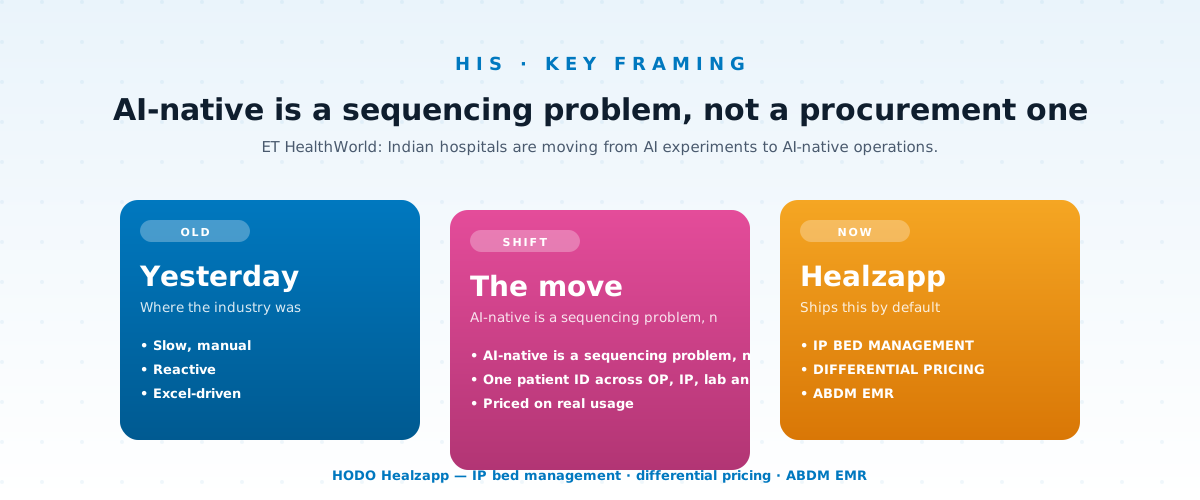
AI-native is a sequencing problem, not a procurement one.
One patient identity, or nothing compounds
The single most common structural defect in a 100-bed hospital's data is that the same patient exists several times over. One record from OP registration in March, another created at IP admission in July because the front desk could not find the first, a third in the lab module because the sample was booked under the referring doctor's name, and a fourth in the pharmacy because a relative bought the medicines.
Nothing downstream survives this. Readmission analysis is meaningless if a readmission looks like a new patient. Any AI-condensed history is condensing a fragment. Package costing per procedure is wrong because the pharmacy and lab spend attached to that episode were never linked to it. And the clinical risk is real, allergy and comorbidity history that exists in the system but not in the record the consultant is looking at.
Fixing this is unglamorous work: mobile number as the search key, a mandatory duplicate-check at registration, a monthly merge exercise on flagged records, and a single patient ID carried across Patient Management, IP/OP, Appointments, Billing, lab and Pharmacy rather than four module-specific IDs. The side benefit has nothing to do with AI, recovery of outstanding balances becomes possible, because the balance attaches to a person rather than a visit.
Machine interfacing is the cheapest AI prerequisite
If a hospital does one technical thing this year, direct analyser-to-system integration is the one with the clearest return. A bidirectional interface on the biochemistry, haematology and immunoassay analysers removes the manual transcription step entirely. Results land as structured numeric values with units, reference ranges and the instrument's own flags intact.
Three consequences follow. Turnaround time drops by the length of the typing queue, which in most 100-bed hospitals is the largest component of lab TAT after 6 pm. Transcription error disappears as a category, which matters for NABH documentation and for clinician trust. And the hospital finally has a longitudinal series of numeric results per patient, the only form in which lab data is useful to an AI layer later.
The same logic extends to outsourced tests. B2B Referral / Outsource Lab / Corporate-partner logins keep the referred-out workload inside the same record instead of arriving back as a PDF on WhatsApp, and differential pricing per partner makes a reference lab arm costable. None of this is AI. All of it is the precondition.
Where AI earns its keep first: beds, throughput and discharge timing
Occupancy is where a 100-bed hospital's economics live, and it is also where prediction is genuinely useful. The practical target is not a sophisticated forecasting model, it is knowing, at 8 am, which beds will free up by 2 pm. Most hospitals cannot answer that because the discharge decision, the final billing, the pharmacy return and the housekeeping turnaround are tracked in four places, if at all.
A live bed occupancy view that includes expected discharges, pending clearances and cleaning status is the input any AI scheduling layer would need anyway, and it pays for itself before the AI arrives. Hospitals that moved discharge decisions to a morning round and tracked bed-release-to-readiness time have pulled an hour or more out of the turnaround, which at 100 beds is effectively free capacity.
On the OP side the equivalent lever is queue visibility: multi-doctor scheduling with realistic slot lengths, a token display in the waiting area so patients stop crowding the counter to ask for position, and Teleconsultation for review visits that do not need a physical slot. Each reduces the staff minutes spent answering "how long more", and staff minutes per patient is what actually moves cost per patient.
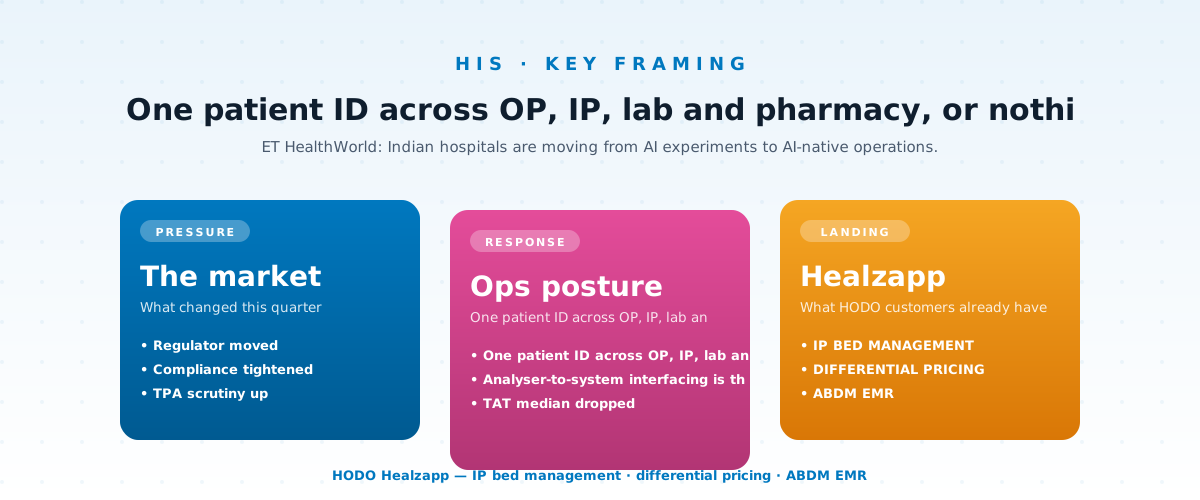
One patient ID across OP, IP, lab and pharmacy, or nothing compounds.
Documentation completeness decides TPA and PMJAY cashflow
For most 100-bed hospitals, the largest single operational risk is not clinical and not technological, it is the 40 to 90 days of working capital sitting in TPA and PMJAY receivables. A meaningful share of rejections and queries are documentation defects: a missing investigation report, an unsigned note, a discharge summary that does not state the indication for the procedure that was billed.
AI can draft a discharge summary. It cannot invent the note that was never written. So the first intervention is capture: consultation notes entered in the EMR rather than on paper, investigation results attached to the episode automatically via the analyser interface, and a pre-submission checklist that blocks a claim file from going out incomplete. Once that is in place, AI-condensed history genuinely helps, the consultant reads a summarised prior record instead of scrolling 40 visits, and the claim pack assembles from structured fields rather than from a scanned bundle.
ABDM-compliant EMR matters here for a reason beyond compliance: the same structured discharge and diagnosis data that satisfies ABDM is what makes claim documentation reusable and auditable. For hospitals heading towards NABH, the audit trail, who entered what, when, and what was changed, is the part AI tools tend not to supply and the part assessors ask for.
What this means for HODO customers
AI-native is a sequencing problem, not a procurement problem. The hospitals that get value from AI in the next two years are the ones whose operational record is already complete, de-duplicated and structured, ordinary HIS discipline, not a new budget line. Machine Interfacing removes manual transcription from the lab and gives the hospital structured, longitudinal numeric results. EMR (AI-condensed history) puts a summarised prior record in front of the consultant instead of a 40-visit scroll, and feeds structured fields into claim documentation. IP bed management makes expected discharges and bed readiness visible in one view, which is both the throughput lever and the data any predictive layer will need. Hospitals running more than one unit get the same configuration through one-click new-centre setup rather than a fresh implementation each time.