
Digital Health News has published a wide survey of AI platform adoption across India's healthcare sector, mapping where deployments are concentrated, where investment is moving, and which challenges are holding back scale. The useful signal in that report is not the enthusiasm — it is the distance between the number of hospitals, labs and health startups running an AI pilot and the much smaller number that can point to an operating metric that actually changed. That distance has a structural cause, and it is not model quality.
Read across the adoption categories and a pattern appears: Indian healthcare AI spend clusters around a handful of visible, bounded use cases — imaging reads, clinical documentation, patient-facing chat, claims and coding support. These are the easiest to procure because the before-and-after is legible inside a single department. Investment follows the same logic, because a narrow use case is easy to underwrite.
What the report files under challenges — data readiness, integration effort, workforce adoption, trust — are all downstream of one thing, and none of them are model problems. A ~100-bed hospital in Kochi or a three-city lab chain does not fail at AI because the model is weak; it stalls because the pilot was never connected to how the organisation already runs. The radiology tool does not know the hospital's TPA rejection patterns. The chatbot does not know which of the four outlets runs evening collections. The documentation assistant does not know last month's NABH observation.
For founders building lab-at-home or doctor-at-home products, the same asymmetry shows up at a different scale. The demo is cheap; institutionalising the capability so it survives a staffing change, a new city or a new partner lab is the expensive part — and that is where the investment thesis quietly sits.
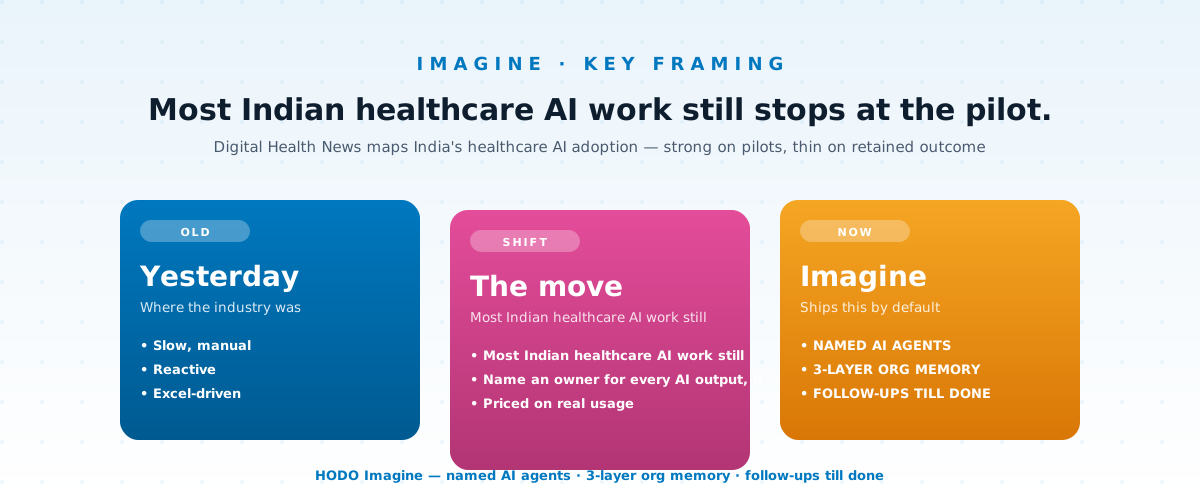
Three failure modes repeat. The first is amnesia. Most AI usage in Indian healthcare today runs as individual staff sessions inside a general assistant, and every conversation restarts from zero. The context a coordinator spent forty minutes assembling — partner rate cards, which referring doctor wants reports on WhatsApp, how the pre-auth desk words a query — evaporates when the tab closes. The organisation pays for the same context twice a week, forever.
The second is ownership. A use case gets approved, but nobody is named accountable for the output. When the AI drafts something wrong, there is no reporting line to correct it against, so staff quietly route around it. Adoption surveys then record workforce resistance, which is a symptom rather than a cause.
The third is that nothing closes. The AI produces a draft, a summary, a follow-up list — and then the task sits. Healthcare operations are almost entirely follow-up work: pending reports, unclosed claims, incomplete consents, repeat-visit reminders, vendor AMC renewals. A tool that generates good first drafts and never chases the second step adds reading load, not capacity. Operators feel that in the first fortnight, which is why pilots get polite reviews and no renewal. None of these three are fixed by switching to a newer model. They are fixed by changing what sits around the model.
The alternative framing is to treat AI not as a tool that staff use, but as a layer the organisation owns. That is the design behind imagine: named AI agents that have a defined job, a memory and a reporting line, instead of a chat window shared by whoever happens to open it.
The mechanism that matters most is memory structured in three layers — today, this week, and forever. Today holds live context: which samples are pending, what the duty manager flagged this morning. This week holds the running thread, so Thursday's work knows what Monday decided. Forever holds the institutional layer: rate structures, partner rules, escalation norms, the wording that has survived an audit. Each piece of knowledge is entered once and keeps compounding, instead of being re-explained by whoever is on shift.
The consequence is churn resistance. In Indian healthcare operations, front-office and coordinator attrition is a standing cost, and most process knowledge leaves with the person. When that knowledge sits in the organisation's agents rather than in one staff member's chat history, a replacement joins into an existing record instead of a blank one. imagine does not replace Microsoft 365, Copilot or ChatGPT; it connects them with memory, so existing tool spend becomes cumulative rather than disposable.
For entrepreneurs and operators, saying the organisation uses AI has stopped being a differentiator — the adoption numbers in the report are precisely why. What still differentiates is evidence: an audit trail showing that an AI teammate handled a recurring process, consistently, over months, in the organisation's own voice.
That evidence is concrete. A lab-at-home founder raising a bridge round can show that partner onboarding queries were handled by a named agent with a measurable close rate, rather than describing an intention. A diagnostics chain pitching a corporate contract can show that report-delivery exceptions were chased to closure without adding a coordinator. A hospital group can show that patient communication followed one voice across four outlets, instead of five staff members writing five registers of English.
Brand voice consistency sounds cosmetic until it is costed. Patient-facing communication in Indian healthcare is usually written by the least-senior, highest-turnover part of the organisation, and inconsistency there surfaces as repeat calls, disputed bills and avoidable escalations. Fixing it at the agent layer fixes it once. The same holds for follow-ups: when the system is built to pursue tasks until they close, the reported metric moves from drafts produced to items closed, which is the only number worth putting in a board pack.
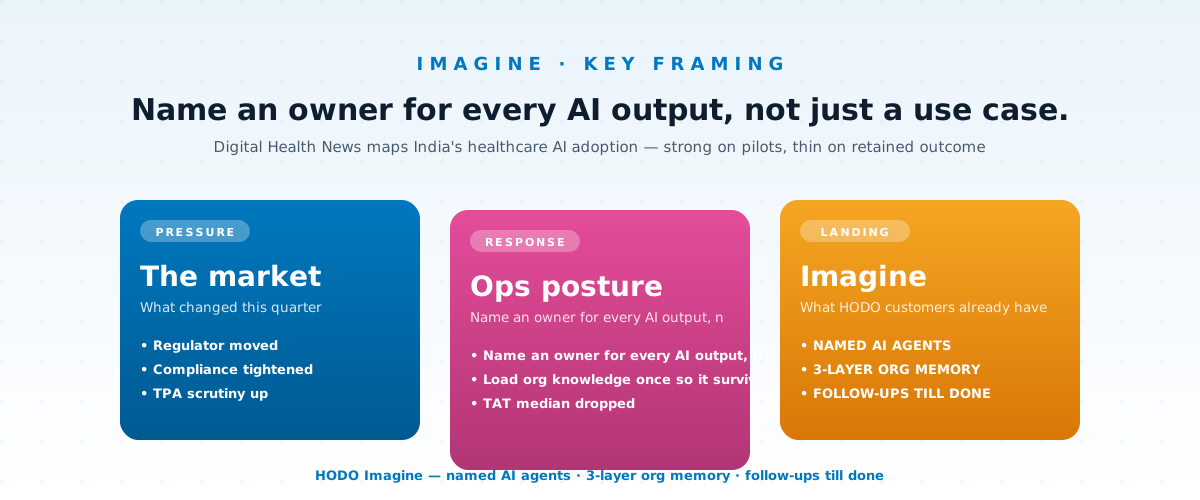
The practical path is narrow on purpose. Start with one recurring, already-documented process that eats coordinator hours — pending report follow-ups, partner rate queries, pre-auth document chasing, AMC renewal tracking. Choose the process where the correct answer is already written down somewhere, because that is what loads cleanly into the forever layer.
Next, name the agent and give it a job description and a reporting line, the way a new hire would get one. Ambiguous ownership is what killed the previous pilot; there is no gain in repeating it with better technology. Then load the organisation's real artefacts — rate cards, SOPs, escalation matrices, approved message templates — so the first output already reads in house style.
Measure one number, chosen before the start: items closed per week, coordinator hours returned, or average time to close a pending item. Review it weekly for six weeks, which is long enough for the memory layers to accumulate and short enough to abandon honestly. Only then widen to a second process. Organisations that attempt five AI use cases in month one tend to end up exactly where the report found the market — a long list of pilots and an unchanged operating metric.
Healthcare AI in India is now a retention story rather than an access story. Access to capable models is close to universal and no longer scarce; what remains scarce is an organisation that gets measurably better at its own work every month. That compounding is what named AI agents with memory are built to produce — jobs, reporting lines and accountability attached to AI output instead of a shared chat window.
Two mechanics carry most of the weight. 3-layer memory — today, this week, forever means context is captured once and keeps paying, so institutional knowledge survives coordinator attrition rather than walking out with it. Follow-ups until tasks close shifts the measured unit from drafts generated to items actually closed, which is the version an operator or an investor can audit. Brand voice consistency then makes that output usable in front of patients and partners without a rewrite pass.
See how imagine turns AI into organisational intelligence — explore imagine.
See how Healzapp, Labzapp and EReazy fit your speciality in a free 30-minute demo.
Book a Free Demo