Private hospitals in Andhra Pradesh have been instructed to treat patients using their ABHA (Ayushman Bharat Health Account) ID cards, as reported by The Hindu under the Ayushman Bharat Digital Mission (ABDM) coverage. The directive turns what was, until recently, a voluntary integration into an operational baseline for any facility that wants to keep its OP counter, IP admissions and TPA claims running without friction. For owners and administrators of 50-500 bed hospitals in the state, the countdown is on for registration desks, HIS vendors and MRD teams to catch up.
What the Andhra Pradesh directive actually asks for
The state order does not simply request that hospitals record an ABHA number in a spreadsheet. It expects private hospitals to accept ABHA IDs at registration, link the visit to the patient's ABHA address, and push a discharge summary or OP consultation record back to the ABDM Health Information Exchange (HIE-CM). Anything less is cosmetic compliance. The instruction sits alongside the broader ABDM push: HFR (Health Facility Registry) enrolment, HPR (Healthcare Professional Registry) linkage for consultants, and consented data-sharing across the network.
For a 200-bed hospital running 600 OP registrations a day, this changes the front-desk script. Reception cannot ask patients for an ABHA number as an optional field printed at the bottom of the form. It has to be a primary demographic capture, with fallback flows for patients who arrive without one, either creating an ABHA on the spot via Aadhaar or mobile OTP, or issuing a temporary MRN that is reconciled later. Hospitals that treat this as an MRD problem rather than an IT-and-workflow problem will lose the first three months to rework.
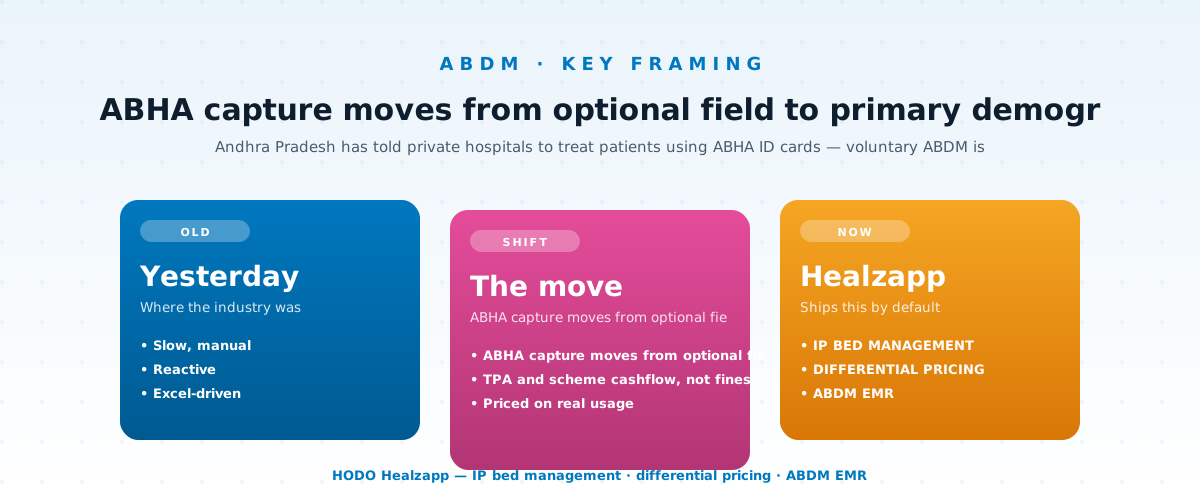
ABHA capture moves from optional field to primary demographic at every registration desk.
Why the operational cost of non-compliance is higher than it looks
Administrators tend to price ABDM compliance as a one-off IT project. The state directive changes that maths. The immediate exposure is not a fine, it is TPA and government-scheme cashflow. As states move health-scheme empanelment, insurance claim workflows and referrals onto ABDM rails, a hospital that cannot produce an ABHA-linked record for a discharged patient will find claim rejection rates creeping up. Second-order costs include duplicate MRNs (the same patient walking in with different phone numbers over three years), broken referral loops with diagnostic partners, and audit exposure when the state asks for the ABHA-linkage percentage of its inpatient population.
There is also a talent cost. Consultants who are registered on the HPR expect their digital signature on discharge summaries to flow to the patient's ABHA address without them chasing MRD. If the HIS cannot do that, the hospital is quietly training its senior doctors to distrust its own systems, which is worse than any single missed claim.
Where most Indian HIS deployments break on ABDM
The typical failure mode is not the ABHA linkage screen. It is upstream and downstream of it. Upstream: the front desk uses a separate Aadhaar / demographics tool, then re-keys into the HIS, so the ABHA number and the MRN drift apart. Downstream: the EMR captures the consultation, but the discharge summary is a Word document that a junior doctor pastes into a PDF and hands to the patient, nothing goes back to ABDM.
The fix is not more manuals. It is a HIS where ABHA capture, EMR authoring, discharge summary generation and ABDM push sit inside the same patient chart, triggered by the same clinical event. Hospitals that already run structured EMRs with digital signatures find the shift is a two-week configuration exercise. Hospitals still running paper case sheets with a billing-first HIS bolted on will need three to six months, and should start now rather than in December.
The multi-outlet complication
Chains with 4-15 branches across Andhra Pradesh have a specific problem. ABDM compliance is not a per-branch checkbox, it is a per-facility HFR registration, per-consultant HPR linkage, and per-patient ABHA linkage that has to hold across the network. A patient registered at the Guntur branch and discharged from the Vijayawada branch must show one longitudinal record on their ABHA app. If each branch has its own HIS instance and MRNs do not reconcile, the patient will see two disconnected episodes and the chain will look like two different hospitals.
This is where centralised master data, one HFR-linked patient index, and consistent discharge-summary templates across outlets stop being nice-to-haves. The chains that solved this in Maharashtra and Karnataka through 2024-25 did it by consolidating onto a single HIS instance with branch-level roles and shared MRN space, not by running separate deployments and hoping the ABDM sandbox would stitch them together.
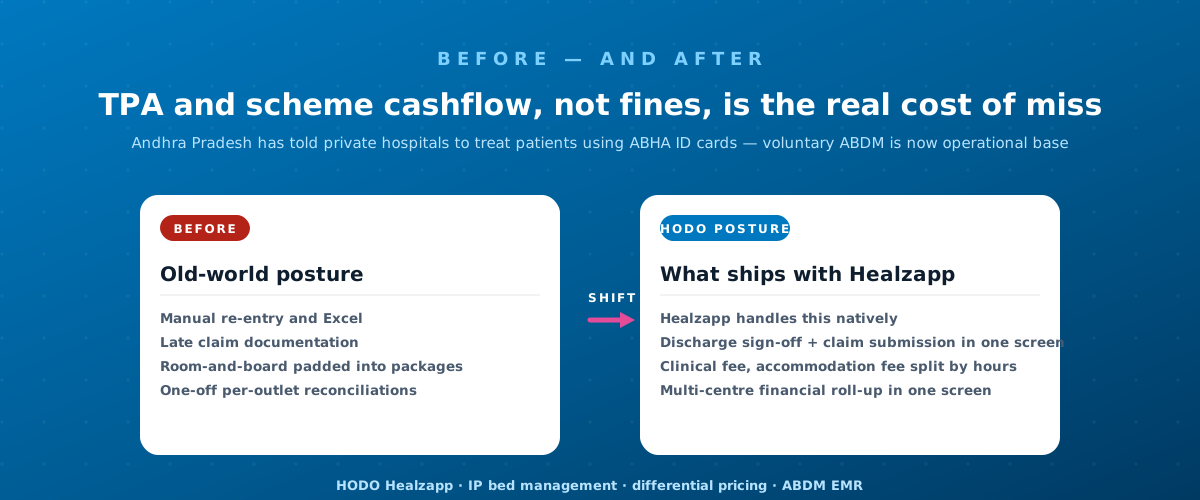
TPA and scheme cashflow, not fines, is the real cost of missing ABDM linkage.
A 60-day operational checklist for AP hospitals
Week 1-2: Confirm HFR registration for every facility. Confirm HPR IDs for every consultant on payroll and empanelled. Audit the current OP registration form and identify where ABHA capture will sit, before or after payment collection matters. Week 3-4: Configure the HIS to accept ABHA number, ABHA address and demographic auto-fill via the ABDM APIs. Run a parallel period where reception captures ABHA for 100% of walk-ins, even if the record does not yet push to ABDM. Week 5-8: Turn on discharge-summary push and OP consultation push to the HIE-CM. Measure the linkage rate weekly at the administrator review. Anything below 70% by day 60 is a workflow problem, not a technology problem, usually a reception queue length issue that needs a token-display or a second registration counter, not a software patch.
What this means for HODO customers
Healzapp is the HODO product on the front line of this directive. Hospitals already running it in Andhra Pradesh should confirm three specific configurations. First, the ABDM-compliant EMR module, ABHA linkage at registration and consented push of discharge summaries and OP notes to the HIE-CM should be switched on for every outlet, not just the flagship. Second, Patient Management with its unified MRN across branches, this is what prevents a patient from having two disconnected records if they move between the Vijayawada and Visakhapatnam units of the same chain. Third, Multi-outlet scale-up with one-click new-centre setup, new branches inherit the ABDM configuration, HFR linkage template and discharge-summary format from day one, so compliance does not degrade as the chain adds outlets. HODO is one of the first 20 ABDM-integrated HealthTechs in India and is NRCeS listed, which means the plumbing to the ABDM sandbox is in place and does not need to be built from scratch for the AP directive.